Bladenhorst Castle
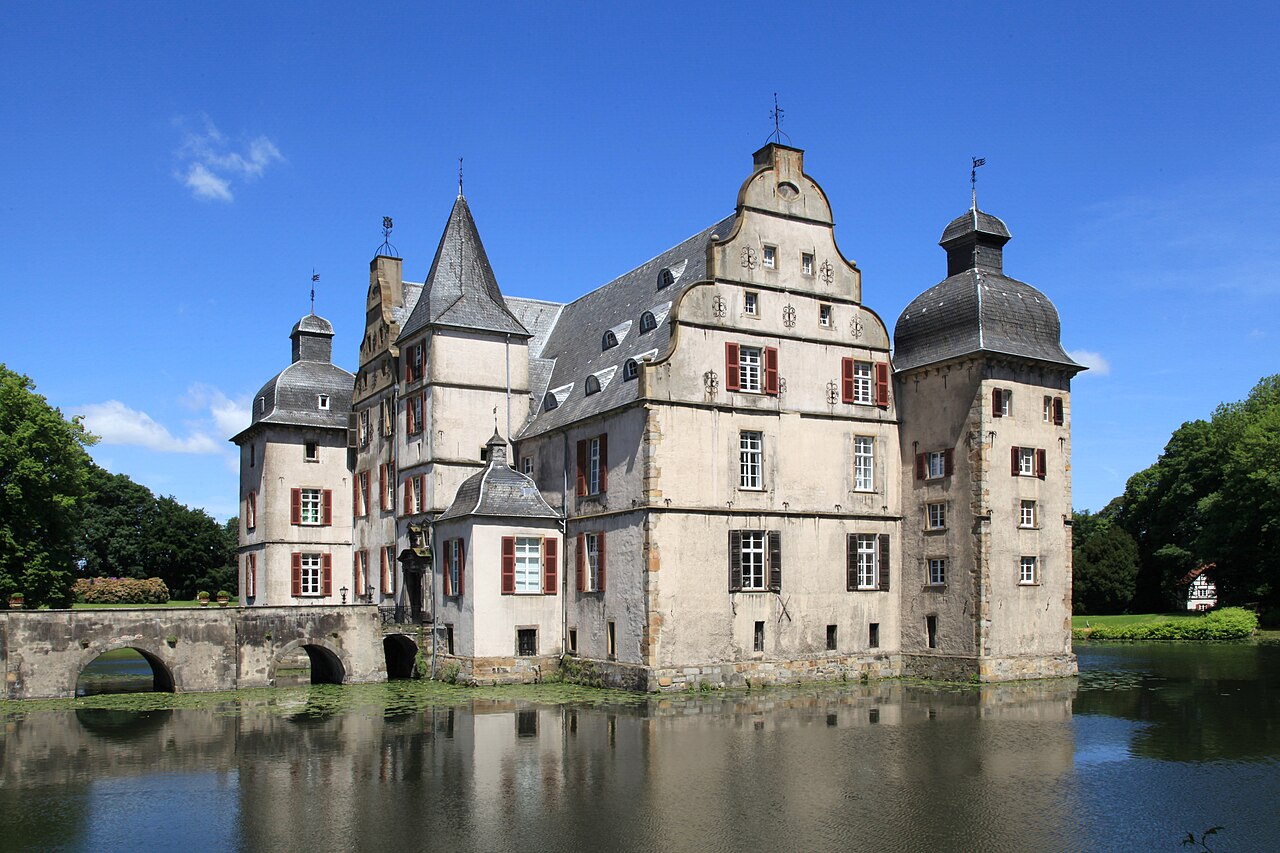
Bladenhorst Castle (German: Schloss Bladenhorst) is a notable moated hill castle located in the suburbs of Castrop-Rauxel in Germany. Its origins trace back to the 13th century, with the first documented mention occurring in 1266 as the residence of the lords of Blarnhurst. Over the centuries, the castle has witnessed a series of ownership changes, architectural transformations, and historical events that reflect the region's medieval and Renaissance heritage.
Early history and medieval significance
The castle initially served as a fortified residence for the lords of Blarnhurst. By the early 14th century, ownership passed to the influential Düngelen family. In 1338, Rötger Düngelen pledged the castle to the Duchy of Cleves for use during wartime, highlighting its strategic importance in regional conflicts. The castle's defensive role was characteristic of high medieval hill castles, designed to control surrounding territories and provide refuge.
Architectural evolution and renaissance rebuilding
Originally, Bladenhorst Castle featured a quadrangular layout with four wings enclosing a central courtyard. The gatehouse remains the oldest surviving part of the structure, serving as the primary fortified entrance. The castle chapel, constructed in 1332, reflects the religious functions integrated within the castle complex.
Between 1530 and 1584, the castle underwent significant rebuilding in the Renaissance style, which defines much of its present appearance. This transformation involved updating defensive features to accommodate changing military technologies and enhancing residential comfort and aesthetics, typical of Renaissance architectural trends in German noble residences.
Moat and fortifications
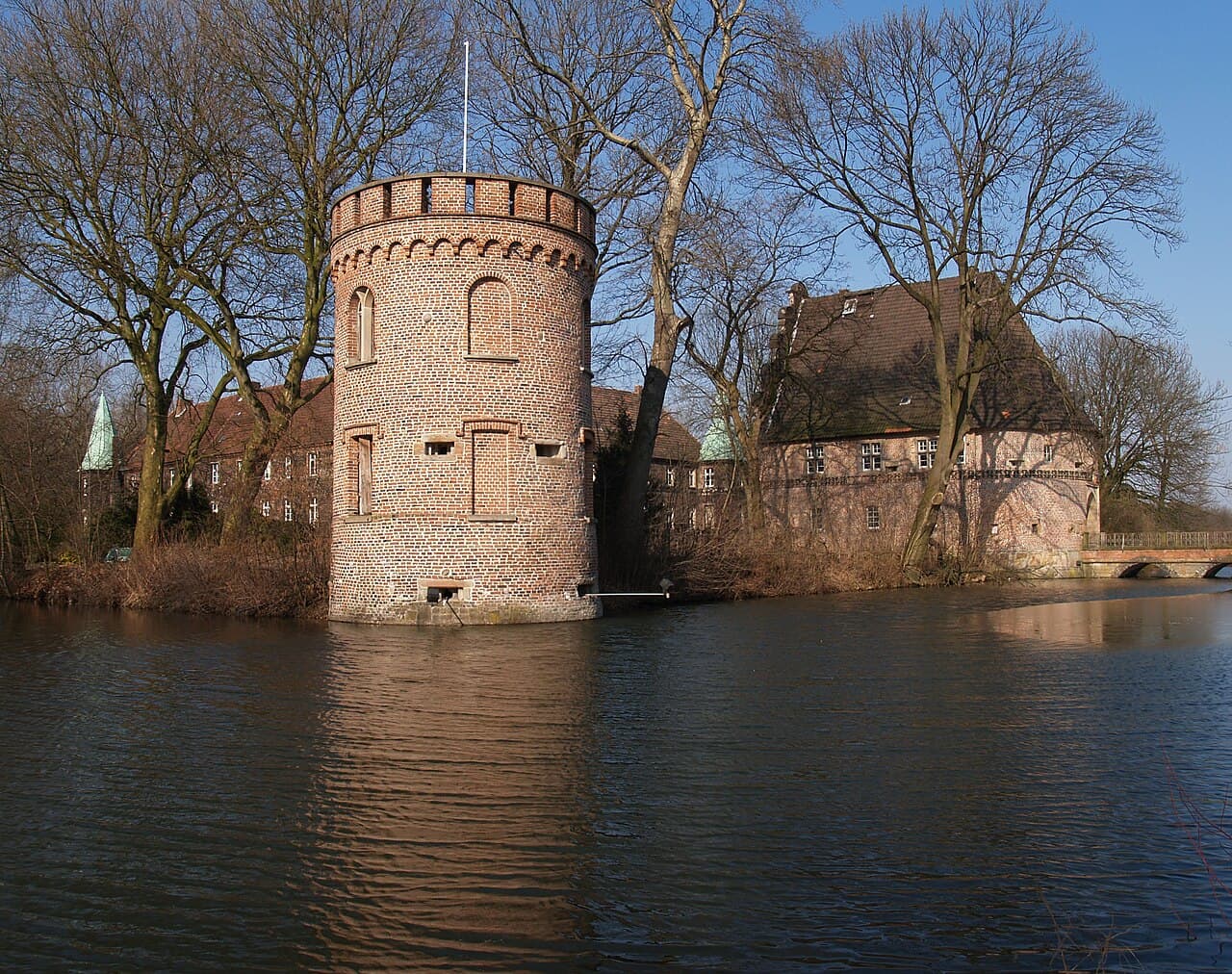
The castle's moat is a defining feature, providing both defense and status symbolism. The water-filled moat surrounds the castle, emphasizing its role as a fortified water castle despite its classification as a hill castle due to its elevated position. The combination of natural elevation and water defenses made Bladenhorst a formidable stronghold in its time.
Ownership transitions and noble families
Through marriage alliances, the castle passed to Philip of Viermünden in 1496. Later, from 1624 to 1881, it was inherited by the Westphalian noble family von Romberg, who maintained the property for over two centuries. These families played significant roles in local governance and the social fabric of the region, with the castle serving as a symbol of their status and power.
Modern usage and preservation
Today, Bladenhorst Castle remains privately owned and is still partially inhabited. Due to its private status, the castle is not generally open to public tours, although some sections are rented out to private individuals. The castle's preservation reflects ongoing efforts to maintain its historical fabric while adapting to contemporary residential use.
The castle's condition is generally well preserved, retaining key architectural elements from its medieval origins and Renaissance reconstruction. Its continued habitation ensures that the structure remains an active part of the local heritage landscape rather than a static monument.
Architectural features and cultural significance
Bladenhorst Castle exemplifies the evolution of German castle architecture from the high medieval period through the Renaissance. The integration of a moat, gatehouse, chapel, and the four-winged layout illustrates typical noble residence design adapted for defense and status.
The castle's Renaissance rebuilding reflects broader European architectural trends emphasizing symmetry, proportion, and decorative elements, marking a shift from purely military fortifications to more comfortable and representative noble homes.
As a historic site, the castle contributes to understanding the region's feudal history, noble lineage, and architectural developments. Its location in Castrop-Rauxel situates it within the cultural and historical context of North Rhine-Westphalia, an area rich in medieval and early modern heritage.
Frequently asked questions (FAQ)
- Can I visit Bladenhorst Castle?
- Bladenhorst Castle is privately owned and partially inhabited, so it is not generally open to public tours. Some parts are rented to private individuals, but public access is limited.
- When was Bladenhorst Castle originally built?
- The castle was first mentioned in 1266, with its origins dating back to the 13th century, making it a high medieval structure.
- What architectural styles are represented in Bladenhorst Castle?
- Bladenhorst Castle showcases a combination of high medieval defensive architecture and Renaissance style from its rebuilding between 1530 and 1584.
- What is the significance of the moat at Bladenhorst Castle?
- The moat provides both defensive protection and status symbolism, surrounding the castle and enhancing its role as a fortified water castle despite its hilltop location.
- Who were the notable families associated with Bladenhorst Castle?
- The castle was associated with the lords of Blarnhurst, the Düngelen family, Philip of Viermünden, and the Westphalian noble family von Romberg, who owned it from 1624 to 1881.
Photo gallery

Information
Current owner
Private owner
Loading map...
Visitor reviews
No reviews yet. Been here? Write the first review and help other travelers!
Write the first reviewVisited this castle? Share your experience
Your review helps other travelers and adds first-hand knowledge to our encyclopedia.