Birr Castle — Ireland castle

Birr Castle

Birr Castle, historic hill castle in County Offaly, Ireland
Birr, Ireland
Well Preserved

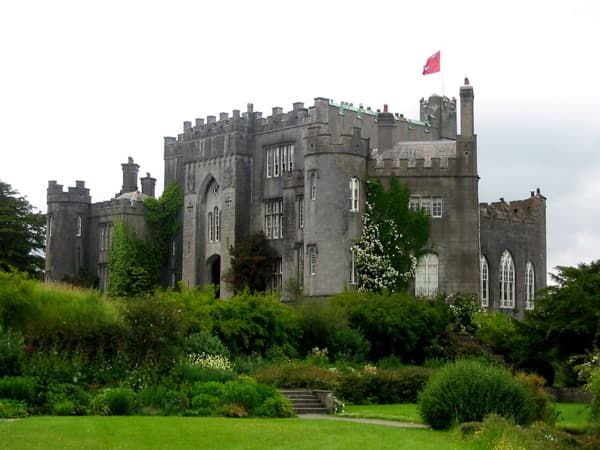
Birr Castle (Irish: Caisleán Bhiorra) is a prominent hill castle located in the town of Birr, County Offaly, Ireland. This castle has been the ancestral home of the Parsons family since the 17th century, currently occupied by Brendan Parsons, 7th Earl of Rosse and his family. While the castle itself is generally not open to the public, the extensive demesne grounds and gardens are accessible and form a significant cultural and scientific attraction in the region.

Historical background and significance

The origins of Birr Castle date back to the early 17th century when the Parsons family established their seat here. The castle has witnessed several phases of construction and remodeling, reflecting architectural trends from the early modern period through the 19th century. The estate became notable not only as a noble residence but also as a center of scientific innovation, particularly under the 3rd Earl of Rosse, William Parsons.

Architectural features and layout

Birr Castle is characterized by its hilltop location which provided strategic advantages and commanding views of the surrounding landscape. The castle complex includes a fortified house with towers, battlements, and a courtyard. Over centuries, the structure has been adapted to suit residential needs and scientific pursuits rather than purely military defense.

The demesne and gardens

The castle grounds encompass extensive formal gardens, parkland, and woodlands. The demesne is renowned for its botanical collections and carefully designed landscapes, which have been maintained and enhanced over generations. Visitors can explore walking paths, ornamental lakes, and historic tree specimens.

Scientific heritage and notable features

Birr Castle is internationally famous for its contributions to astronomy and engineering. The 3rd Earl of Rosse, William Parsons, commissioned the construction of the Leviathan of Parsonstown in the mid-19th century. This was a giant reflecting telescope with a 72-inch (1.83-meter) mirror, which held the record as the world's largest telescope for over 70 years. The telescope was a pioneering instrument in astronomical observation and research.

Modern scientific installations

Today, the castle grounds host a science museum dedicated to the history of the telescope and the Parsons family's scientific achievements. Additionally, a modern radio telescope has been installed on the estate, continuing the tradition of scientific innovation.

Visiting Birr Castle

While the castle itself remains a private residence, the public gardens and demesne are open for visitors. The site includes a visitor center with a café and exhibitions. The grounds offer a unique combination of historical architecture, landscaped gardens, and scientific heritage, making it a distinctive destination in Ireland.

Access and amenities

The demesne is accessible year-round, with guided tours available for the gardens and the telescope installations. Visitors can enjoy walking trails, picnic areas, and educational displays. The site is especially popular among those interested in astronomy, history, and garden design.

Frequently asked questions (FAQ)

How do I get to Birr Castle?
Birr Castle is located in the town of Birr, County Offaly, Ireland. It is easily accessible by car and public transport, with ample parking available on-site. The castle is well-signposted and can be reached via the N62 road.
What is the historical significance of Birr Castle?
Birr Castle has a rich history dating back to the 12th century and has been the seat of the Parsons family for over 400 years. It is renowned for its historical contributions to science, particularly in astronomy, as it was home to the Great Telescope, the largest in the world during the 19th century. The castle and its grounds are also associated with significant events in Ireland's history.
When was Birr Castle built?
Birr Castle was originally built in the 12th century, although it has undergone numerous renovations and expansions over the centuries. The most notable changes were made during the 17th and 19th centuries, giving it a unique blend of architectural styles. Today, it showcases elements from different periods, reflecting its long history.
Can I visit the gardens at Birr Castle?
Yes, the beautiful gardens at Birr Castle are open to the public and are a major attraction. The gardens feature a variety of plant species, historic trees, and intricate landscaping that invite visitors to explore. A leisurely stroll through the gardens provides a peaceful retreat and stunning views of the castle.
Why is Birr Castle known for its architecture?
Birr Castle is known for its unique architectural features that reflect its evolution through the ages. Visitors can admire its imposing stone structure, impressive towers, and the intricate designs of its Victorian-era additions. The blend of medieval and Victorian styles makes it a fascinating example of historical architecture.
Is it possible to take guided tours of Birr Castle?
Yes, guided tours of Birr Castle are available, providing visitors with an in-depth look at its history and architecture. Knowledgeable guides share stories and insights about the castle and its past residents. This immersive experience enhances understanding and appreciation of the castle's significance.
What are the opening hours for Birr Castle?
Birr Castle is typically open to visitors from 10 AM to 6 PM, with varying hours depending on the season. It's advisable to check the official website for the most current opening hours and any potential changes due to special events or maintenance. Plan your visit accordingly to make the most of your experience.
What are the ticket prices for visiting Birr Castle?
Ticket prices for Birr Castle vary depending on age and group rates, with discounts often available for families and students. Children under a certain age may enter for free, making it an affordable outing for families. Check the official website for detailed pricing and any special offers available during your visit.
When is the best time to visit Birr Castle?
The best time to visit Birr Castle is during the spring and summer months when the gardens are in full bloom and the weather is generally mild. This period allows visitors to fully enjoy the outdoor spaces and participate in various events held throughout the season. Additionally, autumn can provide beautiful foliage and a quieter experience.
Are there any nearby attractions to Birr Castle?
Yes, there are several attractions near Birr Castle, including the historic town of Birr itself, which offers charming shops and cafes. Nearby, you can explore the Slieve Bloom Mountains, perfect for hiking and enjoying nature. Other historical sites, such as the Birr Theatre & Arts Centre, are also worth a visit.

Photo gallery

Birr Castle
Click to view

Photo by The original uploader was Tpower at English Wikipedia.•CC BY-SA 3.0

1 photo • Click any image to view in full screen

Information

Hill Castle

Loading map...

Visitor reviews

No reviews yet. Been here? Write the first review and help other travelers!

Write the first review

Visited this castle? Share your experience

Your review helps other travelers and adds first-hand knowledge to our encyclopedia.

Write a review

(5/5)

0/2000 characters

Your review will be visible after admin approval

Nearby castles

0.3 km

Birr Castle

Birr, United Kingdom

Birr Castle stands as a remarkable example of a historic hill castle in County Offaly, Ireland. Established originally in the 12th century as an Anglo-Norman fortress, it has evolved through centuries of architectural modifications and historical events, becoming the ancestral home of the Parsons family, notably the Earls of Rosse. The castle remains a private residence, currently occupied by the 7th Earl of Rosse, with the surrounding grounds and gardens open to the public, offering a rich blend of heritage, science, and natural beauty. Historical development and ownership The site of Birr Castle has been continuously occupied since its foundation around 1170. Initially constructed as a stronghold for the Anglo-Normans, it later became the seat of the O’Carroll family, rulers of the territory known as Ely O’Carroll, from the 14th to the 17th century. The O’Carrolls' original structures, including the Black Tower gatehouse, laid the groundwork for the castle's defensive layout. Following the death of Sir Charles O’Carroll in 1620, the castle and lands were granted to Sir Laurence Parsons. Parsons commissioned English masons to rebuild the castle near the original gatehouse, incorporating diagonal flankers to the gatehouse that define the castle’s current layout. The Parsons family has maintained ownership ever since, with notable figures such as William Parsons, who endured a 15-month siege during the Irish Rebellion of 1641, and his son Laurence Parsons, who became a baronet in 1677 and refurbished the castle post-civil war. Architectural evolution and style In the early 19th century, the castle underwent significant transformation under Laurence Parsons, 2nd Earl of Rosse. He raised the castle’s height and introduced Gothic architectural elements, enhancing its imposing silhouette and aesthetic appeal. The castle's design features a large stone structure with a prominent gatehouse flanked by two projecting towers or flankers, reflecting its defensive origins adapted for residential grandeur. The surrounding demesne includes Ireland’s oldest wrought-iron bridge, dating from 1820, showcasing early industrial craftsmanship. The walled gardens are home to box hedges over 300 years old, recognized by the Guinness Book of Records as the tallest globally. These gardens complement the castle’s historic ambiance and botanical heritage. The great telescope and scientific heritage Birr Castle is internationally renowned for the Great Telescope, also known as the Leviathan of Parsonstown, constructed by William Parsons, 3rd Earl of Rosse and completed in 1845. This 72-inch (183 cm) reflecting telescope was the largest in the world for several decades, pioneering astronomical observation and cementing Birr as a center of scientific innovation. The telescope attracted eminent scientists and dignitaries, including Charles Babbage and Napoléon Eugène, Prince Imperial. It was used extensively until the early 20th century, with its mirror eventually moved to the Science Museum in London. The telescope’s metal framework was dismantled during World War I for the war effort, and wooden components were removed for safety in the 1920s. A comprehensive restoration in the 1990s rebuilt the telescope to operational condition. Today, it is a key attraction open to visitors, with occasional demonstrations that celebrate its scientific legacy. Modern scientific contributions and heritage recognition Continuing its tradition of scientific inquiry, Birr Castle hosts the I-LOFAR radio telescope station, operated by Trinity College Dublin. This modern installation, part of the European LOFAR network, consists of 384 antennas and is the westernmost station in the network. It underscores Birr’s ongoing role in cutting-edge astronomical research. In 2025, Birr Castle, alongside Dunsink and Armagh Observatories, was placed on the UNESCO World Heritage Tentative List, recognizing its outstanding historical and scientific significance. Grounds, gardens, and cultural features The castle’s extensive demesne is notable for its diverse features. The historic wrought-iron bridge near the castle exemplifies early 19th-century engineering. The walled gardens contain the world-record-holding box hedges and a plantation known as Giants’ Grove, featuring Californian sequoia redwoods available for sponsorship. The grounds also include Ireland’s Historic Science Centre museum, which preserves collections related to astronomy, engineering, photography, and botany. A highlight is the photographic darkroom of Mary Parsons, Countess of Rosse, considered the oldest surviving darkroom worldwide. The demesne is bounded by a dry moat and an internal gate on a bridge, with the River Camcor flowing through the property, adding to the scenic and historic atmosphere of the site. Visiting birr castle today While the residential areas of Birr Castle remain private and closed to the public, the grounds, gardens, and scientific attractions are open for visitors. The castle offers a unique combination of historic architecture, world-class scientific heritage, and natural beauty. Visitors can explore the restored Great Telescope, wander the ancient box hedges, and enjoy exhibits at the Historic Science Centre. The site provides a rich educational experience that highlights the intersection of medieval history and modern science.

High Medieval (11th–13th c.)
Details
10.3 km

Leap Castle

, United Kingdom

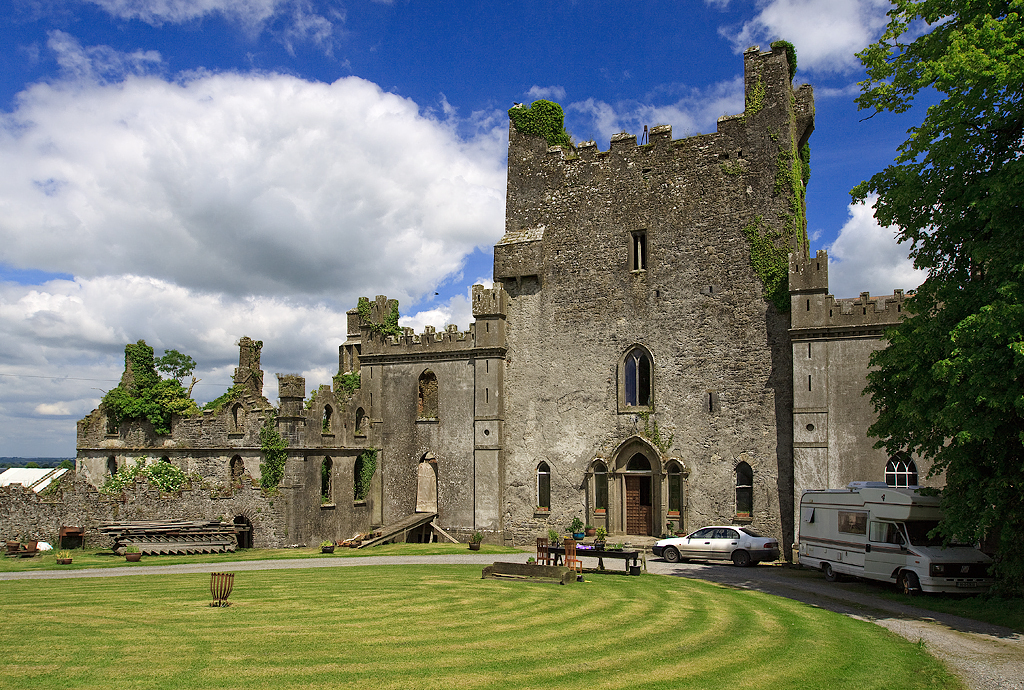
Leap Castle stands as a significant medieval fortress located in the parish of Coolderry, in Northern Ireland. This hill castle occupies a commanding position overlooking a strategic mountain pass linking the Slieve Bloom Mountains to the province of Munster, historically known as The Leap. Its location was chosen for both defense and control of regional movement, a common consideration in castle siting during the High Medieval period. The castle's origins trace back to the mid-13th century, circa 1250 AD, constructed by the native Irish O’Bannon clan under the overlordship of the powerful O’Carroll family. While some debate exists about whether the earliest structures date to the 12th or 16th century, archaeological evidence supports a 13th-century foundation replacing an older fortification on a site with deep spiritual significance to Celtic druids, with continuous occupation since the Iron Age. Historical significance and turbulent past Leap Castle has witnessed centuries of conflict reflecting the broader political struggles in Ireland. In the early 16th century, it became a focal point of power struggles between Irish clans and English forces. The Annals of the Four Masters document attempts by the Earl of Kildare to seize the castle in 1513 and 1516, resulting in damage to the fortress. Despite internal strife, including fratricidal disputes following the death of Mulrooney O’Carroll in 1532, the O’Carroll family retained control by the mid-1500s. In 1558, facing increasing pressure from English forces, the O’Carrolls burned Leap Castle to prevent its capture. However, the Earl of Sussex’s troops soon took the castle, only for the O’Carrolls to reclaim and rebuild it the following year, demonstrating the castle's strategic and symbolic importance. The castle changed hands in the mid-17th century when the English Darby family acquired it through marriage. The Darbys undertook significant expansions in 1753, integrating Gothic architectural elements and adding new wings to the original tower house. This blend of medieval defensive architecture with later stylistic trends reflects evolving tastes and the transition from purely military fortresses to more residential estates. The 20th century brought further tragedy during the Irish Civil War in 1922, when the castle was deliberately set on fire, destroying most interior furnishings and artworks. Economic pressures and land reforms led the Darby family to abandon the castle in 1928, leaving it in ruin for nearly seventy years. Architectural features and layout Tower house and defensive structures The core of Leap Castle is a substantial tower house constructed from roughly shaped limestone blocks laid without plaster, resulting in walls over two meters thick. The rectangular main tower measures approximately 13 by 10 meters and rises three stories high, topped with a crenellated parapet and a flat saddle roof originally covered with stone slates. Defensive features include surviving machicolations on the south wall, which allowed defenders to attack assailants at the main entrance below. Attached to the main tower are two short side wings, each two stories tall with a single bay, added in the mid-18th century. These wings exhibit Gothic architectural touches such as pointed arch windows and battlemented parapets, blending medieval defensive motifs with Georgian stylistic elements. The northern wing connects to the Priest’s House, a separate building dating back to around 1571 but altered during the Georgian period. Interior chambers and notable rooms Inside the tower, the first floor houses a vaulted hall featuring a large fireplace in the northeast corner. This room has been restored to include a gallery and once had flooring designed with polished slate and sandstone arranged to mimic black and white marble, complemented by decorative stucco cornices on the ceiling, which added a touch of elegance to the fortified space. One of the castle’s most infamous rooms is the Bloody Chapel on the second floor, named for its grim history. This chamber contains a narrow opening leading down through a trapdoor to a small oubliette, a hidden dungeon discovered during 20th-century renovations. Excavations revealed human bones and a mid-19th-century gold pocket watch, confirming its use as a prison or execution site. The Bloody Chapel connects via a slender corridor embedded in the thickness of the north wall to the ruins of the former northern wing, illustrating the castle’s complex internal layout and defensive design. Later additions and service yard Adjacent to the main tower is a service yard developed around 1860 in a neo-Gothic style under the Darby family's ownership. This yard comprises two parallel, two-story buildings forming a quadrangle around an interior courtyard. The northern building features a hipped slate roof, seven bays with pointed arch windows in yellow brick surrounds, and a central pointed arch gateway. Distinctive chimneys combine yellow brick and red tile, topped with battlemented parapets on a stone cornice. The southern service building served as a coach house on the ground floor, with large segmental-arched doors opening onto the courtyard. Above, the upper floor housed the Orange Hall, named after the Protestant Orange Order, and features slate roofing and Gothic architectural elements consistent with mid-19th-century additions. East of the service yard lies a walled garden enclosed by a perimeter wall, serving as a private outdoor space linked to the castle’s domestic functions. Restoration and preservation After decades of neglect, Leap Castle was purchased in 1974 by Australian historian Peter Bartlett, who began restoration efforts. Following his death, stewardship passed to musician Sean Ryan and his wife Anne, who have continued rehabilitating much of the tower house and the adjoining south wing, restoring the castle closer to its historical state. Most rooms within the tower house have been restored to usable condition, except the second floor. The original south entrance has been converted into a window opening, while a grand Gothic-style entrance on the west side dates from the 18th-century expansions. Since 1976, Leap Castle has been protected as a National Monument, ensuring its preservation as a vital piece of Ireland’s cultural and architectural heritage. Legend and paranormal reputation Leap Castle is renowned not only for its architectural and historical significance but also for its reputation as one of Ireland’s most haunted castles. Numerous ghost stories and paranormal investigations have been documented since the late 20th century, attracting visitors interested in the supernatural. The castle’s dark history, including the Bloody Chapel and the oubliette, contributes to its eerie allure and enduring fascination.

High Medieval (11th–13th c.)
Details
10.3 km
Leap Castle — Ireland castle

Leap Castle

Roscrea, Ireland

Leap Castle is a prominent 13th-century hill castle located in County Offaly, Ireland, near the town of Roscrea. The castle stands approximately 6 kilometres north of Roscrea and 10 kilometres south of Kinnitty along the R421 road, situating it within a historically rich region of the Irish midlands. Known for its imposing medieval architecture and turbulent past, Leap Castle is one of Ireland's most infamous castles, often associated with legends and ghost stories. Historical background and origins Leap Castle was constructed during the High Medieval period, with its origins tracing back to the 13th century. It was built by the ruling O'Bannon clan, who were a powerful Gaelic family in the region. The castle's strategic location on a hill provided a commanding view of the surrounding landscape, making it a formidable defensive stronghold during a time of frequent clan warfare and territorial disputes. The castle's name, Caisleán Léim Uí Bhánáin in Irish, translates to "Castle of the Leap of the O'Bannons," referring to a legendary leap made by the clan's ancestors to escape enemies, symbolizing both the castle's defensive significance and its deep connection to local lore. Architectural features and layout Leap Castle exemplifies typical hill castle characteristics of the medieval era. Its design includes a robust keep or donjon, which served as the central fortified residence and last line of defense. The thick stone walls of the keep are punctuated by narrow slit windows, designed for archers to defend the castle while minimizing vulnerability. The castle complex also features a courtyard enclosed by defensive walls, with remnants of ancillary buildings such as a chapel, great hall, and living quarters for the garrison and inhabitants. A notable architectural element is the presence of a dungeon, historically used for imprisoning captives and possibly associated with the castle's darker reputation. Leap Castle's defensive structures include battlements and a gatehouse that controlled access to the interior. The castle's elevated position and natural rocky outcrops enhanced its defensibility against attackers. Although the castle suffered damage and periods of neglect, significant portions of its stonework remain intact, offering insight into medieval Irish castle construction. Historical significance and events Throughout its history, Leap Castle was a site of numerous clan conflicts and power struggles, particularly involving the O'Bannons and rival families such as the O'Carrolls. The castle was frequently besieged and changed hands multiple times during the medieval period. In addition to its military role, Leap Castle held social and administrative importance as a seat of local power. The castle's chapel and great hall were centers for religious observance and clan gatherings. Leap Castle is also infamous for its association with grisly events and legends. Stories of violent deaths, betrayals, and hauntings have contributed to its reputation as one of Ireland's most haunted castles. The so-called "Bloody Chapel" within the castle is linked to a particularly brutal murder, adding to the castle's eerie legacy. Preservation and current status Today, Leap Castle is classified as a partially preserved medieval structure. While it has undergone some restoration efforts, much of the castle remains in a state of ruin, with certain sections stabilized to prevent further decay. The castle is privately owned and has been opened to the public for guided tours, attracting visitors interested in its architecture and haunted history. The castle's location in the Irish midlands makes it accessible for tourists exploring the region's rich heritage. Preservation efforts continue to focus on maintaining the structural integrity of the remaining walls and key features to allow future generations to appreciate this significant example of medieval Irish fortification. Architectural style and influences Leap Castle's architecture reflects typical High Medieval defensive design, with influences from Gaelic Irish castle-building traditions. The use of thick stone walls, narrow windows, and a central keep aligns with contemporary European castle construction methods of the 13th century. The castle's chapel and interior spaces exhibit elements of early Gothic style, evident in the pointed arches and stone detailing, although these features are modest compared to larger ecclesiastical buildings of the period. Visiting Leap Castle Visitors to Leap Castle can explore the ruins and learn about its complex history through guided tours that highlight both the architectural features and the folklore surrounding the site. The castle's dramatic setting and storied past make it a compelling destination for those interested in medieval history and Irish heritage.

High Medieval (11th–13th c.)
Details