
Birkenfels Castle
Birkenfels Castle, also known as Château de Birkenfels or Burg Birkenfels, is a notable medieval ruin located southwest of Mont Sainte-Odile in the Bas-Rhin department of Alsace, France. Nestled within the Obernai Forest on a modest hilltop at approximately 675 meters elevation, the castle occupies a ridge of red sandstone rock on the northern slope of the Kienberg mountain. This site offers a commanding view of an ancient Roman road connecting Mont Sainte-Odile, Champ du Feu, and the Bruche valley, highlighting its historical role in regional surveillance rather than robust military defense.
Historical background and ownership
The castle was constructed circa 1260 by Burkhard Beger (also spelled Berger), a vassal of the Bishop of Strasbourg. This period coincided with the imperial interregnum, during which the bishop exercised significant control over the Obernai area. The earliest documented mention of Birkenfels appears in 1289, when King Rudolf of Habsburg recorded the castle holder's obligation to pay an annual rent of one pound of wax to the Virgin Chapel in Obernai, emphasizing ecclesiastical ties.
Unlike many medieval fortifications, Birkenfels was built on imperial land where neither the Beger family nor the bishop held formal ownership, suggesting its primary function was residential and symbolic of noble status rather than strategic military defense. The Beger family retained ownership until 1532, after which the castle passed to Matthias von Held and subsequently to the Mundolsheim family, who held it until the French Revolution.
The castle ceased to serve as a residence by the late 16th century and suffered significant decline, exacerbated by damage during the Thirty Years' War. It fell into ruin and was eventually acquired by the town of Obernai, becoming part of the continuous forest between Obernai and Bernardswiller. Preservation efforts began in the 19th and 20th centuries, with formal classification as a historic monument in 1984 and stabilization work carried out in the 1970s by local heritage groups such as the Association for the Protection of Medieval Architecture (ASAM).
Architectural features and layout
Site and defensive elements
Birkenfels Castle is classified as a hill castle, though its defensive position is modest due to its location on a low sandstone rock rather than a steep, naturally fortified hilltop. The castle overlooks a shallow neck ditch, which appears only partially completed, and was originally accessed via a drawbridge spanning this trench. Surrounding the lower courtyard or outer ward is a rubble stone curtain wall topped with battlements and a defensive walkway, constructed in the late 15th century to replace earlier fortifications.
The castle’s southern entrance features a late Gothic round-arched portal, leading into the complex through a fortified gatehouse. A small secondary gate on the northern side opens onto a terrace area, possibly used historically as a garden or leisure space.
The palas and residential quarters
The central structure is the palas, a three-story main residential building measuring approximately 19 meters in length and between 6.5 and 9 meters in width. The palas walls are robust, with ground floor thickness reaching nearly two meters and exterior walls rising up to 14 meters high. The ground floor served primarily defensive and storage functions, featuring ten narrow arrow slits or loopholes arranged in niches for protection.
The upper two floors were designed for habitation, with broad windows allowing natural light but compromising defensive capabilities. These floors contained living quarters equipped with fireplaces and tiled stoves, reflecting a focus on comfort and residential use rather than military resilience.
Access to the palas’s first floor was through a wooden porch supported by stone brackets, featuring a pointed arch doorway. This entrance was later fortified by the addition of a two-story stone tower with a ramp and drawbridge, constructed in the late 15th or early 16th century. Today, only the lower portion of this tower remains.
The bergfried and unique features
Attached to the south side of the palas is an unfinished pentagonal bergfried, a type of keep typical in medieval castles intended as a last refuge during sieges. This tower exhibits rusticated ashlar masonry, with thick walls up to three meters wide and eight meters high. A notable architectural feature is the integrated latrine within the wall thickness, demonstrating advanced sanitary planning for the period.
Unlike typical bergfrieds, this tower lacks a ground-level entrance and was accessible only via a wooden passage from the palas roof. Its incomplete state is unique in the Alsace region, indicating possible interruptions in construction or changing priorities during the castle’s history.
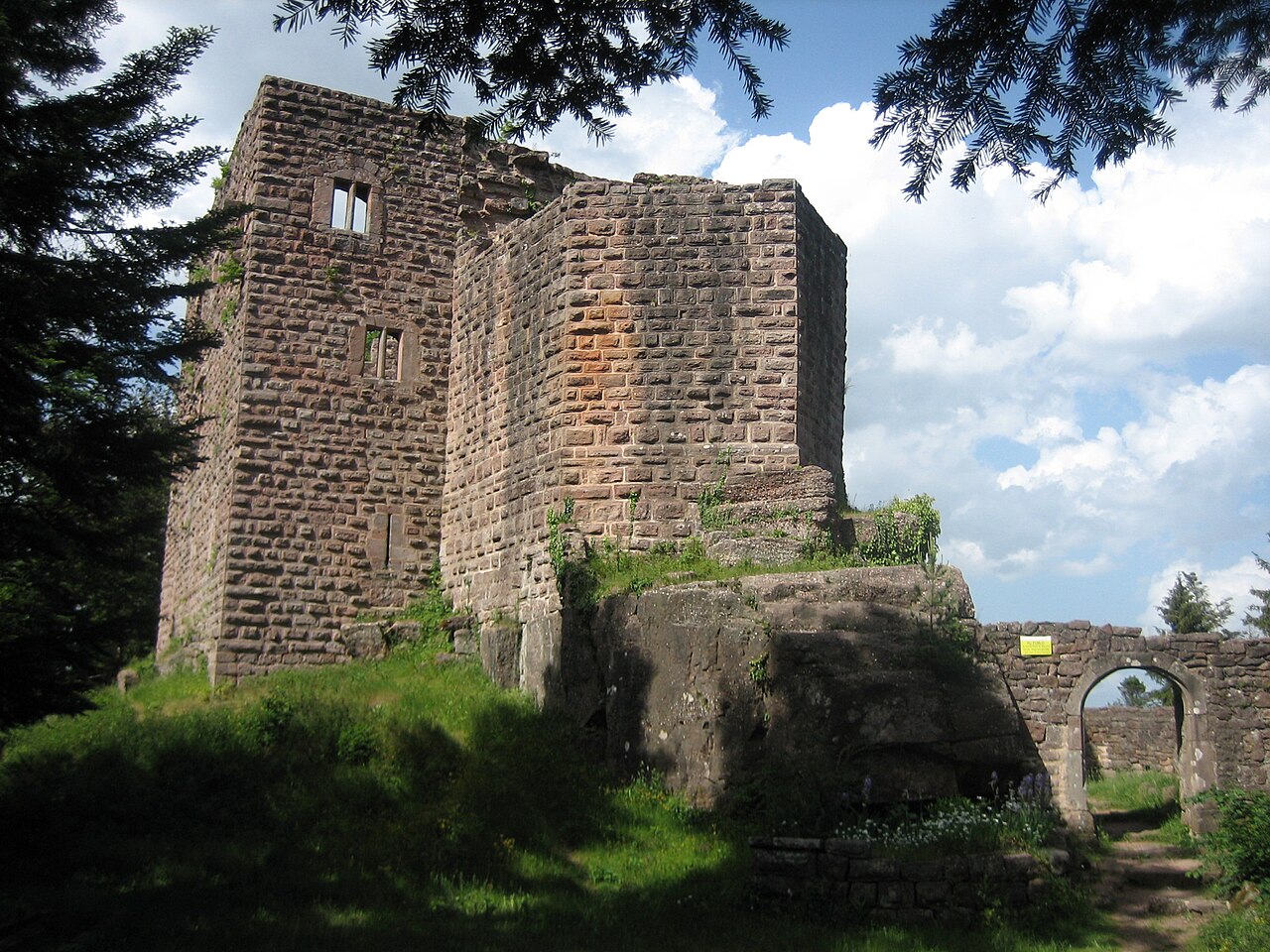
Photo by Richieman • Public domain
Historical events and preservation
The castle suffered a major fire in the 14th century, necessitating extensive restoration in the 15th century, particularly in the lower courtyard and entrance defenses. Excavations by ASAM in the late 20th century confirmed these phases of destruction and reconstruction.
Following its decline after the Thirty Years' War, Birkenfels was abandoned and fell into ruin. Its ownership by Obernai and inclusion within a forested area helped preserve the site from complete destruction. Preservation and stabilization efforts have been ongoing since the 19th century, with significant restoration work in the 1970s ensuring the survival of key structural elements.
Visiting birkenfels castle today
Today, Birkenfels Castle is a ruined hill castle freely accessible to visitors. It is set in a tranquil green environment within the Obernai Forest, offering picturesque hiking opportunities. Access requires a roughly 30-minute hike from the nearest road, making it a rewarding destination for those interested in medieval architecture and regional history.
The remains include the ditch, curtain walls, palas, unfinished bergfried, and parts of the lower courtyard. Visitors can explore the ruins to appreciate the castle’s blend of residential comfort and medieval defensive features.
Birkenfels Castle stands as a testament to the complex feudal and ecclesiastical relationships of the 13th to 16th centuries in Alsace, reflecting noble aspirations, architectural trends, and the gradual transition from fortified stronghold to residential manor.
Frequently asked questions (FAQ)
- How do I get to Birkenfels Castle?
- Birkenfels Castle is accessible by a 30-minute hike through the Obernai Forest from the nearest road. The trail is scenic but requires moderate fitness due to uneven terrain.
- What is the historical significance of Birkenfels Castle?
- Birkenfels Castle was built in the 13th century by a vassal of the Bishop of Strasbourg and served mainly as a residential noble estate overseeing an ancient Roman road.
- Can I explore the ruins of Birkenfels Castle?
- Yes, the castle ruins are freely accessible. Visitors can explore the remains of the palas, bergfried, curtain walls, and lower courtyard, enjoying views of the surrounding forest.
- When was Birkenfels Castle built?
- The castle was constructed around 1260, with the earliest record dating from 1289. It underwent significant restoration in the 15th century after a fire.
- Is Birkenfels Castle suitable for families?
- While the hike to the castle is manageable for older children and adults, the uneven terrain and ruins require caution. It is best suited for visitors comfortable with moderate hiking and exploring historical sites.
Photo gallery

Photo by Richieman•Public domain
Information
Sources & official resources
Verify the information above using these authoritative references.
Loading map...
Visitor reviews
No reviews yet. Been here? Write the first review and help other travelers!
Write the first reviewVisited this castle? Share your experience
Your review helps other travelers and adds first-hand knowledge to our encyclopedia.