Biertan
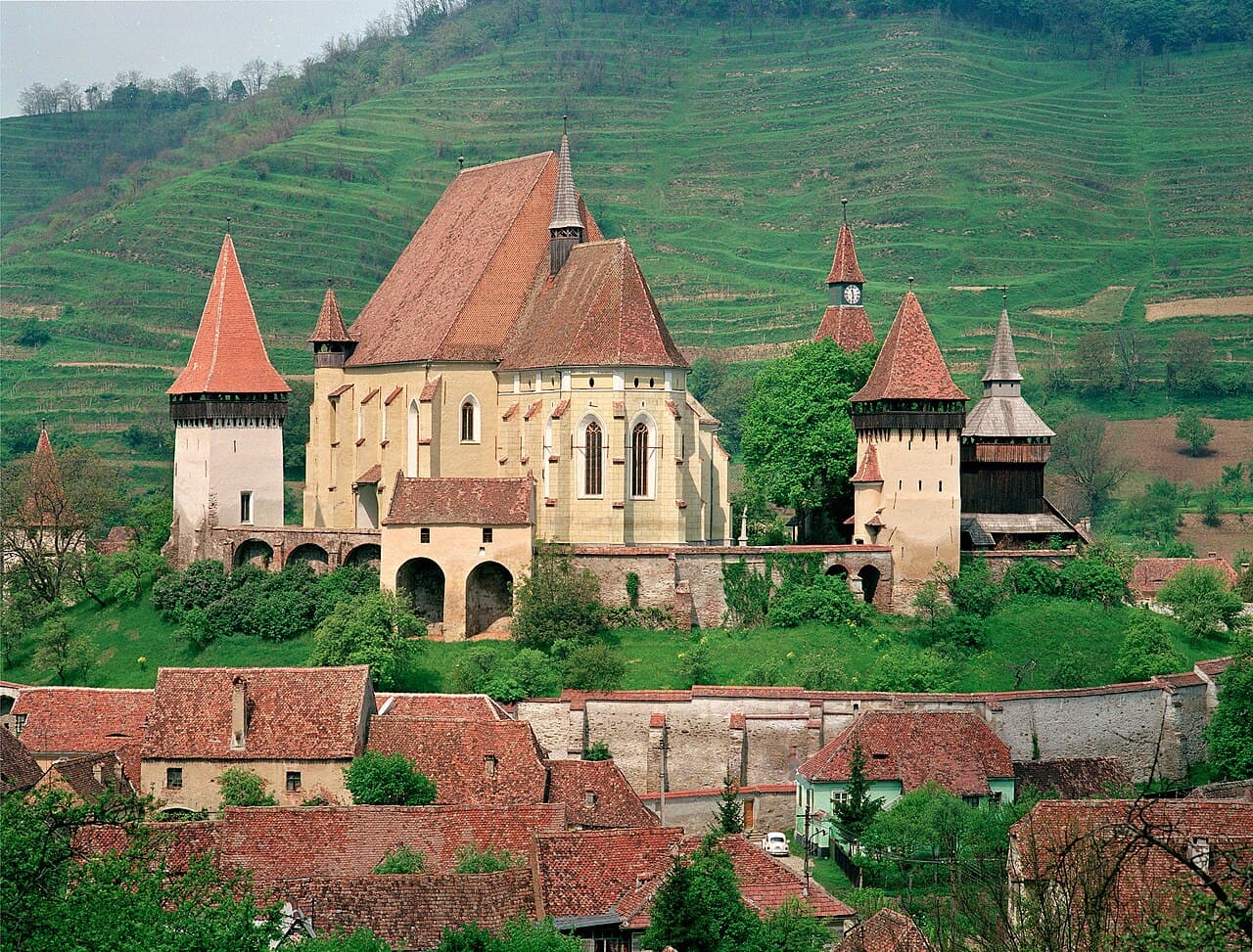
Biertan fortified church stands as a remarkable example of a late medieval bastioned fortress located in the village of Biertan, Romania. This historic site is renowned for its exceptional state of preservation and its unique role as a fortified ecclesiastical complex that served both religious and defensive purposes for the Transylvanian Saxons. The church and its fortifications reflect centuries of architectural evolution, strategic military adaptations, and cultural significance in the region.
Historical origins and early development
The first recorded mention of the church in Biertan dates back to 1402, while the village itself appears in written sources as early as 1283. Biertan was among the earliest settlements established by the German Saxons in Transylvania. The original Romanesque church was constructed on a hill in the 14th century and was soon surrounded by a defensive wall reinforced with four towers. This initial fortification included a northern gate tower that provided controlled access to the fortress area.
The fortified church served as a refuge for the local population during times of threat, a common practice among the Transylvanian Saxons who preferred securing their religious buildings rather than the entire town, a solution that was more practical and economical.
Architectural transformation in the 15th and 16th centuries
During the 15th century, the church hill was further fortified with a second ring of defensive walls. The access route to the fortress was ingeniously designed as a narrow passage between walls on the western side of the hill, protected at both ends by gate towers. Additional security was provided by portcullises and a drawbridge, enhancing the fortress's defensive capabilities.
Between 1486 and 1524, the original church underwent a significant transformation into a three-nave late Gothic hall church. Initially a Catholic place of worship, the church was taken over by Lutherans during the Reformation. From 1572 until 1867, it served as the seat of the Lutheran bishop, elevating Biertan's status among the Saxon settlements in Transylvania.
Expansion of fortifications and military significance
In the 16th century, a third defensive wall was constructed around the church complex on the eastern, southern, and western sides. This included an additional gate tower on the southern section. Fortification efforts continued into the 17th century, with walls reaching heights of nearly 12 meters, demonstrating the strategic importance of Biertan as a military stronghold.
Despite persistent threats from the Ottoman Empire, the fortress was never captured. However, it suffered plundering in 1704 during the Rákóczi uprising by the Kuruc forces. The church also endured damage from an earthquake in 1977, but has since been preserved.
Architectural features and interior highlights
The church is a prime example of Gothic architecture with a three-nave hall design and a star-shaped vault supported by octagonal pillars. Inside, visitors can admire a richly carved stone pulpit, a triptych altar, and intricately sculpted choir stalls. The portals, especially the one leading to the sacristy which also served as a treasury, are notable for their craftsmanship. The sacristy door features a sophisticated locking mechanism with 15 bolts operated by a single key, a testament to the ingenuity of the fortress's defenders.
Defensive structures and towers
The fortress retains all three rings of defensive walls. The innermost ring includes Gothic towers equipped with machicolations and arrow slits, topped with four-sided roofs. To the north of the church stands the Clock Tower, which has a vaulted passage leading to the inner courtyard. Adjacent to it is the only fully wooden tower, serving as the bell tower.
In the northeast corner is the Bishop's Tower, housing the tombs of Lutheran bishops. The southern side features the Catholic Tower, which functioned as a chapel for the Catholic minority during Lutheran dominance. On the eastern side is the so-called "Room of Reconciliation," a unique chamber where couples seeking divorce were confined for two weeks with minimal furnishings, a practice that reportedly resulted in only one divorce in 300 years.
Outer defensive rings and additional towers
The middle ring of walls includes two towers: the Town Hall Tower on the west side with a single-pitched roof, named after the municipal council meetings held there, and the Pig Tower, which has a four-sided roof and houses a gate below. The outermost wall contains two more towers: the Gate Tower in the south and the Weaver's Tower in the west, also covered with a single-pitched roof.
Preservation and cultural significance
Today, the Biertan fortified church is one of Romania's most impressive and well-preserved fortified churches. Its inclusion on the UNESCO World Heritage List in 1993 highlights its outstanding cultural and historical value. The church and its fortifications provide a vivid window into the defensive architecture of the Transylvanian Saxons and their unique approach to safeguarding their communities through fortified religious buildings.
The site attracts numerous visitors interested in medieval architecture, ecclesiastical history, and military fortifications. Its comprehensive defensive system, combined with the artistic richness of its interior, makes Biertan a key destination for understanding the heritage of Transylvania and the broader history of fortified churches in Europe.
Frequently asked questions (FAQ)
- When was the Biertan fortified church built?
- The main construction and transformation of the Biertan fortified church into its current form took place between 1486 and 1524, with earlier origins dating back to the 14th century.
- What architectural style characterizes the Biertan fortified church?
- The church is primarily a late Gothic structure featuring a three-nave hall design and a distinctive star-shaped vault supported by octagonal pillars.
- Is the Biertan fortified church open to visitors?
- Yes, the Biertan fortified church is open to visitors and serves as a popular tourist attraction, showcasing its well-preserved defensive walls and rich interior decorations.
- What defensive features does the Biertan fortified church have?
- The church is surrounded by three rings of defensive walls with multiple towers, including gate towers, machicolations, arrow slits, portcullises, and a drawbridge, making it a formidable bastioned fortress.
- Why was the Biertan fortified church never captured despite threats?
- Its extensive and well-planned fortifications, including high walls nearly 12 meters tall and multiple defensive rings, helped the fortress withstand numerous threats, including from the Ottoman Empire.
Photo gallery

Photo by Otto Schemmel•Public domain
Information
Current owner
Municipality
Loading map...
Visitor reviews
No reviews yet. Been here? Write the first review and help other travelers!
Write the first reviewVisited this castle? Share your experience
Your review helps other travelers and adds first-hand knowledge to our encyclopedia.