Berlanga de Duero Castle
Berlanga de Duero Castle stands as a remarkable example of a late medieval hill castle in the historic town of Berlanga de Duero, Spain. Its origins trace back to a 10th-century Muslim fortress that once dominated the strategic confluence of the Escalote and Duero rivers. Although no physical remnants of the original Muslim fortress survive, the site’s continuous occupation and transformation over centuries reflect the complex history of the Iberian Peninsula, from Muslim rule through the Christian Reconquista and into the Renaissance era.
The castle’s current ruins prominently showcase the architectural evolution that occurred over several centuries. Constructed primarily in the 15th century under the direction of the noble Tovar family, the castle was designed to serve both as a fortified military stronghold and a prestigious noble residence. Its commanding position on a hill provided essential defensive advantages, overseeing the river valleys and protecting the surrounding villages along the Douro riverbanks during turbulent periods of conflict.
Historical context and ownership
The site originally hosted a fortress during the 10th and 11th centuries when Muslim powers controlled much of the Iberian Peninsula. This early fortress formed part of the defensive network during the Muslim Conquest. In 1060, King Ferdinand I of León and Castile captured the fortress, marking a pivotal moment in the Christian Reconquista. Subsequently, the castle and the adjacent medieval town were fortified with an outer defensive wall, portions of which remain visible today.
Between 1460 and 1480, Luis Tovar and María de Guzmán undertook a significant rebuilding of the castle, replacing the older fortress with a new noble residence that combined military and residential functions. The castle remained in the hands of the Tovar family and later passed to the Dukes of Frías, who enhanced the site by constructing a palace within the medieval walls. This palace featured multi-level gardens that harmonized with the natural hill terrain, emphasizing the castle’s role as a noble estate as well as a fortress.
The castle suffered major damage during the Peninsular War in 1811, when Napoleonic troops caused destruction and a fire devastated the palace, leaving only the main façade intact. Earlier, in 1660, a fire had already damaged parts of the structure, and the castle’s military importance declined thereafter. Extensive restoration efforts began in the early 21st century, notably between 2004 and 2005, and continued with further projects in 2019, aiming to preserve this historic monument for future generations.
Architectural features and layout
Medieval core and courtyards
The castle’s core is a 15th-century rectangular structure featuring two internal courtyards with distinct functions. The first courtyard, located near the entrance, served practical military purposes such as drills and troop assembly. The second courtyard was more elaborate, designed as a palatial space with Gothic-style columns supporting elegant porticoes. At the center of this courtyard lies a cistern, historically connected to a sophisticated water supply system that ensured the castle’s resilience during sieges.
Defensive towers and keep
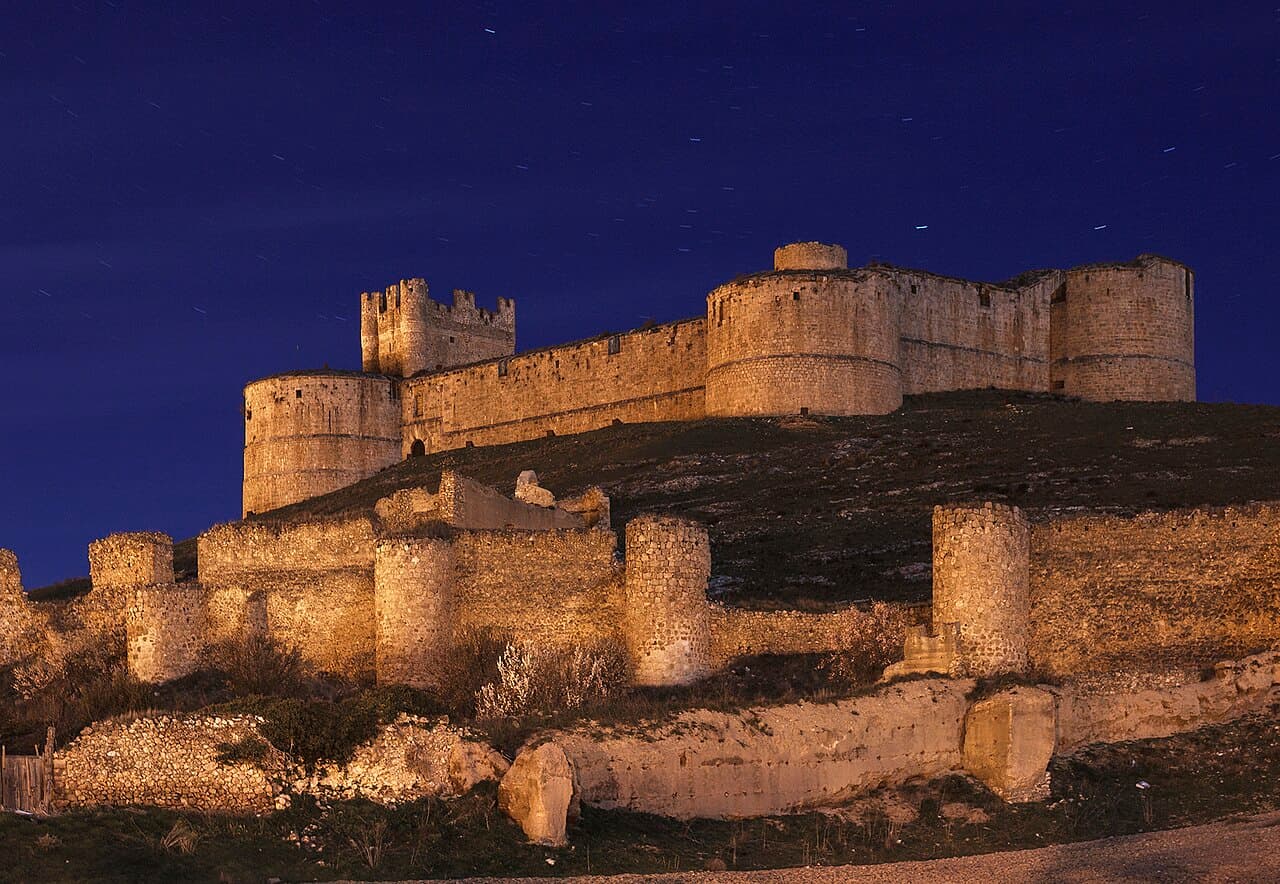
On the southern corner stands a circular tower or “cubo,” which functioned as a lookout and defensive bastion. Opposite this tower is the castle’s prominent keep or “torre del homenaje,” a fortified tower that served as the last refuge during attacks and the lord’s residence. The keep remains in very good condition and is a key surviving element of the medieval fortress.
Renaissance artillery fortress
Above the medieval castle, a 16th-century artillery fortress was constructed to adapt to the evolving nature of warfare, particularly the use of cannons and gunpowder. This addition consists of a rectangular stone enclosure with four large round towers at each corner aligned to the cardinal directions. The walls, built from finely cut ashlar stone blocks, are approximately five meters thick and topped with sloped parapets designed to deflect artillery fire.
The two forward-facing towers contain casemates, enclosed gun emplacements that allowed defenders to mount cannons and repel attackers more effectively. This Renaissance-era fortification represents a significant advancement in military architecture, blending the older medieval structures with modern defensive innovations.
The palace of the dukes of frías
Within the older 12th-century defensive enclosure once stood the palace of the Dukes of Frías. This noble residence was notable for its multi-tiered gardens arranged on different levels to complement the hill’s natural topography. Unfortunately, the palace was largely destroyed during the early 19th century by fire and military actions, leaving only the principal façade standing today. This surviving façade offers a glimpse into the grandeur and architectural sophistication of the palace, highlighting its Renaissance influences.
Preservation and visitor experience
Today, Berlanga de Duero Castle is classified as a ruined hill castle but remains an important cultural and historical landmark. Its layered construction reflects the complex history of the region, from Muslim rule through the Christian Reconquista and Renaissance military innovations. The castle’s strategic hilltop location provides visitors with panoramic views of the surrounding river valleys and town.
Restoration efforts have stabilized the remaining structures, particularly the keep and artillery fortress, enabling visitors to appreciate the castle’s architectural evolution and historical significance. The site is accessible to the public, offering a unique opportunity to explore a fortress that encapsulates centuries of Spanish history and military architecture.
Architectural significance and legacy
Berlanga de Duero Castle exemplifies the adaptive reuse of a strategic military site over centuries. Its transformation from a 10th-century Muslim fortress to a late medieval noble residence and finally to a Renaissance artillery fortress illustrates the dynamic nature of castle architecture in response to changing political and military needs. The castle’s robust construction, including thick ashlar stone walls and innovative artillery defenses, reflects the technological advancements of the Renaissance period.
The castle also serves as a testament to the historical importance of the Douro river region in medieval and early modern Spain. Its preservation allows historians and visitors alike to understand the complex interplay between military strategy, noble prestige, and architectural innovation that shaped the Iberian Peninsula’s heritage.
Frequently asked questions (FAQ)
- What is the historical significance of Berlanga de Duero Castle?
- Berlanga de Duero Castle is a significant medieval fortress that dates back to the 12th century. It played a crucial role in the defense of the region against invasions and has witnessed numerous historical events over the centuries, making it a key site for understanding the local history of Spain.
- When was Berlanga de Duero Castle built?
- The construction of Berlanga de Duero Castle began in the late 11th century, with major developments occurring during the 12th century. Its architecture reflects the transition from Romanesque to Gothic styles, showcasing the evolving military architecture of the time.
- What are the opening hours for Berlanga de Duero Castle?
- Berlanga de Duero Castle is typically open to visitors from 10 AM to 6 PM, though hours may vary depending on the season. It is advisable to check the official website or local tourist information for any updates before planning your visit.
- Can I take guided tours of Berlanga de Duero Castle?
- Yes, guided tours are available for Berlanga de Duero Castle, providing visitors with in-depth knowledge of its history and architecture. These tours are led by knowledgeable guides who can enhance your understanding of the castle's significance and its surroundings.
- Is it possible to access Berlanga de Duero Castle with a wheelchair?
- While Berlanga de Duero Castle has made efforts to improve accessibility, some areas may be challenging for wheelchair users due to uneven terrain and stairs. It is recommended to contact the castle administration in advance to inquire about specific accessibility options and assistance available.
- What is the best time to visit Berlanga de Duero Castle?
- The best time to visit Berlanga de Duero Castle is during the spring and fall when the weather is mild, and the surrounding landscapes are particularly beautiful. Additionally, these seasons tend to have fewer tourists, providing a more relaxed experience.
- Are there any nearby attractions to visit?
- Yes, visitors to Berlanga de Duero Castle can explore other nearby attractions such as the charming village of Berlanga de Duero, known for its medieval architecture, and the picturesque landscapes of the surrounding countryside. The area offers hiking trails and opportunities to experience local culture and cuisine.
- What are the ticket prices for Berlanga de Duero Castle?
- Admission prices for Berlanga de Duero Castle are generally affordable, with discounts available for students, seniors, and children. It is advisable to check the official site for the most current pricing and any special offers that may be available during your visit.
Photo gallery

Information
Loading map...
Visitor reviews
No reviews yet. Been here? Write the first review and help other travelers!
Write the first reviewVisited this castle? Share your experience
Your review helps other travelers and adds first-hand knowledge to our encyclopedia.