Berkhamsted Castle
Berkhamsted Castle is a remarkable example of a Norman motte and bailey castle located in the historic town of Berkhamsted, Hertfordshire, England. Established shortly after the Norman Conquest in 1066, this fortress played a significant role in medieval England's political and military history. Its strategic position between London and the Midlands, near an important medieval road through the Chiltern Hills, made it a vital stronghold for controlling the region. The castle's origins trace back to a probable Saxon fortification, but its definitive construction began under Robert, Count of Mortain, half-brother to William the Conqueror, who was granted the manor and honor of Berkhamsted.
Originally built as a timber structure typical of early Norman castles, Berkhamsted was designed with a conical motte topped by a keep and an oval-shaped bailey. Over the centuries, it evolved significantly, especially during the reigns of Henry I and Henry II, when it was held by royal chancellors including the famous Thomas Becket. Becket's tenure saw the first stone buildings constructed, including a shell keep—a circular stone wall enclosing the summit of the motte—and the division of the bailey into inner and outer wards by a stone wall, enhancing its defensive capabilities.
Medieval history and royal connections
Berkhamsted Castle was a favored residence and administrative center for several English monarchs and nobles. King Henry I held court here in 1123, and the castle remained under the control of the chancellors during the 12th century. In 1191, King Richard I (Richard the Lionheart) granted the castle to his queen, Berengaria of Navarre, who resided there until his death in 1199. The castle then passed to Richard's brother, King John, who gave it to his queen, Isabella of Angoulême.
During the turbulent period of the First Barons' War, the castle was besieged in 1216 by Prince Louis of France, who held it for just two weeks before royal forces reclaimed it. The castle was subsequently granted to Richard, Earl of Cornwall, younger brother of King Henry III, who made it one of his main residences. Richard undertook extensive restoration and expansion works, including the addition of a prominent three-storey stone tower in 1254.
The castle's importance continued through the 14th century when it became part of the Duchy of Cornwall under Edward III and his son, Edward the Black Prince. Notably, King John II of France was imprisoned here after his capture at the Battle of Poitiers in 1356. The castle later served as a residence for queens such as Margaret of France, Isabella of France, and Margaret of Anjou.
In the late 15th century, Cecily Neville, Duchess of York, lived at Berkhamsted until her death, after which the castle fell into decline and disrepair. By the late 16th century, much of the stone was repurposed for local buildings, including Berkhamsted Place, built by Sir Edward Carey using stone from the castle ruins.
Architectural features and remains
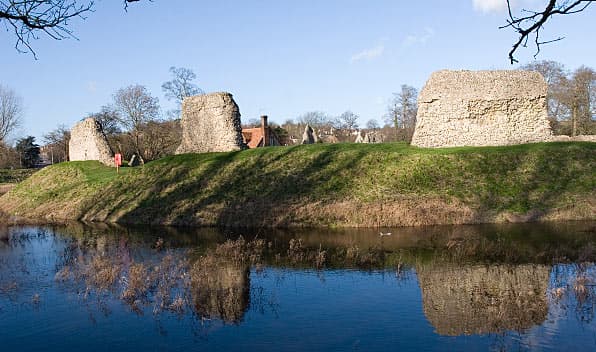
Berkhamsted Castle exemplifies the classic Norman motte and bailey design. The motte is a large earthen mound approximately 12 to 14 meters (40 to 46 feet) high and about 55 meters (180 feet) wide. It supports a shell keep with a diameter of roughly 18 meters (59 feet). The bailey is an oblong courtyard about 150 by 90 meters, originally covering around 0.6 acres (0.24 hectares), with earthworks extending to approximately 11 acres (4.5 hectares) in later periods.
The bailey was divided into inner and outer wards by a stone wall, adding an extra defensive layer. Surrounding the castle were two earthen banks and ditches, which were originally filled with water to form double moats. Although the inner moat was drained in the 1950s, the earthworks remain prominent. The main entrance involved crossing a wooden bridge over the River Bulbourne, followed by a drawbridge at the central gateway, which was destroyed during railway construction in the 1830s.
Additional earthworks outside the walls, dating to the 13th century, likely served as platforms for siege engines during the 1216 siege. The castle was surrounded by a large deer park that expanded to over 1,200 acres by the early 17th century, providing hunting grounds for nobility. Nearby vineyards highlight the castle's role in medieval estate management.
Stone construction and later modifications
The transition from timber to stone marked significant architectural advancement at Berkhamsted. The shell keep and curtain walls were built in stone during the mid-12th century, reflecting the castle's growing importance. The three-storey tower added by Richard, Earl of Cornwall, in 1254, significantly altered the castle's silhouette and provided enhanced living and defensive space.
Over time, the castle's stone was quarried for local building projects, especially after its decline in the late medieval period. Despite this, substantial masonry remains, including wall rubble cores and the base of the tower, provide valuable insights into Norman military architecture.
Preservation and modern significance
Berkhamsted Castle is notable as the first site in England to receive legal protection by Parliament in 1833, following threats from the construction of the London and Birmingham Railway, which destroyed the main gatehouse. The surviving ruins are managed by English Heritage and remain freely accessible to the public.
Restoration efforts in the early 20th century cleared vegetation and drained moats, uncovering artifacts such as a 13th-century crossbow stave now held by the British Museum. During World War II, the castle grounds were used to store statues evacuated from London for safekeeping, adding a unique chapter to its history.
Today, the castle stands as a well-preserved ruin, showcasing impressive earthworks and masonry remains that illustrate the evolution of Norman castle architecture. It continues to attract historians, archaeologists, and visitors interested in England's medieval heritage and the legacy of Norman conquest.
Visitor information and cultural importance
Berkhamsted Castle offers a fascinating glimpse into medieval fortification design and royal history. Visitors can explore the extensive earthworks, the motte with its shell keep remains, and the surrounding landscape that once formed a royal deer park and vineyard. The site's accessibility and ownership by English Heritage ensure its preservation for future generations.
The castle's historical significance is enhanced by its association with prominent figures such as William the Conqueror, Thomas Becket, Richard the Lionheart, and Edward the Black Prince. Its role in major historical events, including the First Barons' War and the imprisonment of King John II of France, underscores its importance in medieval England.
Frequently asked questions (FAQ)
- What is the historical significance of Berkhamsted Castle?
- Berkhamsted Castle is a key historical site in England, originally built in the 11th century by the Norman conquerors. It served as the administrative center for the region and was later the residence of several notable figures, including King Henry III and the Black Prince. The castle's ruins today reflect its importance in medieval history.
- When was Berkhamsted Castle built?
- Berkhamsted Castle was constructed shortly after the Norman Conquest of England in 1066. The castle has undergone many modifications over the centuries, evolving from a wooden motte-and-bailey structure to a stone fortress by the 12th century. Its long history is evident in the remaining structures.
- What are the opening hours for Berkhamsted Castle?
- Berkhamsted Castle is generally open to visitors daily, with varying hours depending on the season. During the summer months, the castle typically opens from 10 AM to 6 PM, while winter hours may be reduced. It's best to check the official website for the most up-to-date information before your visit.
- Can I visit Berkhamsted Castle with my family?
- Yes, Berkhamsted Castle is a family-friendly attraction, and visitors of all ages can enjoy exploring its historic grounds. The site offers plenty of open space for children to play and learn about the castle's history through informative signage. Additionally, picnic areas are available for families to enjoy their meals.
- Is it possible to access Berkhamsted Castle with a wheelchair?
- Berkhamsted Castle has made efforts to improve accessibility for all visitors. While some areas may have uneven terrain, there are paths that provide access to the main sections of the castle. It is advisable to contact the site ahead of your visit for specific accessibility information and assistance.
- What is the best time to visit Berkhamsted Castle?
- The best time to visit Berkhamsted Castle is during the spring and early autumn months when the weather is generally mild and pleasant. These seasons allow you to fully enjoy the castle's outdoor spaces and gardens. Additionally, visiting during weekdays may help you avoid crowds.
- Are there any nearby attractions to Berkhamsted Castle?
- Yes, there are several nearby attractions worth exploring, including the picturesque town of Berkhamsted itself, which offers charming shops and cafes. You can also visit the Grand Union Canal for scenic walks and boat rides. Other historical sites such as Ashridge Estate are just a short drive away.
- What are the ticket prices for Berkhamsted Castle?
- Entry to Berkhamsted Castle is generally free, allowing visitors to explore the grounds without any charge. However, there may be special events or guided tours that require a fee. It's advisable to check the official website for any updates on ticketing and events.
Photo gallery

Information
Sources & official resources
Verify the information above using these authoritative references.
Loading map...
Visitor reviews
No reviews yet. Been here? Write the first review and help other travelers!
Write the first reviewVisited this castle? Share your experience
Your review helps other travelers and adds first-hand knowledge to our encyclopedia.