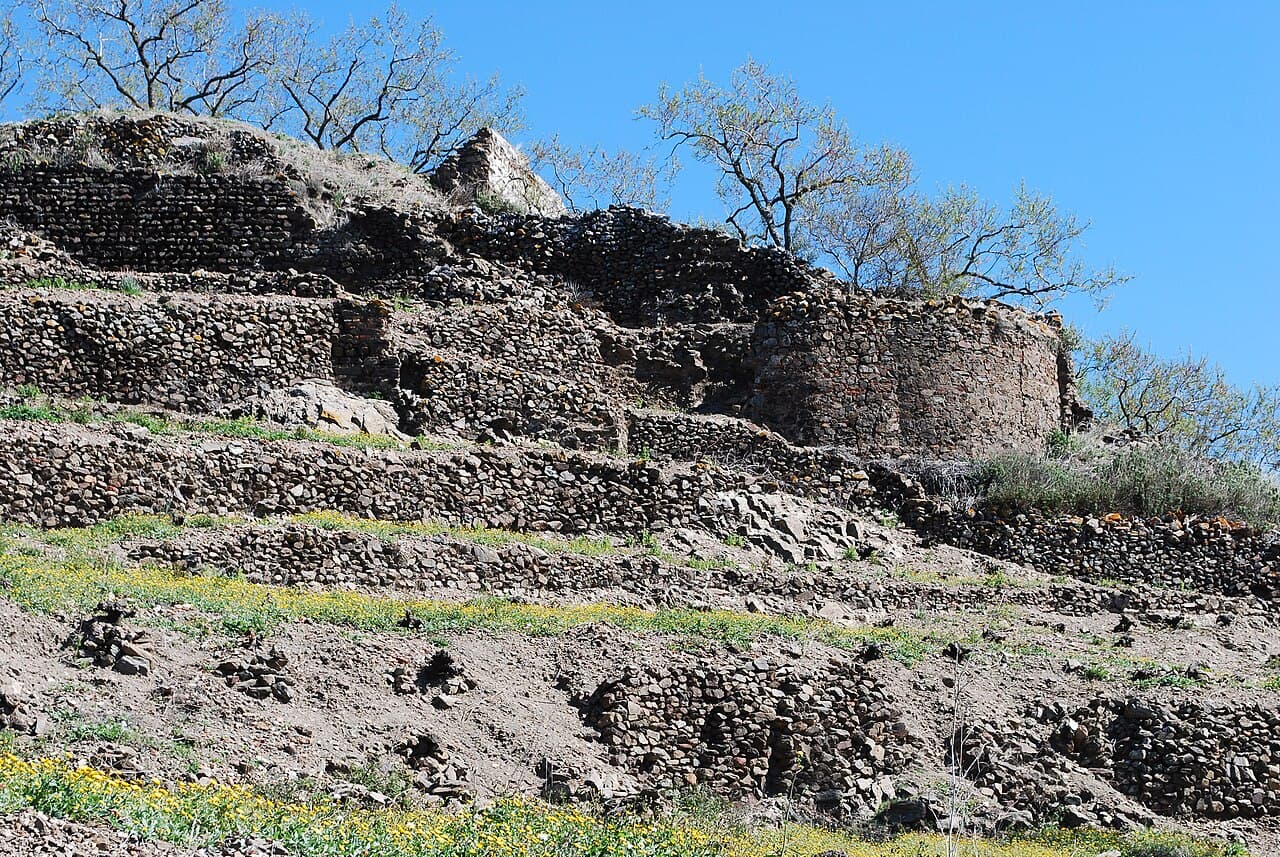
Bentomiz Castle
Bentomiz Castle stands as a remarkable example of a Moorish fortress perched on a hill near the village of Arenas in the province of Málaga, Spain. Situated at an altitude of 711 metres, this castle commands expansive views over the Axarquía region stretching towards the Mediterranean Sea. Its strategic location and imposing ruins reflect a complex history of occupation, adaptation, and military significance spanning from ancient Mediterranean civilizations through the Islamic period and into the Christian Reconquista.
The site of Bentomiz Castle has been occupied since antiquity, with evidence of Phoenician, Greek, and Roman presence. Archaeological remains include Roman baths, underscoring the site's long-standing importance as a settlement and defensive position. However, the most prominent surviving structures date to the High Medieval period, specifically the 11th century, when the Moors constructed the fortress on the hill, then known as Munt Mās. This name appears in the memoirs of Abdallah ibn Buluggin, the last Zirid ruler of the Taifa of Granada, who described Bentomiz as a formidable stronghold during his 11th-century civil war against his brother.
Historical significance and military role
Throughout the Nasrid Kingdom of Granada era, between the 13th and 15th centuries, Bentomiz Castle functioned as the administrative center of a district, or ta’a, within the kingdom. This period coincided with economic prosperity in the surrounding mountains, fueled by the production of silk and raisins. Bentomiz was part of a strategic defensive network that included the castles of Comares and Zalia, forming a triangular line of fortifications designed to protect the region.
The castle played a significant role during various conflicts, including the revolt of Umar ibn Hafsun against the Umayyad state. In the late 15th century, as the Christian forces advanced during the Reconquista, Bentomiz was involved in military actions leading up to the Siege of Málaga in 1487. The Granadan Sultan El Zagal stationed troops around Bentomiz to oppose the forces of Ferdinand II of Aragon. Despite a night attack by the Moors on the Christian siege train, the defenders were repulsed, and the castle ultimately surrendered peacefully to the Catholic Monarchs in 1487.
After the Reconquista, Bentomiz remained a military outpost overseeing a population largely composed of Moriscos, Muslims who had converted to Christianity. The castle was involved in the Morisco Revolt of 1570, after which its military importance declined, leading to gradual abandonment and ruin. Historical records from 1492 note a population of approximately 7,500 defenders and Muslim families, many of whom fled during the Christian conquest, leaving behind properties and a legacy of cultural transition.
Architectural features and layout
Bentomiz Castle is recognized as one of the largest and most architecturally distinctive castles in the Málaga area. Its design is characterized by a double enclosure that adapts to the irregular terrain of the hilltop. The fortress comprises two main sections: a smaller upper enclosure crowning the summit and a larger lower enclosure wrapping around the plateau below.
Upper enclosure
The upper enclosure is fortified with thick stone walls supported by several square towers and a notable hexagonal tower. This hexagonal tower is remarkable for housing two vaulted cisterns with barrel-shaped vaulting, used to collect and store water, a critical feature for sustaining the fortress during sieges.
Lower enclosure
The larger lower enclosure features robust walls reinforced by multiple towers, some retaining their original battlements where defenders once stood guard. This section contains two large cisterns with ribbed vaulted roofs, a sophisticated architectural element that parallels the water storage systems found beneath the Palace of Charles V in the Alhambra. These cisterns highlight the advanced water management techniques employed in Nasrid fortifications, ensuring the castle's self-sufficiency.
Construction techniques and materials
The castle's construction reflects multiple historical phases, evidenced by the variety of masonry techniques and materials. Stonework is predominant, but sections of the fortress were built or repaired using rammed earth (tapia), a traditional method involving compacted earth, which was common in Islamic architecture of the region. These variations indicate continuous occupation and adaptation from the early Caliphate period through the late 16th century.
Despite the passage of centuries, substantial portions of the walls, towers, and internal chambers survive, although some have collapsed. Attached to the northern side of the lower enclosure's wall is a cluster of residential houses that remained inhabited until recent times, demonstrating the site's prolonged use beyond its military function. At the highest point of the upper enclosure, a modern small building serves as a television repeater, marking the intersection of ancient and contemporary uses.
Cultural and heritage importance
Bentomiz Castle is not only a military monument but also a cultural symbol reflecting the layered history of southern Spain. Its name possibly derives from the Latin "montemar," meaning "mountain overlooking the sea," or from Arabic place names beginning with "ben-," indicating lineage or family association. The castle's ruins, including its towers, walls, and underground chambers, offer valuable insights into the Islamic architectural heritage and the complex socio-political dynamics of the Nasrid Kingdom.
Today, Bentomiz Castle stands as a significant archaeological site that attracts historians, architects, and visitors interested in the medieval fortifications of Andalusia. Its preservation, though partial, allows for the study and appreciation of the defensive strategies and architectural innovations employed by the Moors, as well as the impact of the Reconquista on the region's cultural landscape.
The castle's large cisterns, battlements, and towers continue to evoke the strength and resilience of this historic fortress. Bentomiz remains a testament to the enduring legacy of Islamic military architecture in Spain and the rich tapestry of Mediterranean history.
Frequently asked questions (FAQ)
- How do I get to Bentomiz Castle from Arenas?
- Bentomiz Castle is located near the village of Arenas in Málaga province. Visitors can reach the castle by car or hiking along marked trails from Arenas, enjoying scenic views of the Axarquía region.
- What is the historical significance of Bentomiz Castle?
- Bentomiz Castle was a key Moorish fortress in the Nasrid Kingdom of Granada, serving as a strategic defensive site and administrative center during the 11th to 15th centuries.
- Can I explore the ruins of Bentomiz Castle?
- Yes, visitors can explore the extensive ruins including walls, towers, and underground cisterns, though some areas may be unstable. Proper footwear and caution are recommended.
- When is the best time to visit Bentomiz Castle?
- The best time to visit is during spring and autumn when the weather is mild and the landscape is lush, offering pleasant hiking conditions and panoramic views.
- Is there an entrance fee to visit Bentomiz Castle?
- Bentomiz Castle is an open archaeological site and does not charge an entrance fee, making it accessible to all visitors interested in history and architecture.
Photo gallery

Information
Website
Visit websiteSources & official resources
Verify the information above using these authoritative references.
Loading map...
Visitor reviews
No reviews yet. Been here? Write the first review and help other travelers!
Write the first reviewVisited this castle? Share your experience
Your review helps other travelers and adds first-hand knowledge to our encyclopedia.


