Belvoir Castle
Belvoir Castle stands as a magnificent hill castle in the heart of Leicestershire, England, commanding sweeping views over the Vale of Belvoir. This imposing fortress and stately home has evolved over nearly a millennium, reflecting the turbulent history and architectural trends of England from the Norman Conquest through the Gothic Revival of the 19th century. It remains the family seat of the Dukes of Rutland, embodying centuries of aristocratic heritage and regional influence.
Situated near villages such as Redmile, Woolsthorpe, and Knipton, and close to the market town of Grantham, Belvoir Castle is not only a private residence but also a cultural landmark open to visitors. Its strategic location on a high hilltop made it a key defensive site following the Norman invasion of 1066, and its architecture narrates a story of destruction, renewal, and adaptation through the High Medieval, Tudor, Baroque, and ultimately Gothic Revival periods.
Early history and medieval origins
The origins of Belvoir Castle trace back to the immediate aftermath of the Norman Conquest, when the land was granted to Robert de Todeni, a Norman lord documented in the Domesday Book of 1086. The initial fortification was likely a motte and bailey structure, typical of early Norman military architecture, designed to assert control over the newly conquered territory.
The castle's strategic position atop a prominent hill allowed it to dominate the surrounding landscape, overseeing vital routes and fertile lands of the Vale. By 1267, the castle was officially licensed for crenellation, permitting the addition of defensive battlements, a sign of its growing military and administrative importance. It functioned as a royal manor until the mid-13th century, after which it passed through the hands of the de Aubigny and de Ros families.
However, by the mid-15th century, the medieval fortress had fallen into disrepair, reflecting the shifting political and military landscape of England. The castle's decline set the stage for a significant transformation during the Tudor era.
Tudor manor and the manners family legacy
In 1508, ownership transferred to George Manners, whose family would become synonymous with Belvoir Castle for centuries. His descendant, Thomas Manners, 1st Earl of Rutland, initiated the construction of a grand Tudor manor house on the site, completed in 1555. This manor was notable for incorporating stone salvaged from nearby dissolved religious institutions, including Croxton Abbey and Belvoir Priory, a testament to the sweeping religious reforms under Henry VIII.
The Tudor manor blended residential comfort with defensive features, reflecting the era's transition from fortified castles to stately homes. It became a symbol of the Manners family's rising prominence and wealth.
Civil war destruction and restoration
During the English Civil War, Belvoir Castle was a staunch Royalist stronghold. Its allegiance to King Charles I made it a target for Parliamentarian forces. In 1649, following the war, the Tudor manor was deliberately destroyed in a process known as slighting to prevent its future military use.
Between 1654 and 1668, the Manners family commissioned John Webb, a prominent architect and protégé of Inigo Jones, to design a new family residence on the ruins. This large country house was a departure from medieval fortress style, embracing the classical influences of the period. The construction cost of £11,730 was a significant investment, equivalent to several million pounds today.
18th-century elevation and gothic revival transformation
The Manners family's status was further elevated when they were granted the duke title of Rutland in 1703. Belvoir Castle continued as their principal residence, reflecting their aristocratic standing.
In 1799, the 5th Duke of Rutland married Elizabeth Howard, who played a pivotal role in reshaping the castle and its grounds. She commissioned the renowned architect James Wyatt to rebuild the castle in the burgeoning Gothic Revival style, a movement that romanticized medieval architecture while incorporating modern comforts.
This ambitious project was financed by selling seven villages and their lands, underscoring the scale of the undertaking. Wyatt's design emphasized crenellated battlements, towers, and a picturesque silhouette, enhancing Belvoir's medieval character while updating it for contemporary use.
The great fire and 19th-century rebuilding
Tragedy struck in 1816 when a devastating fire ravaged much of the castle, destroying a priceless art collection that included masterpieces by Titian, Rubens, van Dyck, and Reynolds. The financial loss was enormous, estimated at £120,000 in early 19th-century currency.
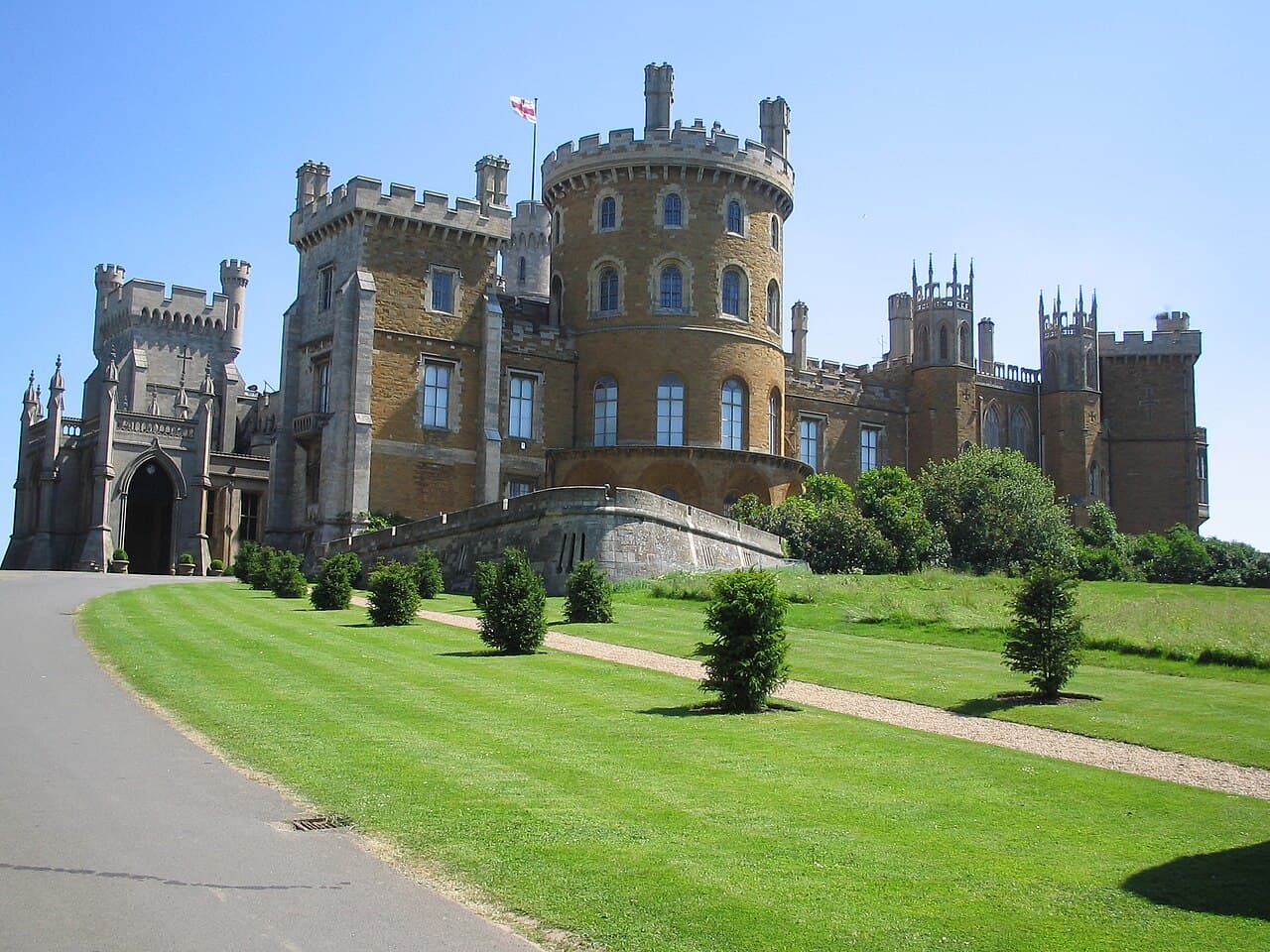
The castle was meticulously rebuilt under the supervision of Sir James Thornton, adhering closely to Wyatt's Gothic Revival plans. The reconstruction was completed by 1832, costing an additional £82,000, and restored Belvoir Castle's grandeur with its characteristic crenellated battlements and imposing central tower inspired by Windsor Castle.
Architectural features and estate grounds
The current Grade I listed Belvoir Castle is a striking example of Gothic Revival architecture. Its design features include a prominent central tower, battlements, turrets, and expansive state rooms such as the Elizabeth Saloon, Regent’s Gallery, and a State Dining Room inspired by classical Roman motifs.
The extensive estate spans approximately 15,000 acres (6,000 hectares) and includes meticulously designed gardens laid out in 1799 by Elizabeth Howard, the 5th Duchess of Rutland. The gardens incorporate a natural amphitheatre formed by glacial moraines and contain unique structures like the root house, a surviving summer house.
The estate is also ecologically significant, hosting the Briery Wood Heronry, a designated biological Site of Special Scientific Interest, highlighting the castle’s integration with its natural surroundings.
Reuse of monastic materials
The Tudor manor’s construction notably reused stone from dissolved religious sites, a practice reflecting the Dissolution of the Monasteries under Henry VIII. This material recycling linked Belvoir Castle’s fabric to the broader religious and political upheavals of the 16th century.
The ducal mausoleum
Near the castle stands the ducal mausoleum, built in 1825 to serve as the primary burial place for the Manners family. This replaced the parish church of St Mary the Virgin in Bottesford as the family’s resting place. The mausoleum contains monuments relocated from the 18th century, preserving the legacy of the Dukes of Rutland.
Modern uses and visitor experience
Belvoir Castle remains a private residence of the Manners family but welcomes visitors to explore its rich history and impressive interiors. It has hosted various functions, including housing the Queen’s Royal Lancers regimental museum from 1964 to 2007.
The estate also serves as a venue for annual events such as the Equinox24 ultramarathon, which began in 2013, blending heritage with contemporary community engagement.
In 2019, a retail village was opened below the castle, featuring independent shops including a butcher offering estate-produced beef, enhancing the visitor experience with local products.
The Manners Arms, a Grade II listed former shooting lodge and country house hotel on the estate, underwent refurbishment in 2024 to preserve its 18th-century character while modernizing its facilities.
Visitor information and accessibility
Visitors to Belvoir Castle can tour the lavish state rooms and explore the extensive gardens. The castle’s hilltop location offers panoramic views of the surrounding countryside and nearby villages. Guided tours provide insights into the castle’s architectural evolution and the Manners family history.
The estate’s blend of historical significance, architectural grandeur, and natural beauty makes it a compelling destination for those interested in English heritage and aristocratic culture.
Frequently asked questions (FAQ)
- When was Belvoir Castle originally built?
- Belvoir Castle was originally fortified shortly after the Norman Conquest in the 11th century, with significant developments through the medieval period.
- What architectural style characterizes the current Belvoir Castle?
- The current castle is designed in the Gothic Revival style, featuring crenellated battlements, turrets, and a central tower inspired by Windsor Castle.
- Can visitors tour the interior of Belvoir Castle?
- Yes, Belvoir Castle is open to visitors who can explore its lavish state rooms and extensive gardens, often through guided tours.
- Is Belvoir Castle still a private residence?
- Yes, a part of Belvoir Castle remains the family home of the Manners family, the Dukes of Rutland, who continue to own the estate.
- What notable events are held at Belvoir Castle today?
- The estate hosts annual events such as the Equinox24 ultramarathon, blending heritage with contemporary community activities.
- What is the significance of the ducal mausoleum at Belvoir Castle?
- The ducal mausoleum, built in 1825, serves as the primary burial place for the Manners family, containing monuments relocated from Bottesford church.
Photo gallery

Information
Sources & official resources
Verify the information above using these authoritative references.
Loading map...
Visitor reviews
No reviews yet. Been here? Write the first review and help other travelers!
Write the first reviewVisited this castle? Share your experience
Your review helps other travelers and adds first-hand knowledge to our encyclopedia.