Leicester Castle
Leicester Castle stands as a prominent Norman hill castle located in the historic city of Leicester, England. Founded shortly after the Norman Conquest, around 1067–1070, by Hugh de Grandmesnil, a trusted ally of William the Conqueror, the castle was strategically positioned on elevated ground overlooking the River Soar. This location offered both defensive advantages and control over the surrounding settlement, marking the castle as a key fortification in consolidating Norman power in the region.
The original design of Leicester Castle followed the typical motte-and-bailey layout common to Norman military architecture. The castle encompassed approximately four acres, featuring a raised earthwork mound (the motte) topped by a wooden tower, surrounded by an enclosed courtyard (the bailey) protected by a wooden palisade and an oval-shaped earthwork ditch. While no wooden structures remain today, the substantial stone base of a large bridge that once supported the wooden citadel survives, standing about nine meters tall and over thirty meters wide.
The transition to stone fortifications and medieval expansion
During the early 12th century, ownership passed to the influential Beaumont family through marriage, with Robert de Beaumont, the second Earl of Leicester, spearheading significant reconstruction efforts. He replaced the initial wooden defenses with robust stone curtain walls integrated along the motte's perimeter, greatly enhancing the castle's fortifications. This period also saw the construction of the Church of St Mary de Castro, a smaller stone replacement of an earlier wooden church, and a grand Great Hall which remains one of the castle's most important surviving features.
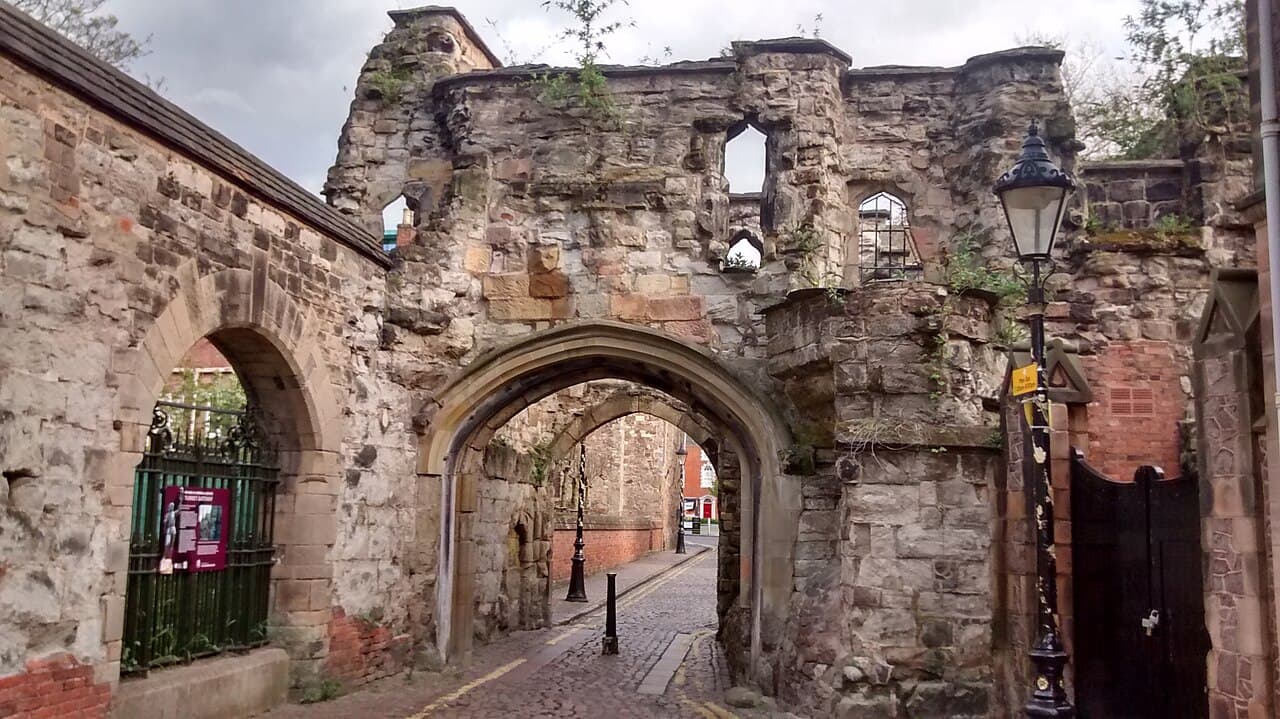
The Great Hall is architecturally notable for its interior, supported by two rows of timber columns dividing the space into three aisles with passageways along each side. Elements of the original 12th-century masonry and timberwork are still visible, offering valuable insights into medieval construction techniques. Surrounding the castle precinct were thick stone walls enclosing three sides, punctuated by two major gate towers: the southern gate and the northeast tower, now known as the Powder Tower or Turret Gateway. The castle's main entrance was marked by a grand triple-arched vaulted gatehouse, emphasizing the site's importance and defensive strength.
Leicester Castle's evolving role in the late medieval period
By the 14th century, Leicester Castle had transitioned from a primarily military fortress to a noble residence with significant administrative and ceremonial functions. In 1331, Henry Plantagenet, the third Earl of Lancaster and Leicester, established a nearby hospital known as Trinity Hospital, reflecting the castle's growing association with charitable and religious activities. This hospital complex could accommodate up to one hundred patients and included a church and residential buildings for a community of collegiate clergy.
Henry Grosmont, Duke of Lancaster, expanded the southern precinct in the mid-1300s, creating a religious district that featured a collegiate church serving as a mausoleum for the ducal family. This ambitious project included housing a sacred relic reputed to be part of the Crown of Thorns. The complex was completed under John of Gaunt, who died at the castle in 1399, underscoring the site's significance as a ducal and royal residence.
Following the merging of the Lancastrian ducal line with the English crown, Leicester Castle became a royal residence used for ceremonial purposes. It notably witnessed the knighting of the future King Henry V. Throughout the 15th century, the castle's role shifted towards law and governance. The Great Hall served as a venue for legal courts and parliamentary sessions, including the famous Parliament of Bats in 1426, named for the prohibition of weapons other than clubs during the assembly.
Military significance and later transformations
Although its military importance waned over time, Leicester Castle briefly regained strategic relevance during the English Civil War in 1645 when Leicester endured a siege. The castle's fortifications, including walls near the Turret Gateway, were adapted with gun loops for muskets and cannons. Despite the conflict, the castle walls largely survived, but extensive demolition occurred in the early 19th century.
The Turret Gateway, also known as Prince Rupert's Gateway, suffered partial destruction during an 1832 political riot, losing its top storey and leaving it partially ruined. The Great Hall underwent alterations in 1695, receiving a brick frontage in the Queen Anne style. By the 19th century, the hall was subdivided internally to create two courtrooms separated by a central staircase, reflecting its continued use as a legal venue until judicial functions moved elsewhere in 1980.
Architectural and historical remnants today
Today, Leicester Castle preserves several significant medieval structures and features. The Church of St Mary de Castro, with origins in the 12th century, remains an active parish church, retaining parts of its original stonework. The castle grounds include the motte mound and various stone remains, such as medieval masonry and decorative elements from the church and Great Hall.
The castle's historic landscape is enriched by gardens bordering the nearby Grand Union Canal, enhancing the site's cultural and heritage value. Notable features like "John of Gaunt's cellar," formerly misidentified as a torture chamber, are visible on site, adding to the castle's intriguing history.
Leicester Castle is recognized as a scheduled monument and includes several listed buildings, preserving its legacy as a symbol of Norman conquest, medieval nobility, royal residence, and judicial authority. Its layered history, from a defensive motte-and-bailey to a center of governance and charity, offers a comprehensive glimpse into England's medieval past and architectural evolution.
Frequently asked questions (FAQ)
- When was Leicester Castle originally built and by whom?
- Leicester Castle was originally constructed around 1067–1070 by Hugh de Grandmesnil, a Norman ally of William the Conqueror, to secure Norman control over Leicester.
- What are the key medieval features still visible at Leicester Castle?
- Key surviving features include the Great Hall with its 12th-century timber columns, the Church of St Mary de Castro, the Turret Gateway, and sections of the stone curtain walls enclosing the castle precinct.
- Can visitors explore the Church of St Mary de Castro today?
- Yes, the Church of St Mary de Castro remains an active parish church and is accessible to visitors interested in its medieval architecture and history.
- How did Leicester Castle's role change during the 15th century?
- In the 15th century, Leicester Castle shifted from a military fortress to a center for law and governance, hosting legal courts and the notable Parliament of Bats in 1426.
- Is Leicester Castle open to the public and what are the visiting hours?
- Leicester Castle grounds and some structures are accessible to the public, though visiting hours may vary. It is recommended to check with local heritage organizations for current access information.
Photo gallery

Information
Website
Visit websiteSources & official resources
Verify the information above using these authoritative references.
Loading map...
Visitor reviews
No reviews yet. Been here? Write the first review and help other travelers!
Write the first reviewVisited this castle? Share your experience
Your review helps other travelers and adds first-hand knowledge to our encyclopedia.