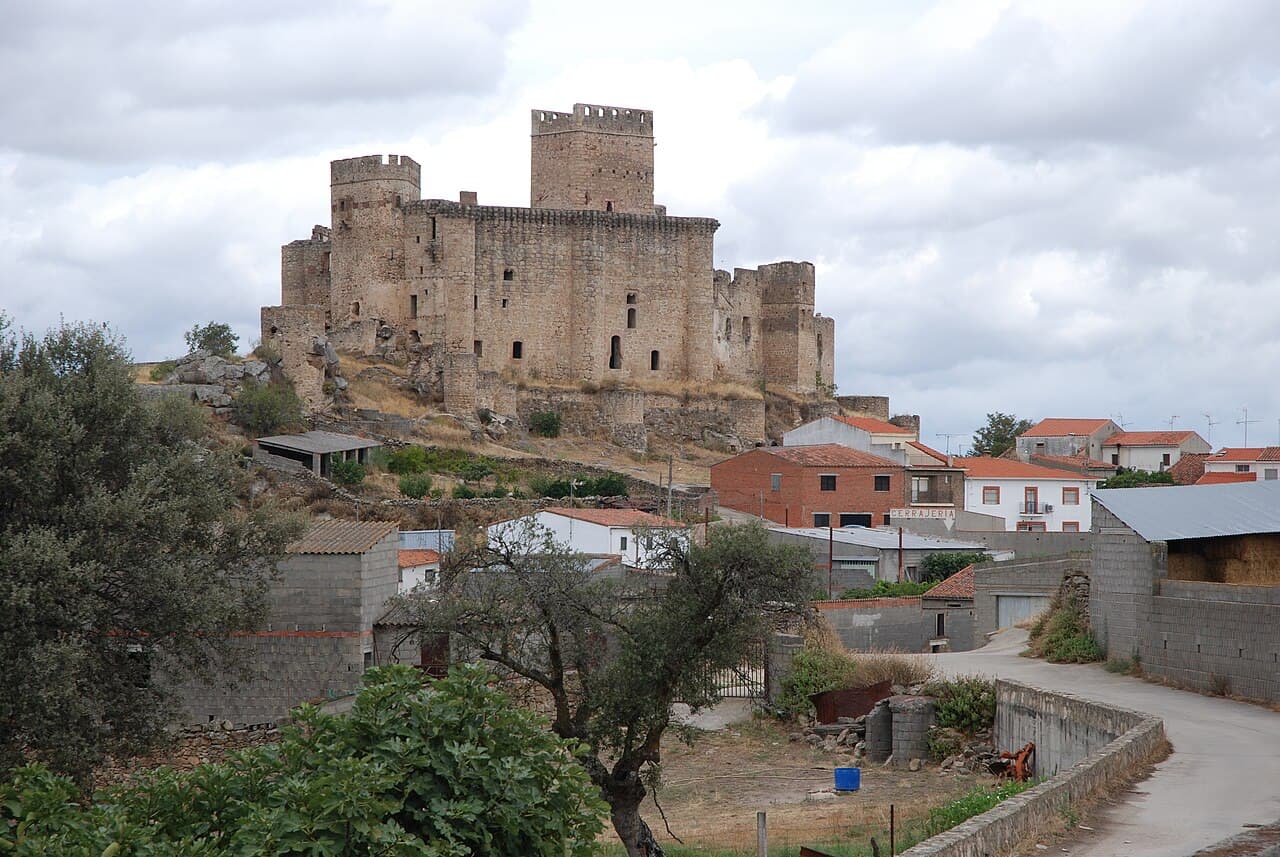
Belvís de Monroy Castle
Belvís de Monroy Castle stands as a significant historical monument in central Spain, embodying a rich legacy that spans several centuries. Originally constructed in the 13th century on the site of a former Moorish fortress, this hill castle reflects the turbulent history of the Iberian Peninsula during and after the Reconquista. The castle’s evolution from a fortified residence to a palatial complex illustrates the shifting priorities of its occupants, from military defense to residential comfort and aesthetic expression.
The origins and early history of Belvís de Monroy Castle
The castle’s foundation is closely linked to the reign of King Sancho IV of Castile, who in the late 13th century granted the land known as the "cortijo de Belvís" to Hernán Pérez del Bote. Charged with repopulating and securing this strategic area, Hernán was instructed to establish a fortified residence, termed a "Casa Fuerte." This initial structure served both as a military stronghold and a symbol of Christian authority in a recently reconquered territory.
In the early 14th century, Hernán’s grandson, Alonso Fernández del Bote, expanded this initial fortification by constructing a more substantial fortified house. This development marked the beginning of the castle’s transformation into a complex defensive and residential site. The castle’s location on a hill provided a commanding view over the surrounding landscape, enhancing its strategic importance.
Architectural evolution through the medieval and Renaissance periods
Belvís de Monroy Castle’s architecture is characterized by an eclectic blend of medieval and Renaissance elements. The original medieval core centered around a prominent keep (tower of homage), which served as the last line of defense and the lord’s residence. Surrounding this keep was a robust defensive wall reinforced with semicircular towers, a design choice that improved defensive capabilities by eliminating blind spots common in square towers.
By the 16th century, the castle underwent significant modifications reflecting Renaissance tastes and domestic needs. A notable addition was a Plateresque-style courtyard, renowned for its intricate ornamentation inspired by silverwork. Although this courtyard no longer survives, historical records suggest it was comparable in artistic quality to the courtyard of the nearby Monastery of Yuste.
Alongside the courtyard, new residential quarters were added to accommodate the castle’s inhabitants more comfortably. These quarters incorporated architectural features typical of the Renaissance period, emphasizing symmetry, proportion, and decorative detail. The castle thus served a dual purpose as a fortified military installation and a noble residence.
Baroque influences and later modifications
Subsequent centuries introduced Baroque architectural elements to the castle, further enriching its stylistic diversity. These additions often included ornamental details and structural adaptations that aligned with contemporary tastes and functional requirements. The layering of medieval, Renaissance, and Baroque styles makes Belvís de Monroy Castle a unique example of architectural continuity and adaptation over time.
Military significance and historical events
Belvís de Monroy Castle played a strategic role in regional conflicts, particularly during the War of Spanish Succession and the Peninsular War in the 18th and early 19th centuries. These conflicts led to the castle’s abandonment and subsequent deterioration. Its hilltop position made it a valuable military asset for controlling the surrounding territory, but advances in warfare and changing political landscapes eventually rendered such fortifications obsolete.
Current condition and conservation efforts
Today, the castle is recognized as a protected cultural heritage site under Spanish law. Although closed to the public for interior visits, it remains accessible for external viewing. Conservation efforts focus on stabilizing the structure and preventing further decay, aiming to preserve the castle’s historical fabric for future generations.
The castle’s layout still prominently features the tower of homage, surrounded by the defensive curtain wall and its semicircular towers. While the Plateresque courtyard no longer exists, the surviving architectural elements provide valuable insights into the castle’s complex history and its role as both a fortress and a noble residence.
Visiting Belvís de Monroy and local attractions
Visitors to Belvís de Monroy can explore the charming village at the castle’s base, which retains its traditional character and offers a glimpse into rural Spanish life. The local museum is a recommended stop, providing detailed information about the castle’s history, the region’s heritage, and archaeological findings. Although the castle interior is not open, the exterior views and the surrounding landscape offer a rewarding experience for history enthusiasts and travelers alike.
Frequently asked questions (FAQ)
- When was Belvís de Monroy Castle originally built?
- Belvís de Monroy Castle was originally built in the 13th century following the Reconquista, established on the site of an older Moorish fortress.
- What architectural styles are visible at Belvís de Monroy Castle?
- The castle features a mix of medieval defensive architecture alongside Renaissance and Baroque elements, reflecting its long history of modifications.
- Is it possible to visit the interior of Belvís de Monroy Castle?
- Currently, the castle is closed to the public for interior visits, but visitors can view the exterior and explore the nearby village and local museum.
- What is the significance of the tower of homage at Belvís de Monroy Castle?
- The tower of homage is the castle's central keep, originally serving as the fortified residence and last defensive stronghold.
- Are there any notable historical events associated with Belvís de Monroy Castle?
- The castle played a role during the War of Spanish Succession and the Peninsular War, after which it was abandoned and fell into disrepair.
Photo gallery

Information
Website
Visit websiteSources & official resources
Verify the information above using these authoritative references.
Loading map...
Visitor reviews
No reviews yet. Been here? Write the first review and help other travelers!
Write the first reviewVisited this castle? Share your experience
Your review helps other travelers and adds first-hand knowledge to our encyclopedia.


