Belsay Castle
Belsay Castle stands as a remarkable example of medieval fortification and evolving domestic architecture in the historic county of Northumberland, England. Established in the 14th century, the castle originally functioned as a fortified residence for the Middleton family, a prominent local lineage. It is located in the village of Belsay, set upon rising ground approximately 133 meters above sea level, commanding views over gently sloping terrain that descends steeply to the east. The surrounding landscape of open grassland enhances the castle's prominence and strategic visibility.
Medieval origins and defensive architecture
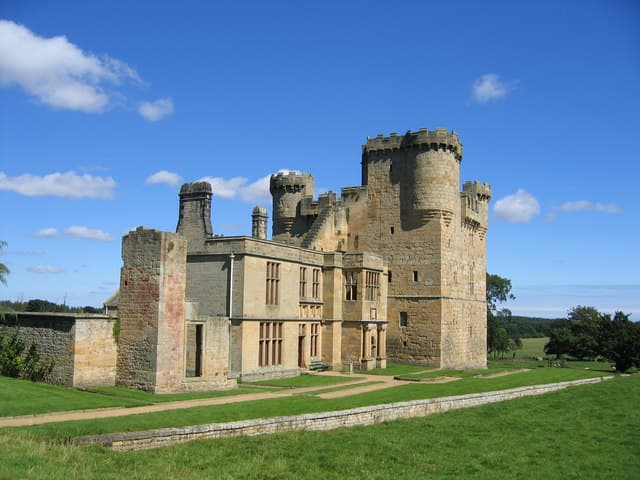
The core of Belsay Castle is its imposing pele tower, a type of small fortified keep typical of the border regions between England and Scotland during the turbulent medieval period. Constructed around 1370, this three-storey rectangular stone tower was designed primarily for defense. Its robust walls and rounded turrets at each corner are crowned with crenellated battlements, providing defenders with protective parapets from which to observe and repel attackers. The pele tower served both as a stronghold and a residence, reflecting the need for security in the often volatile border region.
Architectural features of the pele tower
The tower's stone construction exhibits the typical medieval masonry techniques of its time, with thick walls to withstand sieges. The battlements feature crenellations—alternating high and low sections—that allowed defenders to shield themselves while firing arrows or other projectiles. The rounded turrets not only reinforced the corners structurally but also provided vantage points for surveillance and defense. Internally, the tower would have contained living quarters and storage areas, though much of the original interior has been lost over time.
Transition to a manor house in the 17th century
In 1614, the castle underwent significant transformation under the direction of Thomas Middleton, who expanded the living space by attaching a new manor house to the existing pele tower. This addition marked a shift from purely defensive architecture to a more comfortable and spacious domestic residence. The manor house featured larger windows and more refined living quarters, reflecting the changing social and political climate of the early 17th century when fortified residences were less essential.
Expansion and later modifications
The manor house was further enlarged in 1711 with the addition of a west wing, enhancing the residential capacity and architectural complexity of the estate. However, this wing was mostly demolished in 1872 by Sir Arthur Middleton, who also undertook remodeling of the remaining structures. These alterations altered the manor house's late Renaissance character and reflected Victorian tastes and priorities. By this time, the castle had ceased to be the principal family residence.
19th-century changes and the rise of belsay hall
In the early 19th century, the Middleton family shifted their primary residence to the newly built Belsay Hall, a more modern and comfortable home located nearby. This transition marked the decline of the castle as a lived-in home. The castle's interiors were largely stripped, and the building was repurposed as a decorative feature or folly. It became a venue for social events such as garden parties and aristocratic entertainments rather than a defensive or residential structure.
Current condition and heritage status
Today, Belsay Castle is recognized for its historical and architectural significance. It is protected as a Scheduled Monument and a Grade I listed building, ensuring its preservation for future generations. The castle's exterior stonework, including the pele tower and remaining manor house sections, remains largely intact. However, the interior has been mostly stripped of original fittings, reflecting its change in function over the centuries.
Landscape and setting
The castle's elevated position provides commanding views of the surrounding countryside, emphasizing its historical role as a defensive stronghold. The surrounding land is predominantly open grassland, with a moderate population density in the nearby area. This setting contributes to Belsay Castle's picturesque and historically resonant presence in Northumberland.
Architectural significance and cultural heritage
Belsay Castle exemplifies the evolution of English fortified residences from the medieval period through the early modern era. Its pele tower is a classic example of border defensive architecture, while the attached manor house illustrates the transition to more domestic and comfortable living spaces in the 17th century. The castle's later modifications and partial demolition reflect changing tastes and the decline of fortified homes in favor of modern country houses like Belsay Hall.
The castle remains a valuable cultural and historical asset, attracting visitors interested in medieval architecture, English history, and the heritage of Northumberland. Its preservation as a Scheduled Monument and Grade I listed building underscores its importance as a testament to the region's turbulent past and architectural development.
Frequently asked questions (FAQ)
- How do I get to Belsay Castle?
- Belsay Castle is located in the village of Belsay, Northumberland, England. It is accessible by car via local roads and is near the A696. Public transport options are limited, so driving is recommended.
- What is the historical significance of Belsay Castle?
- Belsay Castle is a prime example of a 14th-century pele tower and early 17th-century manor house, reflecting the evolution of fortified residences in Northumberland during the medieval and early modern periods.
- Can I visit the interior of Belsay Castle?
- The interiors of Belsay Castle have been largely stripped and are not fully furnished. Visitors can explore the exterior structures and the surrounding grounds but should not expect fully restored interiors.
- When is the best time to visit Belsay Castle?
- The castle is open daily from 10:00 to 16:00. Spring and summer months offer the best weather and scenery for visiting the castle and its gardens.
- Is there an admission fee to enter Belsay Castle?
- Admission to Belsay Castle is free, making it accessible for visitors interested in exploring its historic architecture and grounds.
Photo gallery

Information
Sources & official resources
Verify the information above using these authoritative references.
Loading map...
Visitor reviews
No reviews yet. Been here? Write the first review and help other travelers!
Write the first reviewVisited this castle? Share your experience
Your review helps other travelers and adds first-hand knowledge to our encyclopedia.