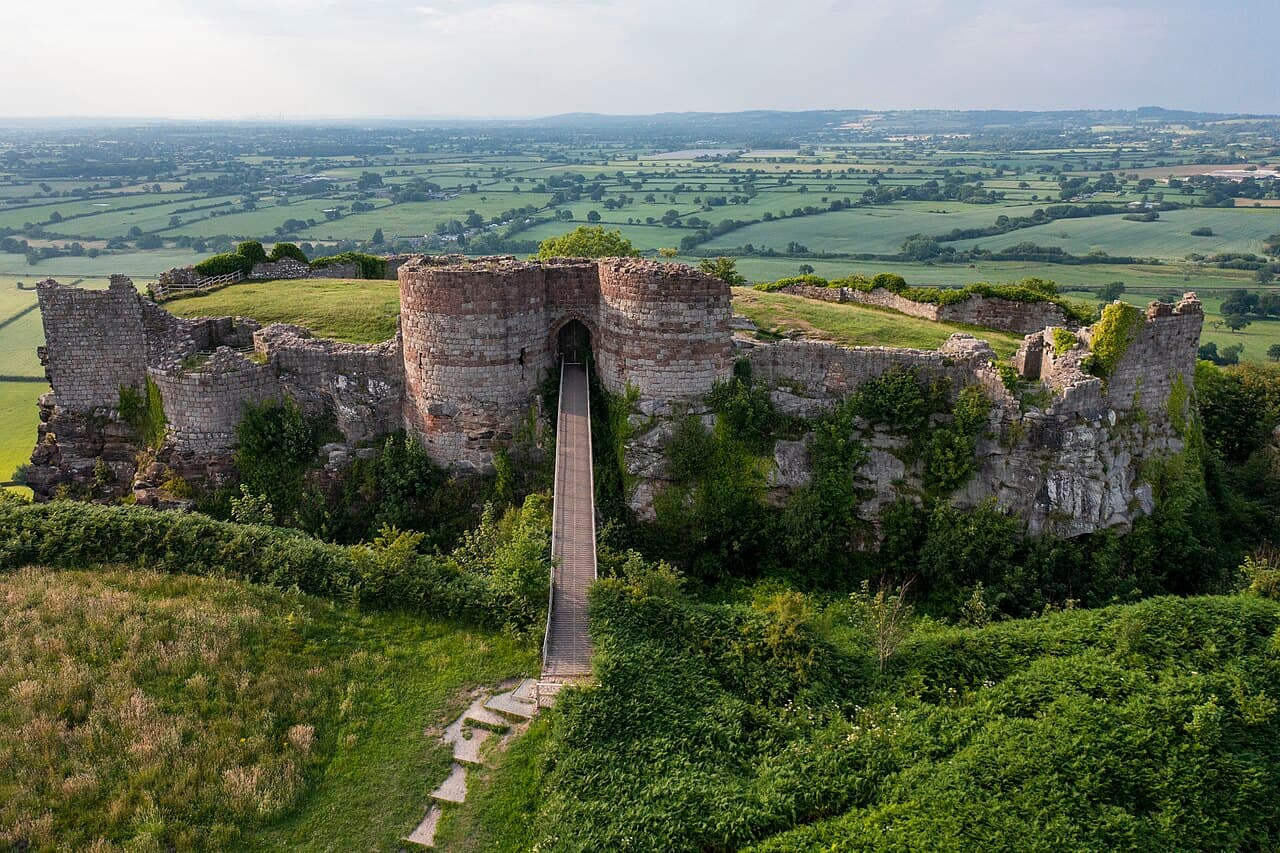
Beeston Castle
Beeston Castle stands majestically atop Beeston Crag, a sandstone hill rising approximately 350 feet above the Cheshire Plain. This hill castle is a remarkable example of medieval military architecture, blending natural geological defenses with innovative man-made fortifications. Its commanding position offers some of the most breathtaking panoramic views in England, stretching across eight counties from the Pennines in the east to the Welsh mountains in the west. Visitors today can explore the extensive ruins, enjoy long woodland walks, and immerse themselves in the rich history and legends that surround this iconic fortress.
Early origins and historical significance
The site of Beeston Castle has been significant for over 4,000 years, originally serving as a Bronze Age hill fort and later an Iron Age settlement. Its strategic location atop a natural sandstone crag made it an ideal defensive position long before the medieval fortress was constructed. The present castle was established in the 13th century by Ranulf de Blondeville, the 6th Earl of Chester, during the 1220s. Ranulf, a powerful Anglo-Norman lord, designed the castle to emulate the formidable Crusader castles he had encountered in the Holy Land, incorporating advanced defensive features to create an impregnable stronghold.
Following Ranulf's death, the castle passed to the English crown. King Henry III expanded the fortress amid ongoing conflicts with the Welsh, using it as a prison for Welsh captives. Later, his son Prince Edward (later King Edward I) held the castle as Earl of Chester and utilized it during his campaigns to conquer Wales. Throughout the 14th century, Beeston Castle was maintained and enhanced, reflecting its continued military importance.
Role during the english civil war and later history
By the 16th century, Beeston Castle was considered outdated for modern warfare and was sold in 1602 to Sir Hugh Beeston. During the English Civil War in the mid-17th century, the castle changed hands multiple times. It was seized by Parliamentary forces in 1643, briefly retaken by Royalists, and ultimately besieged until surrendering in 1645. In 1646, Oliver Cromwell ordered its partial demolition to prevent future military use, a fate common to many castles during this period.
In the 18th century, quarrying activities altered the castle grounds, leading to the demolition of the gatehouse to facilitate stone extraction. The site was purchased in 1840 by John Tollemache, 1st Baron Tollemache, who revitalized the area by hosting annual charitable events, attracting visitors and preserving the castle's legacy.
Architectural features and defensive design
Beeston Castle is notable for its use of the natural terrain as a key defensive element. The summit's steep cliffs protect three sides of the inner bailey, while the fourth side is secured by a deep, rock-cut ditch nearly 30 feet deep. The castle lacks a traditional central keep; instead, its defense relies on thick curtain walls, massive gatehouses, and strategically placed D-shaped towers, an innovative design allowing defenders to cover the walls with overlapping fields of fire.
The outer bailey is enclosed by sandstone-faced walls approximately six feet thick with a rubble core. The D-shaped towers have curved fronts to enable defenders to fire along the curtain walls and directly ahead, while their open backs prevent enemies from using them as shelter if captured. The gatehouse, once protected by a deep ditch about 16 feet wide and 10 feet deep, was dismantled during quarrying in the 18th century, but remnants of the curtain walls and towers remain prominent.
Two deep wells, dug into the bedrock, supplied fresh water to the castle's occupants. One well plunges approximately 370 feet, making it one of the deepest known castle wells in England, a critical feature for withstanding sieges.
Cultural significance and present-day status
Beeston Castle is steeped in legend, including tales of buried treasure belonging to King Richard II, who is said to have scattered gold bags at the site during his journey to suppress a rebellion in Ireland. Though no treasure has ever been found, these stories add to the castle's allure and mystery.
Today, Beeston Castle is a protected Scheduled Ancient Monument with its ruins and surviving structures designated as Grade I listed buildings. The site includes a 19th-century lodge built by John Tollemache, featuring two circular towers flanking a central archway, itself a listed structure.
The castle grounds serve as a haven for wildlife, with extensive woodlands home to diverse bird species and small mammals. Visitors are encouraged to bring binoculars to observe the rich fauna. The combination of natural beauty, historic ruins, and panoramic views makes Beeston Castle a popular destination for history enthusiasts, nature lovers, and families alike.
Visitor experience and attractions
Visitors to Beeston Castle can enjoy extensive walking trails through lush woodlands surrounding the fortress, exploring the many nooks and crannies of the ruins. The elevated position provides spectacular views that are reputedly the best from any castle in England. The site offers educational opportunities to learn about medieval military architecture, the Anglo-Norman legacy, and the castle's role in English history.
The castle is accessible to the public, with information panels and guided tours available seasonally. Its combination of natural and historical attractions ensures a fulfilling day out for families, history buffs, and outdoor enthusiasts.
Frequently asked questions (FAQ)
- When was Beeston Castle built and by whom?
- Beeston Castle was constructed in the 1220s by Ranulf de Blondeville, the 6th Earl of Chester, on a site with prehistoric significance.
- What makes Beeston Castle's location strategically important?
- Its position atop Beeston Crag, a sandstone hill 350 feet above the Cheshire Plain, provides natural defenses and expansive views across eight counties.
- Can visitors explore the castle ruins and surrounding woodlands?
- Yes, the castle ruins and extensive woodlands are open to the public, offering walking trails, wildlife observation, and panoramic views.
- What historical events is Beeston Castle known for?
- Beeston Castle played roles in the Anglo-Norman consolidation, Welsh conflicts, and the English Civil War, including sieges and partial destruction by Cromwell.
- Is there any truth to the legend of buried treasure at Beeston Castle?
- While legends suggest King Richard II buried treasure at Beeston, no evidence has been found despite numerous searches.
Photo gallery

Information
Website
Visit websiteSources & official resources
Verify the information above using these authoritative references.
Loading map...
Visitor reviews
No reviews yet. Been here? Write the first review and help other travelers!
Write the first reviewVisited this castle? Share your experience
Your review helps other travelers and adds first-hand knowledge to our encyclopedia.



