Beersel Castle
Beersel Castle, also known locally as Kasteel van Beersel, is a striking example of medieval military architecture located in the town of Beersel, in the province of Flemish Brabant, Belgium. Situated just south of Brussels, the castle occupies a strategic position near the meadows of the Zenne River at the foot of a hill, which historically allowed it to serve as a vital defensive outpost protecting the southern borders of the Duchy of Brabant.
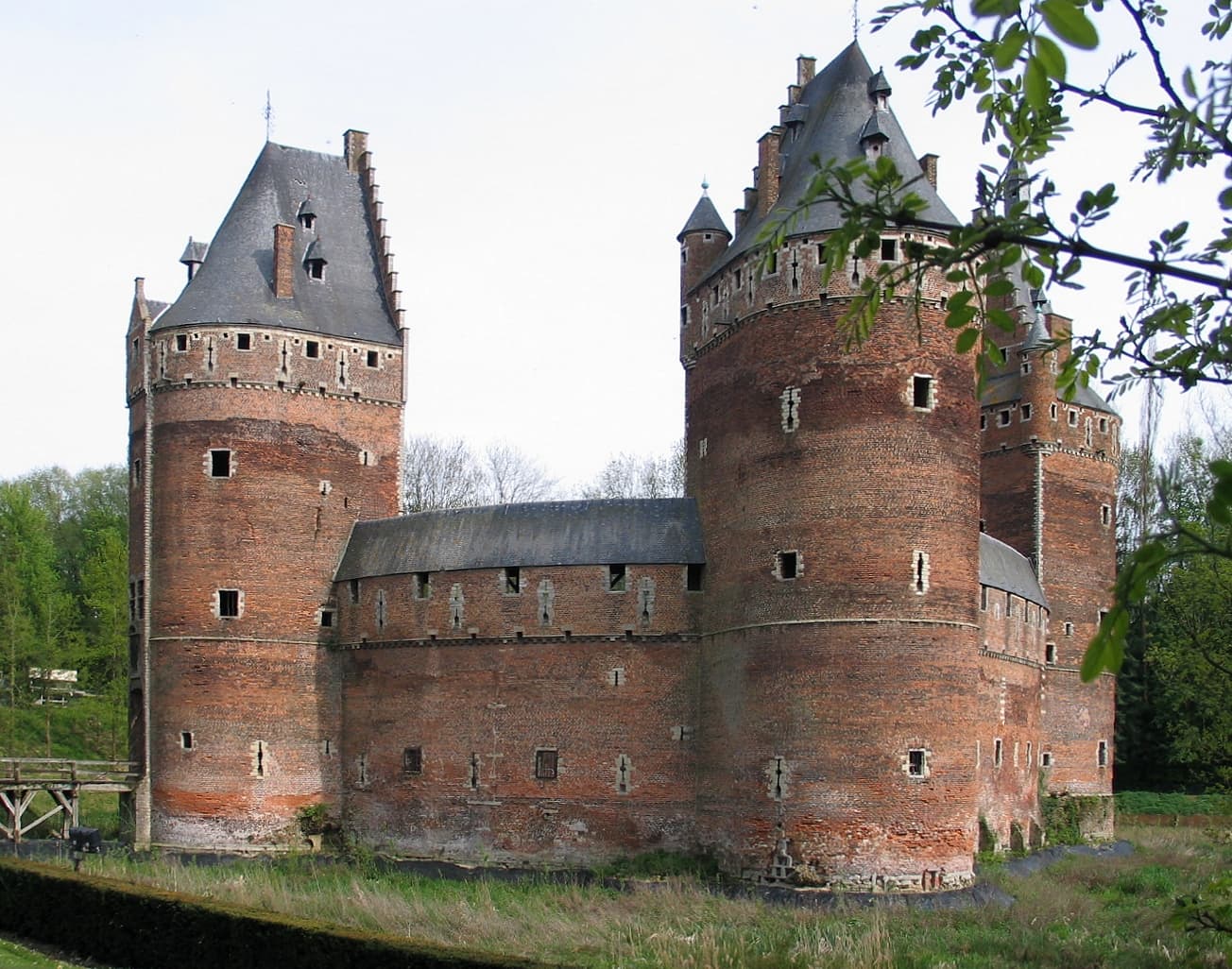
The castle’s origins trace back to the early 14th century, specifically between 1300 and 1310, when it was constructed under the direction of Godfrey of Hellebeek, the first known lord associated with the site. It was built by order of Duke John II of Brabant as part of a defensive network designed to safeguard Brussels from incursions by the neighboring County of Hainaut. The castle was initially a fortified structure featuring a moated elliptical layout with robust brick curtain walls and three massive semicircular towers, each topped with conical roofs added in later centuries.
Historical significance and ownership lineage
The Lords of Beersel, first mentioned in the latter half of the 12th century, initially held a wooden or stone keep on a moated circular motte at this location. By the early 14th century, the castle was firmly established as a critical military fortress. Ownership passed through several noble families over the centuries, most notably the Witthem family from the late 14th century until the late 16th century. The castle’s strategic importance is underscored by its role during the War of Succession of Brabant in 1356-1357, when it was besieged and burned but quickly rebuilt.
In the late 15th century, during the 1488-1489 rebellion of Brussels against Holy Roman Emperor Maximilian I, the castle sided with the emperor under Lord Hendrik III van Wittem. The castle was besieged twice by the rebels, finally falling after a brief siege involving heavy artillery. The assault caused significant damage to the gate tower, southern tower, and residential wing, breaching the walls. Following the suppression of the revolt, Maximilian forced the city of Brussels to finance the castle’s extensive restoration between 1491 and 1508.
After the extinction of the Witthem line, the castle passed to the Arenberg family in the 17th century. Neglect led to the castle falling into disrepair and eventual abandonment by the 18th century. The early 19th century saw the castle repurposed as a cotton factory, accelerating its decline. The French writer Victor Hugo visited during this period and lamented its dilapidated state in his writings.
Ownership later transferred to the Merode family through marriage, who initiated preservation efforts. In 1928, the descendants donated the castle to the League of Friends of Beersel Castle, which began restoration work. Since 1948, the Royal Association of Historic Residences and Gardens of Belgium has owned the castle, leasing it to the municipal authorities of Beersel. The municipality took over management in 1999, continuing restoration and renovation projects to enhance the castle’s historical authenticity and visitor experience.
Architectural features and military design
Beersel Castle is a rare surviving example of a medieval moated fortress in Belgium that has not been transformed into a residential palace. Its elliptical plan is surrounded by a broad, water-filled moat, characteristic of a water castle designed for defense in flat terrain. The brick curtain walls are reinforced by three prominent semicircular towers with conical roofs, which replaced an original fourth tower that no longer exists.
The castle’s defensive system includes a wide moat, a working drawbridge over the northern gate tower, machicolations for dropping projectiles on attackers, and merlons atop the towers and walls for protection during combat. The walls feature numerous embrasures and arrow slits, some edged with distinctive red and white sandstone, which were adapted over time to accommodate the introduction of artillery in the late 15th century.
The three main towers served multiple functions: the upper floors housed the lord’s chambers, barracks for the garrison, storage rooms, and arsenals. The middle tower contains a knight’s hall with a Gothic vaulted ceiling dating from the 15th century. The towers’ inner faces resemble traditional residential houses with stepped gables, reflecting the dual military and domestic nature of the structure.
Additional defensive features include covered walkways or chemin de ronde along the tops of the walls, allowing defenders to patrol and repel attackers. Within these galleries are two vertical oubliettes (dungeons), emphasizing the castle’s role in both defense and justice. The castle once included a chapel, a kitchen area complete with a displayed torture table, and a watchtower that no longer survives.
Materials and construction techniques
The castle’s walls and towers are predominantly constructed of brick, a somewhat uncommon choice for major fortifications of this period in Belgium, which typically favored stone. The foundations, corners, window frames, and arrow slits utilize local sandstone varieties such as Ledian and Écaussinnes stone. This combination of materials contributes to the castle’s distinctive appearance and resilience.

Photo by Nenea hartia • CC BY-SA 4.0
Cultural significance and modern restoration
Beersel Castle holds a unique place in Belgium’s heritage as one of the few medieval fortresses that remain largely intact and unaltered by later residential conversions. Visitors today can experience firsthand the atmosphere of a heavily fortified medieval castle, with its imposing walls, narrow windows, and defensive features clearly visible.
Since the mid-20th century, the castle has served as a cultural venue, hosting theatrical performances including Shakespearean plays and original productions, enriching the cultural life of the region. Restoration efforts have been ongoing since the early 20th century, with significant campaigns from the 1920s, post-World War II, and a major restoration project beginning in 2007 aimed at returning the castle to its 14th-century appearance.
Current plans include extensive archaeological excavations and the rebuilding of the castle’s residential wing, which was destroyed during the 15th-century siege. The castle is open to the public for a small fee, offering visitors a chance to explore multiple rooms, staircases, and the surrounding moat and towers.
Visitor experience and accessibility
Visitors to Beersel Castle can explore its three massive watchtowers, walk along the drawbridge, and enjoy the moat that encircles the fortress. The narrow exterior windows and low openings emphasize the defensive nature of the structure, while the interior spaces reveal the living and military functions of a medieval stronghold.
The castle’s management by the municipality of Beersel ensures ongoing maintenance and public access, with guided tours and cultural events enhancing the visitor experience. The castle’s well-preserved state and authentic medieval atmosphere make it a recommended destination for those interested in military architecture and medieval history in Belgium.
Frequently asked questions (FAQ)
- How do I get to Beersel Castle?
- Beersel Castle is easily accessible by public transport, with nearby train and bus stations. If you prefer to drive, there is parking available close to the castle.
- What is the historical significance of Beersel Castle?
- Beersel Castle, dating back to the 14th century, is a prime example of medieval architecture in Belgium. It served as a defensive stronghold and residence for local nobility, reflecting the region's feudal history.
- When was Beersel Castle built?
- Construction of Beersel Castle began in 1260 and was completed by the early 14th century. Its impressive structure has stood the test of time, showcasing the architectural styles of the medieval period.
- Can I take guided tours of Beersel Castle?
- Yes, guided tours are available for visitors looking to learn more about the castle's history and architecture. These tours are conducted by knowledgeable guides who provide insights into the castle's past and its significance in Belgian history.
- Why is Beersel Castle a popular tourist attraction?
- Beersel Castle attracts visitors for its stunning medieval architecture, beautiful surroundings, and rich history. It offers a glimpse into the past, making it a favorite destination for history enthusiasts and families alike.
- Is it possible to host events at Beersel Castle?
- Yes, Beersel Castle can be rented for special events such as weddings, parties, and corporate gatherings. The picturesque setting provides a unique backdrop for any occasion.
- What are the opening hours for Beersel Castle?
- Beersel Castle is typically open to the public from Wednesday to Sunday, with varying hours depending on the season. It is recommended to check the official website for the most current opening times before your visit.
- What are the ticket prices for visiting Beersel Castle?
- Ticket prices for Beersel Castle are generally affordable, with discounts available for students and seniors. Children under a certain age may enter for free, making it an accessible option for families.
- What is the best time to visit Beersel Castle?
- The best time to visit Beersel Castle is during the spring and early autumn when the weather is pleasant and the gardens are in full bloom. Visiting during weekdays can also help avoid large crowds.
- Are there any nearby attractions to visit along with Beersel Castle?
- Yes, nearby attractions include the picturesque village of Beersel and the beautiful Sonian Forest, which offers great hiking trails. Additionally, the capital city of Brussels is just a short drive away, providing more cultural experiences.
Photo gallery


Information
Website
Visit websiteSources & official resources
Verify the information above using these authoritative references.
Loading map...
Visitor reviews
No reviews yet. Been here? Write the first review and help other travelers!
Write the first reviewVisited this castle? Share your experience
Your review helps other travelers and adds first-hand knowledge to our encyclopedia.