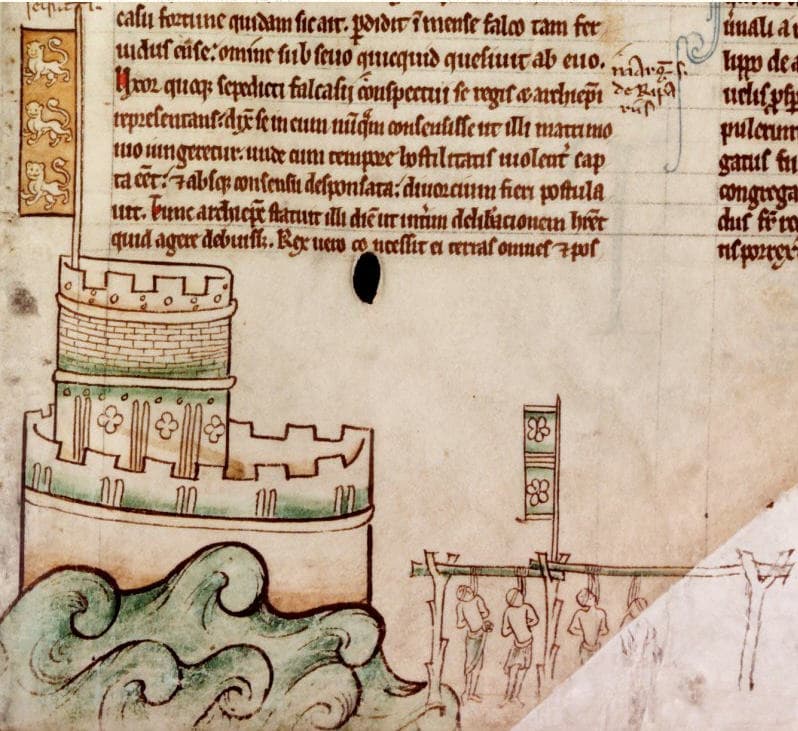
Bedford Castle
Bedford Castle stands as a significant relic of Norman military architecture in Bedford, England. Constructed shortly after 1100, this motte-and-bailey castle was strategically positioned overlooking the River Great Ouse, marking an important defensive and administrative site in the medieval town. The castle's origins reflect the typical Norman approach to fortification, initially featuring a wooden keep atop an earthen motte with an adjacent bailey enclosed by palisades.
The castle's early history is closely tied to the Beauchamp family, particularly Simon de Beauchamp, a royal castellan who controlled the fortress in the early 12th century. Following Simon's death in 1137, Bedford Castle became a focal point during the turbulent period known as the Anarchy (1135–1153), a civil war between King Stephen and Empress Matilda. The castle's military importance was underscored as it endured sieges and changed hands amid the conflict, reflecting the broader instability of England during this era.
The castle's expansion and 13th-century significance
In the early 13th century, Bedford Castle's role evolved during the First Barons' War (1215–1217), when William de Beauchamp rebelled against King John. The castle was seized in 1216 by Falkes de Bréauté, a loyalist commander rewarded with the Honour of Bedford. Falkes initiated extensive modifications, demolishing nearby churches to source stone for strengthening the castle's defenses. This transformation marked Bedford Castle's shift from a modest motte-and-bailey to a substantial stone fortress with a roughly quadrangular layout.
Architectural enhancements
Falkes' expansions included the construction of robust stone walls and the introduction of rare stone-lined ditches, an unusual defensive feature in England with few parallels such as Skenfrith Castle in Wales. The castle's motte, standing 7.5 meters high with a broad summit approximately 49 meters across, likely supported a shell keep, a circular stone wall enclosing a tower or courtyard, similar to those found at Launceston and Bungay castles. The inner bailey, situated in the southeast corner, was protected by a stone-lined palisade and ditch, enhancing the castle's defensive complexity.
A prominent barbican guarded the entrance, while a large stone gatehouse secured the outer bailey. A raised mound in the northeast corner probably supported a substantial tower, adding to the fortress's layered defenses. Within the inner bailey, the foundations of a great hall measuring at least 13 by 40 meters indicate the castle's role as a noble residence and administrative center. A postern watergate provided discreet access to the River Great Ouse, facilitating supply and communication during sieges.
The 1224 siege and destruction
Tensions between Falkes de Bréauté and King Henry III culminated in a major siege in 1224. The royal army deployed extensive siege equipment, including a trebuchet and several mangonels, to batter the castle's stone walls. After an eight-week siege, the defenders were overwhelmed by undermining tactics and a fire that severely damaged the keep. The garrison surrendered in mid-August, with most male defenders executed except for three knights who joined the Knights Templar.
Following the siege, King Henry III ordered the castle's demolition to prevent its future military use. The defensive ditches were filled in, and walls were reduced to half their height. William de Beauchamp was restored to control and built a non-fortified house on the site. Stones from the ruined castle were repurposed for local construction, including church rebuilding and possibly the town's first stone bridge, illustrating the castle's lasting material impact on Bedford's urban fabric.
Later history and archaeological legacy
Despite its destruction, Bedford Castle's motte remained a strategic site. During the English Civil War in the 1640s, a wooden fort and prison were erected atop the motte, housing about 100 soldiers. The castle grounds gradually became enveloped by urban development in the 19th century, with the last remnants of the barbican destroyed by the mid-1800s.
Archaeological investigations from 1969 to 2009 uncovered the castle's layout and physical remains, revealing industrial activity such as lime kilns used for mortar production in the early 1970s. The foundations of the great hall and other structures remain visible within an archaeological park established between 2007 and 2009. This park preserves key features of Bedford Castle, allowing visitors to appreciate its historical significance amidst the modern townscape.
Architectural features and layout
The castle's original motte-and-bailey design was enhanced over time into a complex stone fortress. The motte's summit likely supported a shell keep, a defensive innovation of the period, while the inner and outer baileys were fortified with stone walls and ditches. The presence of a barbican and a substantial gatehouse illustrates the layered defensive strategy. The postern watergate connecting to the River Great Ouse was a critical feature for resupply and escape routes during sieges.
Bedford Castle's stone-lined ditches are particularly noteworthy, representing a rare form of defense in England. These ditches, combined with the castle's robust walls and towers, made it a formidable stronghold until its destruction in the 13th century. The castle's evolution from a wooden motte-and-bailey to a stone fortress reflects broader trends in medieval castle architecture and military technology.
Historical significance and cultural impact
Throughout its history, Bedford Castle was a focal point of royal authority, noble rebellion, and military conflict. Its role during the Anarchy and the First Barons' War highlights its strategic importance in controlling the surrounding region. The castle's destruction by royal command underscores the shifting power dynamics of medieval England and the crown's efforts to consolidate control.
The reuse of castle stones in local buildings and infrastructure demonstrates the castle's enduring influence on Bedford's urban development. The archaeological park today serves as a cultural and educational resource, preserving the memory of Bedford Castle's medieval prominence and architectural innovation.
Frequently asked questions (FAQ)
- When was Bedford Castle originally built?
- Bedford Castle was constructed shortly after 1100 by the Normans as a motte-and-bailey fortress overlooking the River Great Ouse.
- What role did Bedford Castle play during the Anarchy?
- During the Anarchy (1135–1153), Bedford Castle was a contested stronghold, enduring sieges and changing hands between supporters of King Stephen and Empress Matilda.
- How was the castle expanded in the early 13th century?
- Falkes de Bréauté expanded Bedford Castle by demolishing nearby churches to reuse stone, strengthening its defenses with stone walls, stone-lined ditches, and constructing a large gatehouse and barbican.
- What happened during the 1224 siege of Bedford Castle?
- The castle was besieged for eight weeks by King Henry III's forces using trebuchets and mangonels, leading to the keep being burned and the garrison surrendering, after which the castle was ordered destroyed.
- Are there any remains of Bedford Castle today?
- Yes, archaeological excavations have uncovered foundations and features such as the motte, great hall, and defensive ditches, preserved within an archaeological park in Bedford.
Photo gallery

Photo by Matthew Paris•Public domain
Information
Loading map...
Visitor reviews
No reviews yet. Been here? Write the first review and help other travelers!
Write the first reviewVisited this castle? Share your experience
Your review helps other travelers and adds first-hand knowledge to our encyclopedia.


