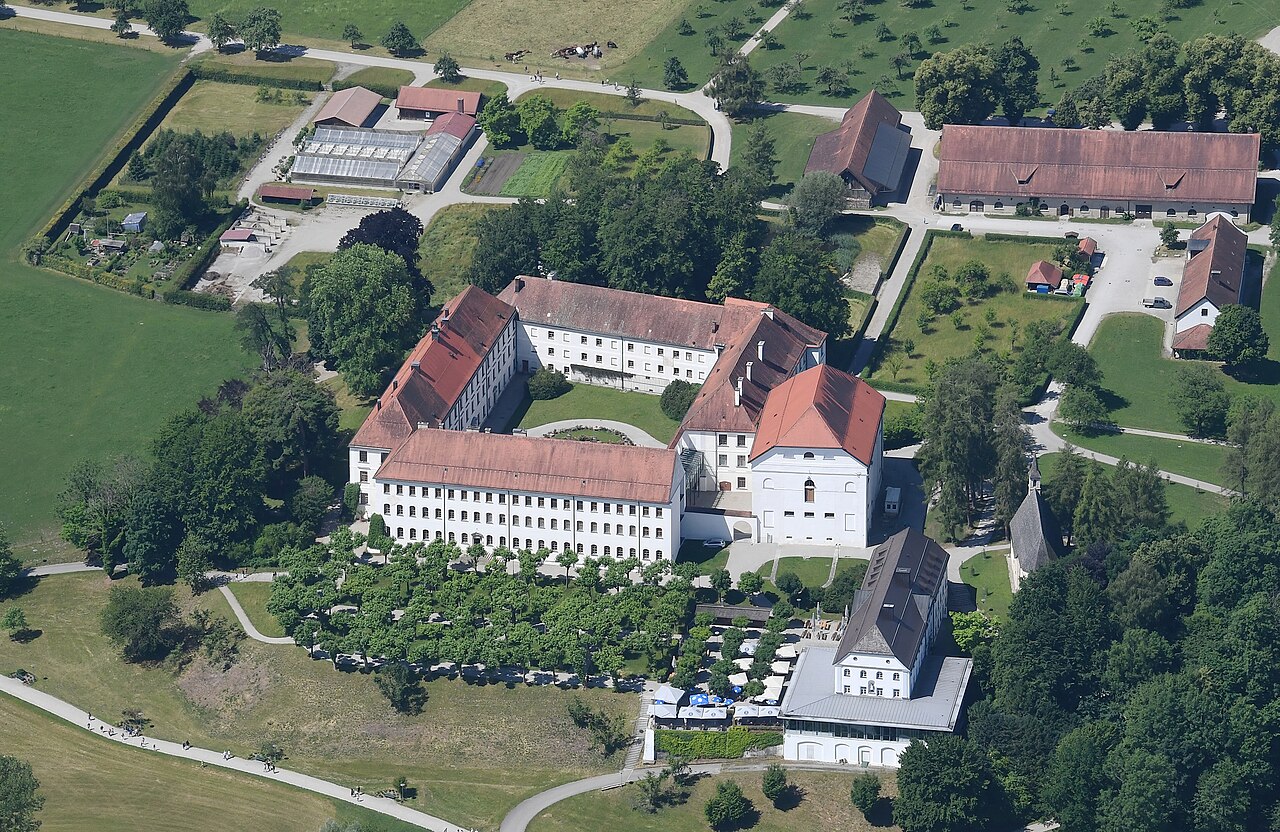
Baumburg Abbey
Baumburg Abbey was founded between 1107 and 1109 by Count Berengar II of Sulzbach as a fulfillment of his oath following the death of his wife, Adelheid von Megling-Frontenhausen. This foundation marked a significant moment in the religious and architectural history of the region. The abbey was established as a community of Augustinian canons, initially populated by canons relocated from the Berchtesgaden Provostry, which itself had been recently established with canons from Rottenbuch Abbey. Count Berengar appropriated lands from Berchtesgaden to support the new monastery, emphasizing the interconnected nature of ecclesiastical properties in the High Middle Ages.
Early history and ecclesiastical disputes
Shortly after its founding, around 1116, the first provost, Eberwin, returned to Berchtesgaden to restore it as an independent monastery. This separation sparked conflict with Baumburg's second provost, Gottschalk (circa 1120–1163), who opposed the detachment and viewed Eberwin as an 'apostate.' Gottschalk challenged the legality of the separation after Count Berengar's death in 1125 and appealed to Archbishop Conrad I of Salzburg for intervention. Despite arbitration in 1136 and papal confirmation by Pope Innocent II in 1142, the separation was upheld, illustrating the complex power dynamics between monasteries and ecclesiastical authorities in the High Medieval period.
Architectural development and religious significance
During Gottschalk's tenure, Baumburg Abbey saw important construction projects, including the consecration of a church dedicated to St. Nicholas in 1129 and the building of the Romanesque Basilica of St. Margaret in 1156. The Romanesque style is characterized by robust masonry, rounded arches, and symmetrical forms, which are evident in the basilica's design. The abbey's prominence grew when the Archbishop of Salzburg appointed the provost as an archdeacon, granting him ecclesiastical jurisdiction, oversight of church affairs, and asset management responsibilities. This role was confirmed by the Pope in 1185, underscoring Baumburg's importance within the church hierarchy.
Monastic functions and regional influence
The Augustinian canons of Baumburg primarily served as pastors, administering a network of parishes including Baumburg-Altenmarkt, Sankt Georgen, Truchtlaching, Traunwalchen, Neuenchieming, Kienberg, and Poing (now part of Truchtlaching), as well as partner churches and properties in Lower Austria. The abbey also operated a school that educated the sons of the regional nobility, highlighting its role as a center of learning and religious instruction.
Challenges and transformations in the late medieval and early modern periods
Like many monastic institutions, Baumburg Abbey experienced decline during the 15th century and the Protestant Reformation. It was placed under administration multiple times, including periods overseen by the provosts of Berchtesgaden Abbey and Höglwörth Abbey. The abbey suffered three devastating fires between 1523 and 1539, which severely affected its structures and community. By 1579, only three canons remained, signaling a near collapse of monastic life.
Revival and Baroque renovation
The abbey began to recover towards the end of the 16th century. The collegiate school regained its reputation among the nobility, and the number of canons increased. Starting around 1600, the monastery underwent a significant Baroque transformation. The medieval church was renovated, and its towers were crowned with characteristic onion domes, a hallmark of Bavarian Baroque ecclesiastical architecture. Provosts Michael Doegger (r. 1688-1706) and Patricius Stöttner (r. 1707-1737) led extensive reconstruction and new building projects, adapting the abbey to contemporary tastes and needs.
Rococo church and secularization
In 1755, to mark the 600th anniversary of the church's consecration, the architect Franz Alois Mayr from Trostberg designed the current church of St. Margareta in the Rococo style. The church features elaborate stucco filigrees and vibrant frescoes, typical of Rococo's ornate and playful aesthetic. This church remains a central architectural and cultural feature of the former abbey.
The abbey was secularized in 1803 under the Bavarian State's policies, leading to the auction of its buildings and properties in 1812. Many monastic buildings were demolished, but the collegiate church continued to serve as the parish church for Altenmarkt an der Alz. Since 1910, parts of the abbey have been repurposed: one wing serves as a parsonage, another was used as a convalescent home, and today it operates as a private seminar hotel frequently used by choirs and orchestras.
Baumburg Abbey brewery and legacy
The abbey's brewery, established in 1612, remains a notable legacy, now privately owned and continuing the tradition of monastic brewing. Baumburg Abbey stands as a testament to the religious, architectural, and cultural history of the region, reflecting the transitions from the High Medieval period through the Baroque and Rococo eras to modern times.
Frequently asked questions (FAQ)
- How do I get to Baumburg Abbey?
- Baumburg Abbey is easily accessible by car or public transportation. If you're traveling by car, it is located just off the A94 motorway, and there is parking available on-site. For public transport, you can take a train to Altenmarkt an der Alz and then a short bus ride to the abbey.
- What is the historical significance of Baumburg Abbey?
- Baumburg Abbey, founded in the 11th century, is a significant example of Romanesque architecture in Bavaria. It served as a center for education and culture throughout the Middle Ages. The abbey's rich history includes its role in the development of the surrounding community and its influence on monastic life in the region.
- When was Baumburg Abbey built?
- Construction of Baumburg Abbey began in 1073 and was completed over the following decades. The abbey has undergone several renovations and restorations, particularly in the 18th century, which have preserved its historical architecture. Today, visitors can admire elements from different architectural periods throughout the structure.
- Can I visit Baumburg Abbey year-round?
- Yes, Baumburg Abbey is open to visitors throughout the year, although opening hours may vary by season. It is recommended to check the official website for the latest information on visiting hours and any potential closures due to special events or renovations. Visiting in spring or summer offers a particularly beautiful experience due to the surrounding gardens.
- Why is Baumburg Abbey a popular tourist attraction?
- Baumburg Abbey attracts visitors with its stunning architecture, rich history, and serene surroundings. The abbey also hosts cultural events and exhibitions, making it a vibrant place for both history enthusiasts and casual tourists. Its picturesque location near the Alz River enhances its appeal as a destination.
- Is it possible to take guided tours of Baumburg Abbey?
- Yes, guided tours are available at Baumburg Abbey, offering an in-depth look at its history and architecture. These tours are led by knowledgeable guides who can provide fascinating insights into the abbey's significance. It is advisable to book in advance, particularly during peak tourist seasons.
- What are the ticket prices for visiting Baumburg Abbey?
- Ticket prices for Baumburg Abbey are typically affordable, with discounts available for students, seniors, and groups. Children under a certain age may enter for free. For the most accurate pricing, check the official website or inquire at the entrance upon arrival.
- What are the opening hours for Baumburg Abbey?
- Baumburg Abbey's opening hours may vary seasonally, but it generally opens daily from 9 AM to 5 PM. Extended hours may be available during the summer months. It's best to verify the current hours on their official website before planning your visit.
- What are some nearby attractions to Baumburg Abbey?
- In addition to the abbey itself, visitors can explore the charming town of Altenmarkt an der Alz, which features beautiful architecture and local shops. The picturesque Alz River offers opportunities for leisurely walks and picnics. Nearby attractions include the historical towns of Burghausen and Wasserburg am Inn, both rich in history and culture.
Information
Loading map...
Visitor reviews
No reviews yet. Been here? Write the first review and help other travelers!
Write the first reviewVisited this castle? Share your experience
Your review helps other travelers and adds first-hand knowledge to our encyclopedia.