Battenberg Castle Ruins
Battenberg Castle ruins stand as a testament to the medieval power and architectural ingenuity of the House of Leiningen in the 13th century. Situated on a steep hill spur known as the Leiningen spur at an elevation of 284 meters, this hill castle was strategically positioned to control access to the Eckbach valley alongside its counterpart, Neuleiningen Castle, located approximately 1,400 meters to the north. The castle's commanding location provided expansive views over the Rhine Plain, the Bergstraße, and the Odenwald regions, underscoring its military and territorial significance in the High Medieval period.
Historical context and lineage
The origins of Battenberg Castle are closely tied to Count Frederick III of Leiningen, who is credited with its construction in the 13th century atop the remains of an earlier structure associated with the Salian dynasty. The castle remained under the possession of the House of Leiningen for several centuries, serving as a key stronghold in the region known as Leiningerland. Its role as a protective bastion was particularly crucial during periods of conflict, such as the War of the Palatine Succession (1688–1697), during which it was destroyed by French troops in 1689.
Despite this destruction, parts of the castle were restored sufficiently to continue serving as a residence for the Leiningen family until 1747. The castle's military importance persisted into the late 18th century, notably during the First Coalition War in 1794, when Prussian forces under the future Prince Blücher expelled French revolutionary troops from the site. This event involved further military actions led by Generals Friedrich Wilhelm von Müffling and Joseph von Cloßmann, highlighting the castle's enduring strategic value.
Architectural features and fortifications
Site layout and defensive structures
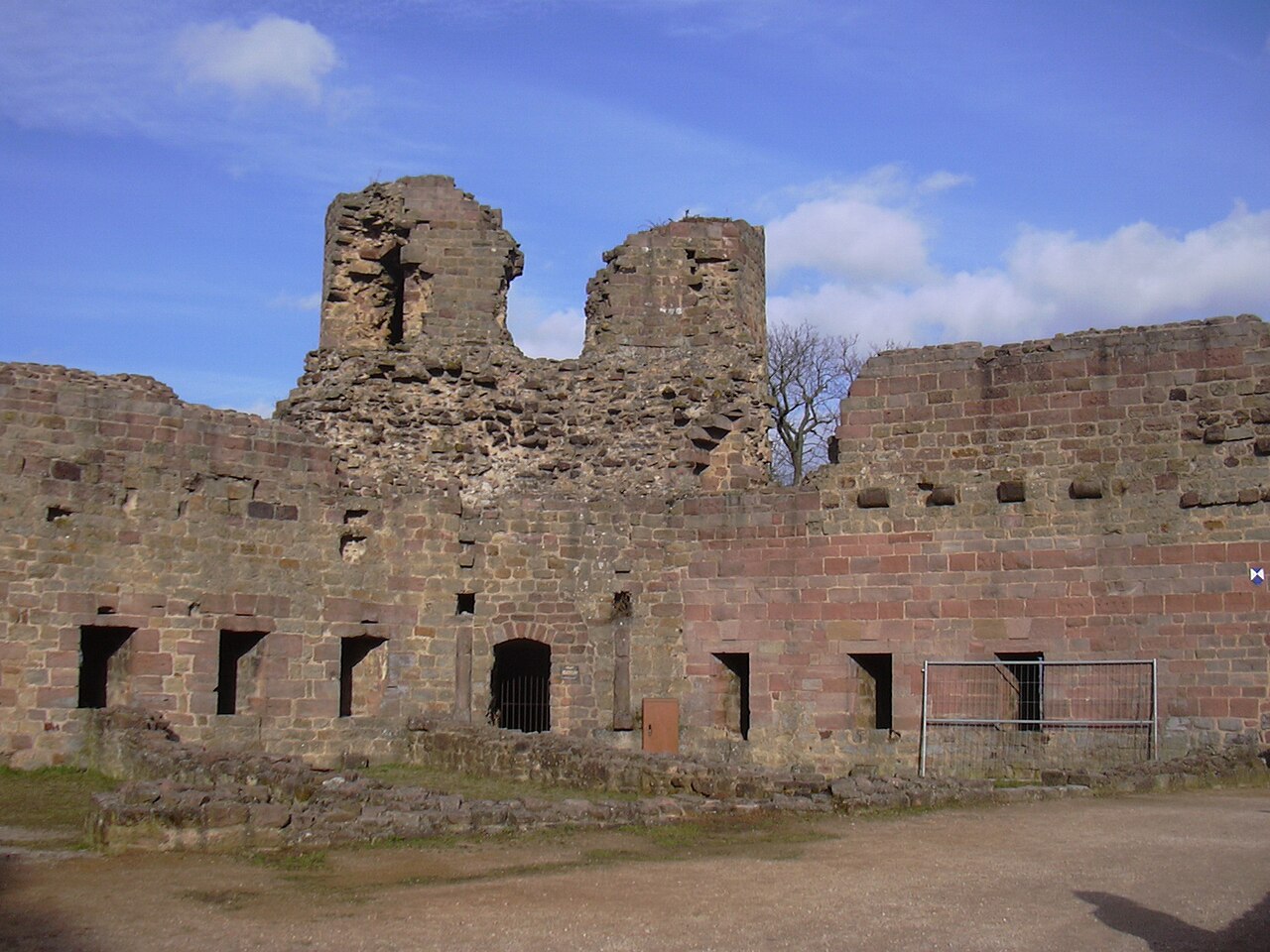
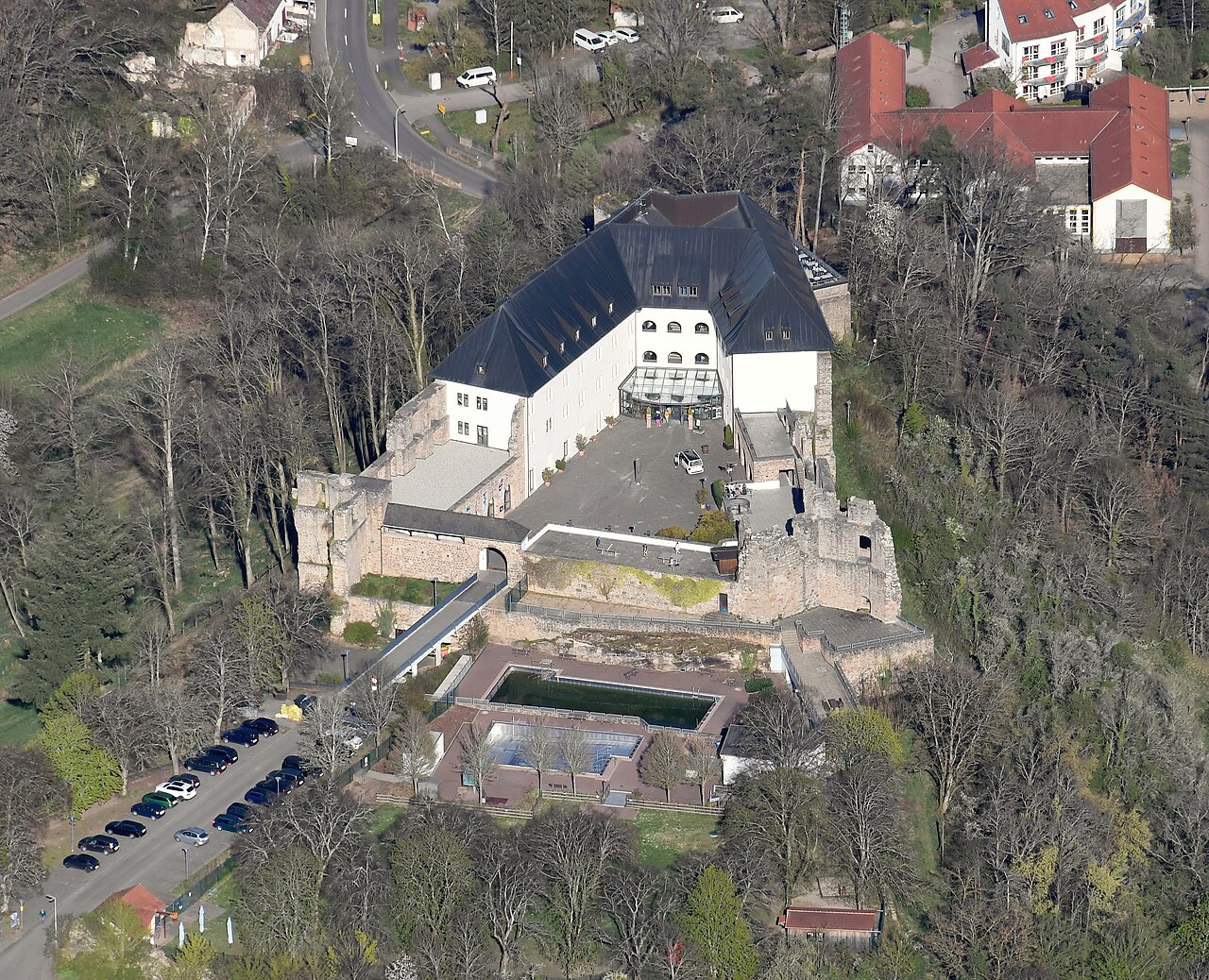
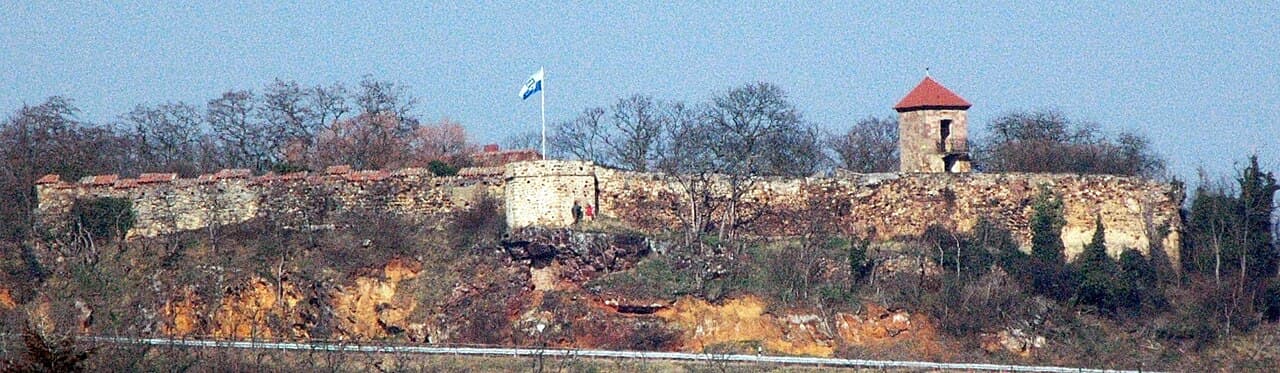
Battenberg Castle was ingeniously designed to exploit the natural topography of the hill spur, with steep drops on three sides providing formidable natural defenses. The fourth side was fortified with a moat, now completely filled in, enhancing the castle's protection. The perimeter was enclosed by robust curtain walls constructed from local stone, which have partially survived to the present day.
Key surviving defensive elements include a gate tower located near the northwest corner on the western curtain wall, marking the main entrance to the castle. On the southern side, a centrally positioned battery tower features an embrasure—an opening designed for artillery fire—reflecting adaptations to evolving military technology during the castle's active use.
Residential buildings and later additions
Within the eastern section of the castle ruins lie the vaulted cellar and foundations of a substantial residential building. Attached to this structure is a distinctive staircase tower dating from the 16th century. Originally a two-story tower, it was later modified to include a pavilion on the upper level facing east. An external iron staircase now connects this pavilion to a terrace occupying the former second-floor space of the residence.
A covered walkway runs along the inner side of the curtain walls, linking the terrace to the battery tower, facilitating movement within the fortified complex. Near the gatehouse, two 18th-century outbuildings remain, adapted for modern use but retaining their historical fabric. These contribute to the layered architectural history visible at the site.
Significant historical events and cultural heritage
Local tradition recounts a notable event in May 1693, when Marshal Tallard and General Mélac reportedly dined at Battenberg Castle while observing the burning of Heidelberg, a devastating fire caused by French forces during the War of the Palatine Succession. This episode highlights the castle's role not only as a military fortification but also as a vantage point during significant regional conflicts.
The castle's involvement in the First Coalition War further emphasizes its enduring military relevance. The expulsion of French revolutionary forces in 1794 underlines the strategic importance of Battenberg Castle well into the modern era of warfare.
Natural surroundings and geological features
The castle's elevated position offers panoramic views of the surrounding landscapes, including the Rhine Plain, the Bergstraße, and the Odenwald. Below the southern slope of the castle, visitors can observe the unique natural formations known as "Blitzröhren" or lightning pipes—ochre-colored sandstone columns formed through mineral-rich water sintering and erosion. These geological features are protected as a natural monument, adding a fascinating dimension to the castle's historical and environmental context.
Current status and visitor information
Today, Battenberg Castle exists as partially preserved ruins, privately owned but with limited public access. The surviving structures, including the curtain walls, gate tower, battery tower, vaulted cellar, and staircase tower, provide valuable insights into medieval castle architecture and the region's turbulent history.
The site remains an important cultural heritage landmark within the Rhineland-Palatinate region, attracting visitors interested in medieval history, architecture, and natural beauty. Its combination of historical significance, architectural remnants, and unique geological surroundings make Battenberg Castle a compelling destination for scholars and tourists alike.
Frequently asked questions (FAQ)
- How do I visit Battenberg Castle ruins?
- Battenberg Castle ruins are privately owned but offer limited public access. Visitors should check local resources or contact the municipality of Battenberg for current visiting hours and any guided tour availability.
- What is the historical significance of Battenberg Castle?
- Battenberg Castle was a strategic fortification built in the 13th century by the House of Leiningen. It controlled access to the Eckbach valley and played roles in the War of the Palatine Succession and the First Coalition War.
- What architectural features remain at Battenberg Castle?
- Surviving features include the outer curtain walls, a gate tower, a battery tower with embrasure, vaulted cellars, foundations of a large dwelling, and a 16th-century staircase tower.
- Is Battenberg Castle accessible for visitors with mobility issues?
- Due to the castle's hilltop location and ruinous condition, accessibility may be limited. Visitors with mobility concerns should inquire locally about the terrain and available accommodations before planning a visit.
- When is the best time to visit Battenberg Castle ruins?
- The best time to visit is during the warmer months from late spring to early autumn when weather conditions are favorable for exploring outdoor ruins and enjoying panoramic views.
Photo gallery

Photo by No machine-readable author provided. Palatinatian assumed (based on copyright claims).•CC BY-SA 2.5
Information
Sources & official resources
Verify the information above using these authoritative references.
Loading map...
Visitor reviews
No reviews yet. Been here? Write the first review and help other travelers!
Write the first reviewVisited this castle? Share your experience
Your review helps other travelers and adds first-hand knowledge to our encyclopedia.