Bastille
The Bastille, also known as Bastille Saint-Antoine, was a prominent medieval fortress located in Paris, France. It served as a key defensive structure and later as a state prison under the French monarchy. The fortress played a significant role in the internal conflicts of France and became an enduring symbol of the French Revolution after it was stormed by a revolutionary crowd on 14 July 1789.
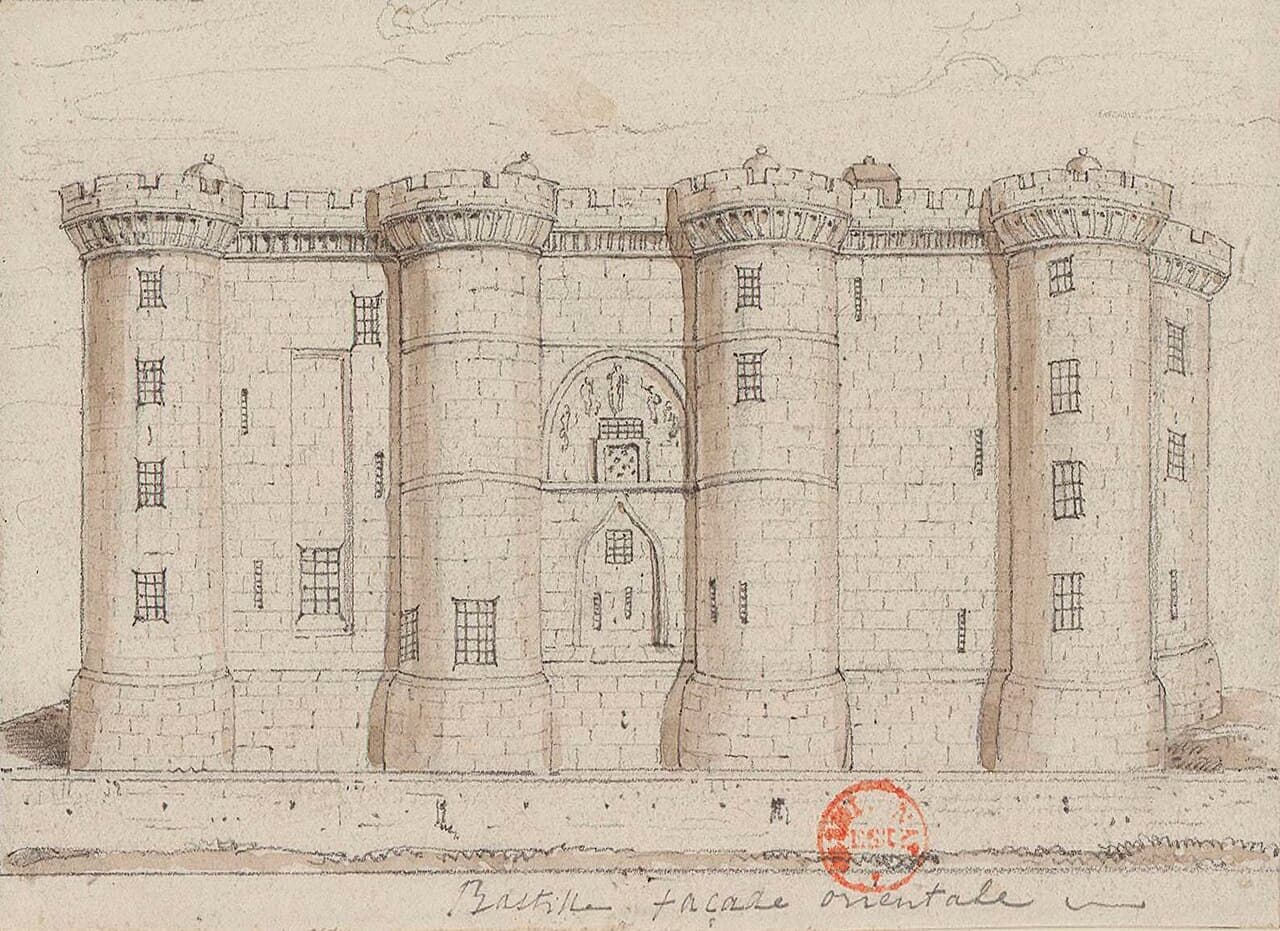
Constructed initially during the Hundred Years' War, the Bastille was built to protect the eastern entrance to Paris from potential English invasions. Although construction began by 1357, the main phase of building occurred from 1370 onwards. The fortress featured a robust design with eight towers encircling the stronghold, guarding the strategic Porte Saint-Antoine gateway. This innovative architectural style influenced fortification designs in both France and England, reflecting the evolving military engineering of the Late Medieval period.
Architectural design and fortifications
The Bastille's design was notable for its massive stone walls and the integration of multiple defensive towers, which provided overlapping fields of fire and strong resistance against siege weaponry. The fortress was surrounded by a moat, enhancing its defensive capabilities. In response to increasing threats, especially during the Wars of Religion in the 16th century, the Bastille's defenses were further strengthened with the addition of a bastion on its eastern side during the 1550s. This bastion was designed to counter artillery attacks and reflected the transition in military architecture towards accommodating gunpowder weaponry.
The Bastille's position guarding the Faubourg Saint-Antoine made it a focal point during various conflicts, including the Burgundian-Armagnac civil wars in the 15th century and the Fronde rebellion in the mid-17th century. The Battle of the Faubourg St Antoine in 1652 saw fighting directly beneath its walls, underscoring its strategic military importance.
Role as a state prison
Declared a state prison in 1417, the Bastille became a symbol of royal authority and political repression. Its use as a penitentiary expanded under the English occupation during the 1420s and 1430s and was further developed under King Louis XI in the 1460s. By the reign of Louis XIV, the Bastille primarily housed members of the upper class who had fallen out of favor with the monarchy, including French Protestants after the revocation of the Edict of Nantes.
From 1659 onward, the fortress functioned mainly as a state penitentiary. By the time of the French Revolution, it had processed over 5,200 prisoners. Under Louis XV and Louis XVI, the Bastille's role expanded to detain a broader range of prisoners and to support the Parisian police, particularly in enforcing censorship of printed materials. Despite relatively good conditions compared to other prisons of the era, the Bastille attracted criticism during the 18th century, amplified by memoirs and autobiographies from former inmates. These critiques led to reforms and a reduction in prisoner numbers before the revolution.
The storming of the bastille and its legacy
The storming of the Bastille on 14 July 1789 was a pivotal event in the French Revolution. The fortress was targeted primarily for its stockpile of gunpowder, essential for the revolutionary forces. The crowd, largely composed of residents from the nearby Faubourg Saint-Antoine, overwhelmed the defenders, freeing the seven remaining prisoners and killing the fortress's governor, Bernard-René de Launay.
Following the storming, the Bastille was ordered to be demolished by the revolutionary government. Its stones were repurposed, and souvenirs were distributed throughout France as symbols of the overthrow of despotism. The site was transformed into the Place de la Bastille, a public square that remains a significant landmark in Paris.
Though almost no physical structures remain today beyond some relocated foundation stones near Boulevard Henri IV, the Bastille's historical and cultural significance endures. In the 19th century, historians reassessed the fortress, recognizing it as a relatively well-administered institution of political control rather than the brutal prison often depicted in popular imagination.
Historical impact and cultural symbolism
The Bastille has been deeply embedded in French political culture and revolutionary symbolism. Its fall marked the beginning of widespread republican movements and inspired numerous political protests and works of literature. The fortress's legacy continues to influence French national identity, commemorated annually on Bastille Day, a national holiday celebrating liberty and the republic.
Frequently asked questions (FAQ)
- What is the historical significance of the Bastille?
- The Bastille was originally built as a fortress in the late 14th century and later became a state prison used by the kings of France. It is famously known for its storming on July 14, 1789, which marked the beginning of the French Revolution and symbolized the fight against tyranny.
- When was the Bastille demolished?
- The Bastille was stormed on July 14, 1789, and subsequently demolished by the citizens of Paris shortly thereafter. Its destruction represented the end of absolute monarchy in France and the rise of the people's power.
- Can I visit the Bastille today?
- While the original structure of the Bastille no longer exists, you can visit the Place de la Bastille, which commemorates its historical significance. The area features the July Column and is surrounded by cafes and shops, making it a great spot to reflect on its legacy.
- What are the opening hours for the Bastille area?
- The Place de la Bastille is open to the public at all times, allowing visitors to explore the site whenever they wish. Nearby attractions, such as the Opéra Bastille, have their own specific opening hours, so it's best to check in advance.
- Is it possible to learn more about the Bastille's history?
- Yes, visitors can learn more about the Bastille's history at various museums and exhibitions in Paris, including the Carnavalet Museum, which focuses on the history of Paris. Guided tours are also available that delve into the Bastille's significance during the French Revolution.
- What is the best time to visit the Bastille area?
- The best time to visit the Bastille area is during spring (April to June) or early fall (September to October) when the weather is mild and the crowds are smaller. These seasons also allow for pleasant outdoor exploration of the surrounding area.
- Are there any nearby attractions to the Bastille?
- Yes, there are several nearby attractions, including the Opéra Bastille and the picturesque Canal Saint-Martin. Additionally, the Marais district is just a short walk away, offering charming streets, boutiques, and cafes.
- What are the ticket prices for nearby attractions?
- Many attractions near the Bastille, such as the Place de la Bastille itself, are free to visit. However, some nearby sites like the Opéra Bastille may have ticket prices ranging from €10 to €100 depending on the performance and seating selection.
- How do I get to the Bastille from central Paris?
- You can easily reach the Bastille area using public transportation, such as the Paris Métro, by taking Line 1 or Line 5 to the Bastille station. Buses and trams also serve the area, making it convenient for visitors coming from various parts of the city.
Photo gallery

Photo by AnonymousUnknown author•Public domain
Information
Loading map...
Visitor reviews
No reviews yet. Been here? Write the first review and help other travelers!
Write the first reviewVisited this castle? Share your experience
Your review helps other travelers and adds first-hand knowledge to our encyclopedia.