Bamburgh Castle
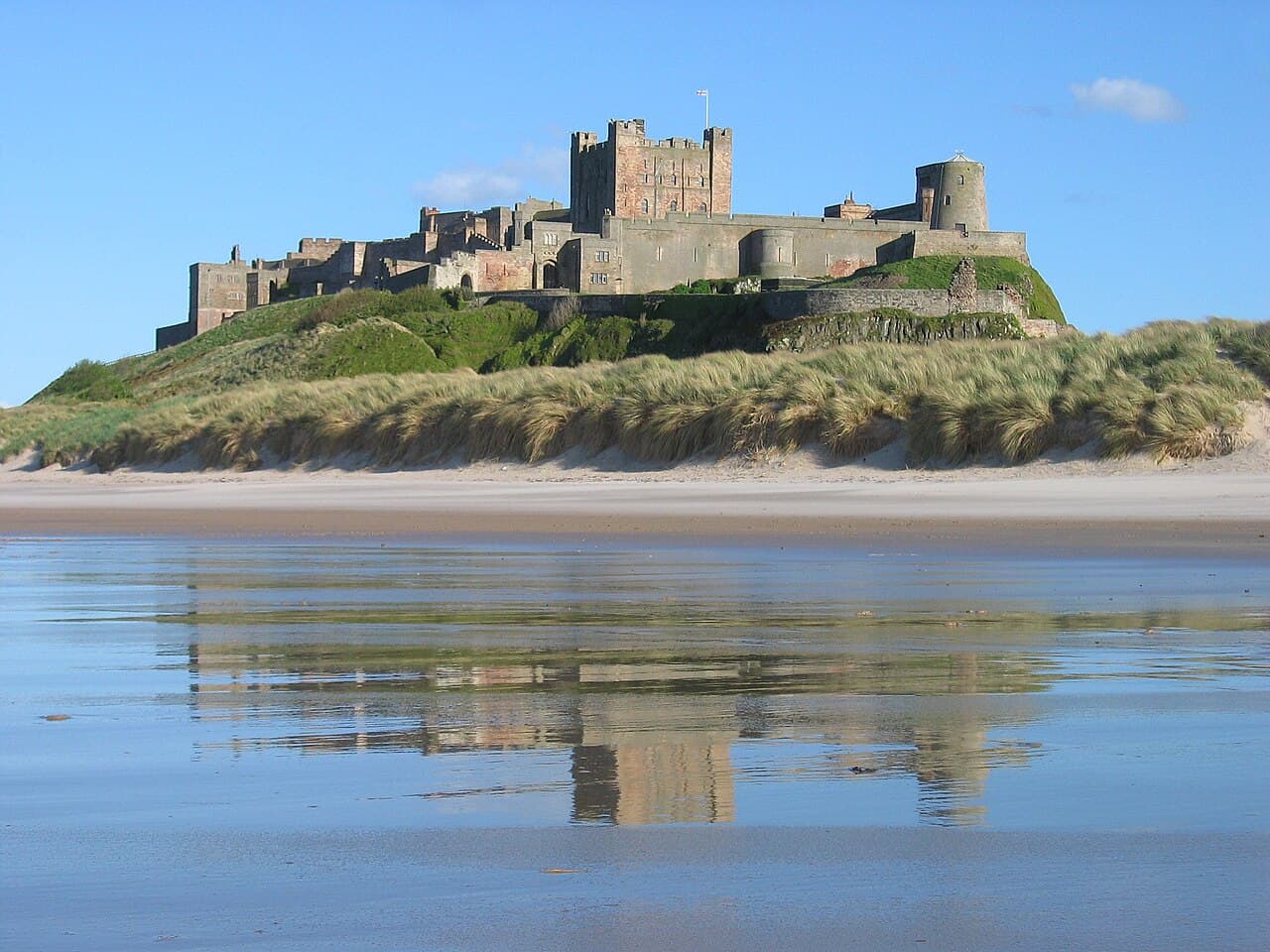
Bamburgh Castle stands majestically on a volcanic dolerite crag overlooking the dramatic coastline of Northumberland, England. With a history spanning over 1,400 years, this iconic hill castle has evolved from an ancient Celtic Brittonic fort into a formidable Norman fortress and royal palace. Its strategic location atop a steep plateau provided commanding views over the North Sea and the surrounding landscape, making it a vital stronghold throughout various historical periods.
Early history and origins
The site of Bamburgh Castle was originally home to a Celtic Brittonic fort known as Din Guarie, which may have served as the capital of the kingdom of Bernicia from around 420 to 547 AD. This early fortification was a significant center of power for the native Britons before the arrival of the Anglo-Saxons. The first recorded mention of the site dates to 547 AD when King Ida of Bernicia captured the fort and established it as his seat of power, marking the beginning of Anglo-Saxon dominance in the region.
Control of Bamburgh shifted multiple times between the native Britons and the Anglo-Saxons until 590 AD, when the Anglo-Saxons secured permanent control. Around 600 AD, Æthelfrith, King of Bernicia, passed the fort to his wife Bebba, giving rise to the early name Bebbanburh, meaning “Bebba’s stronghold.” This name highlights the site's importance in early medieval Northumbria and its role as a royal residence.
Norman conquest and medieval fortification
The original fort was destroyed by Viking raiders in 993 AD, necessitating a new phase of construction. Following the Norman Conquest of England in 1066, a new castle was built on the site, forming the core of the present structure. This Norman castle was designed as a robust stone fortress, replacing earlier wooden fortifications and reflecting the architectural advances of the period.
In 1095, during a rebellion led by Robert de Mowbray, the castle was besieged by King William II but resisted capture until Robert was taken prisoner. The castle's defense was famously maintained by Robert’s wife, who surrendered only under threat to her husband's life. This event underscores Bamburgh’s strategic and symbolic importance in medieval England.
King Henry II likely commissioned the construction of the castle’s massive keep, completed by 1164. This keep, with walls up to 3.5 meters thick, remains the heart of Bamburgh Castle today. The keep served as a formidable defensive structure and royal residence, embodying the military architecture of the high medieval period.
Role in english and scottish conflicts
Due to its proximity to the Scottish border, Bamburgh Castle became a crucial English outpost. In the 14th century, it notably held King David II of Scotland prisoner following the Battle of Neville’s Cross in 1346. The castle also played a central role during the Wars of the Roses in the 15th century, serving as a stronghold for the Lancastrian King Henry VI.
During the Wars of the Roses, Bamburgh endured a nine-month siege in 1464 by Richard Neville, Earl of Warwick, known as the "Kingmaker," who supported the Yorkist cause. This siege is historically significant as the first English castle to be defeated by artillery bombardment, marking a turning point in military technology and castle defense.
Post-medieval decline and restoration
Following the union of the English and Scottish crowns in 1603 under King James I, Bamburgh’s military importance waned. The castle passed into private hands for the first time, but its vast size and upkeep costs led to deterioration and partial ruin.
In the 18th century, restoration efforts were initiated by trustees including Dr. John Sharp, who refurbished the keep and courtrooms and established a hospital and free school within the castle grounds. These efforts helped preserve the site during a period of neglect.
In 1894, the castle was purchased by Victorian industrialist William Armstrong, a pioneering engineer and inventor. Armstrong undertook extensive restoration work, employing architect C.J. Ferguson to rebuild the castle using squared sandstone and ashlar masonry. This restoration, completed by 1904, transformed Bamburgh from a ruin into a habitable family residence and preserved its architectural grandeur.
Architectural features and interior highlights
Bamburgh Castle’s architecture reflects its long history and various phases of construction. The Norman keep remains the oldest and most imposing part, with walls up to three and a half meters thick. The castle’s robust defensive walls, towers, and gatehouses showcase medieval military design adapted to the natural volcanic rock foundation.
The King’s Hall is one of the castle’s most remarkable interior spaces. Built on the site of the medieval Great Hall, it features a magnificent false hammer beam ceiling crafted from teak donated by the King of Siam during the Victorian restoration. Although visually medieval, this ceiling is a 19th-century addition that enhances the hall’s grandeur without serving a structural purpose.
The castle’s interiors also house a rich collection of furniture, tapestries, and porcelain, reflecting centuries of ownership and royal patronage. The Armstrong family’s personal collection includes artifacts from various historical periods, enhancing the castle’s cultural significance.
Within the castle, the Armstrong and Aviation Artefacts Museum exhibits weaponry, engines, and military memorabilia from both World Wars, linking the site’s medieval military heritage with more recent history.
Archaeological discoveries and heritage significance
Extensive archaeological excavations at Bamburgh and the nearby Bowl Hole burial ground have revealed significant early medieval artifacts. Notable finds include the Bamburgh Beast, a rare gold plaque, and the Bamburgh Sword, both dating from the Anglo-Saxon period. These discoveries highlight Bamburgh’s role as a major center of power and culture in early medieval England.
The Bowl Hole cemetery, excavated between 1998 and 2007, contained the remains of 120 individuals from diverse geographic origins including Ireland, Scotland, Scandinavia, the Mediterranean, and North Africa. This diversity illustrates the wide-ranging connections of the community around Bamburgh during the 7th and 8th centuries.
In 2016, these remains were respectfully reinterred in the crypt of St Aidan’s Church in Bamburgh, which remains accessible to visitors, preserving a tangible link between the castle, its early inhabitants, and the local community.
Modern status and visitor experience
Today, Bamburgh Castle remains a well-preserved historic site owned by the Armstrong family. It is a Grade One listed building recognized as one of England’s finest castles. The castle is divided into private apartments but is open to the public year-round, offering visitors a rich experience of history, architecture, and stunning coastal scenery.
Visitors can explore the castle’s extensive grounds, including its imposing keep, medieval courtrooms, and the beautifully restored King’s Hall. The surrounding landscape features vast sandy beaches and dunes, forming a natural habitat for local wildlife and enhancing the castle’s appeal as a destination for cultural tourism and nature appreciation.
Bamburgh Castle has also served as a popular filming location for numerous historical films such as Ivanhoe, El Cid, Mary Queen of Scots, and Elizabeth, further cementing its place in popular culture.
Frequently asked questions (FAQ)
- How do I get to Bamburgh Castle?
- Bamburgh Castle is easily accessible by road, located just off the A1 trunk road in Northumberland. The nearest train station is in Berwick-upon-Tweed, which is about 15 miles away, and from there, you can take a bus or taxi to the castle.
- What is the historical significance of Bamburgh Castle?
- Bamburgh Castle has a rich history dating back to the 6th century, originally serving as a royal fortress for the Kings of Northumbria. It played a crucial role in the region's defense against Viking invasions and later became a symbol of English heritage.
- When was Bamburgh Castle built?
- The current structure of Bamburgh Castle was built in the 12th century, although the site has been fortified since the early medieval period. It has undergone various renovations and restorations throughout the centuries, reflecting architectural changes and historical events.
- Can I visit Bamburgh Castle year-round?
- Yes, Bamburgh Castle is open to visitors throughout the year, but it's always best to check the official website for specific opening times as they can vary by season. During the winter months, hours may be reduced, and certain areas may be closed for maintenance.
- Why is Bamburgh Castle a popular tourist attraction?
- Bamburgh Castle is renowned for its stunning coastal views, impressive architecture, and rich history, making it a must-see destination for tourists. Its dramatic setting against the backdrop of the North Sea adds to its allure, attracting visitors interested in both history and natural beauty.
- Is it possible to access all areas of Bamburgh Castle?
- While many areas of Bamburgh Castle are open to the public, some sections may have restricted access due to preservation efforts or safety concerns. However, the main attractions, including the keep, museum, and gardens, are accessible to visitors.
- What are the ticket prices for Bamburgh Castle?
- Ticket prices for Bamburgh Castle vary, with discounts available for children, seniors, and families. It is advisable to purchase tickets online in advance to secure the best rates and avoid long queues on busy days.
- What is the best time to visit Bamburgh Castle?
- The best time to visit Bamburgh Castle is during the spring and summer months when the weather is generally milder and the gardens are in full bloom. Additionally, many events and activities are scheduled during this period, enhancing the visitor experience.
- Are there any nearby attractions to visit along with Bamburgh Castle?
- Yes, in addition to Bamburgh Castle, visitors can explore the nearby Grace Darling Museum, which celebrates the life of the famous lighthouse keeper's daughter, and the beautiful Bamburgh Beach. The Northumberland Coast Area of Outstanding Natural Beauty is also close by, offering stunning landscapes and walking trails.
Photo gallery

Information
Website
Visit websiteSources & official resources
Verify the information above using these authoritative references.
Loading map...
Visitor reviews
No reviews yet. Been here? Write the first review and help other travelers!
Write the first reviewVisited this castle? Share your experience
Your review helps other travelers and adds first-hand knowledge to our encyclopedia.