Lindisfarne Castle
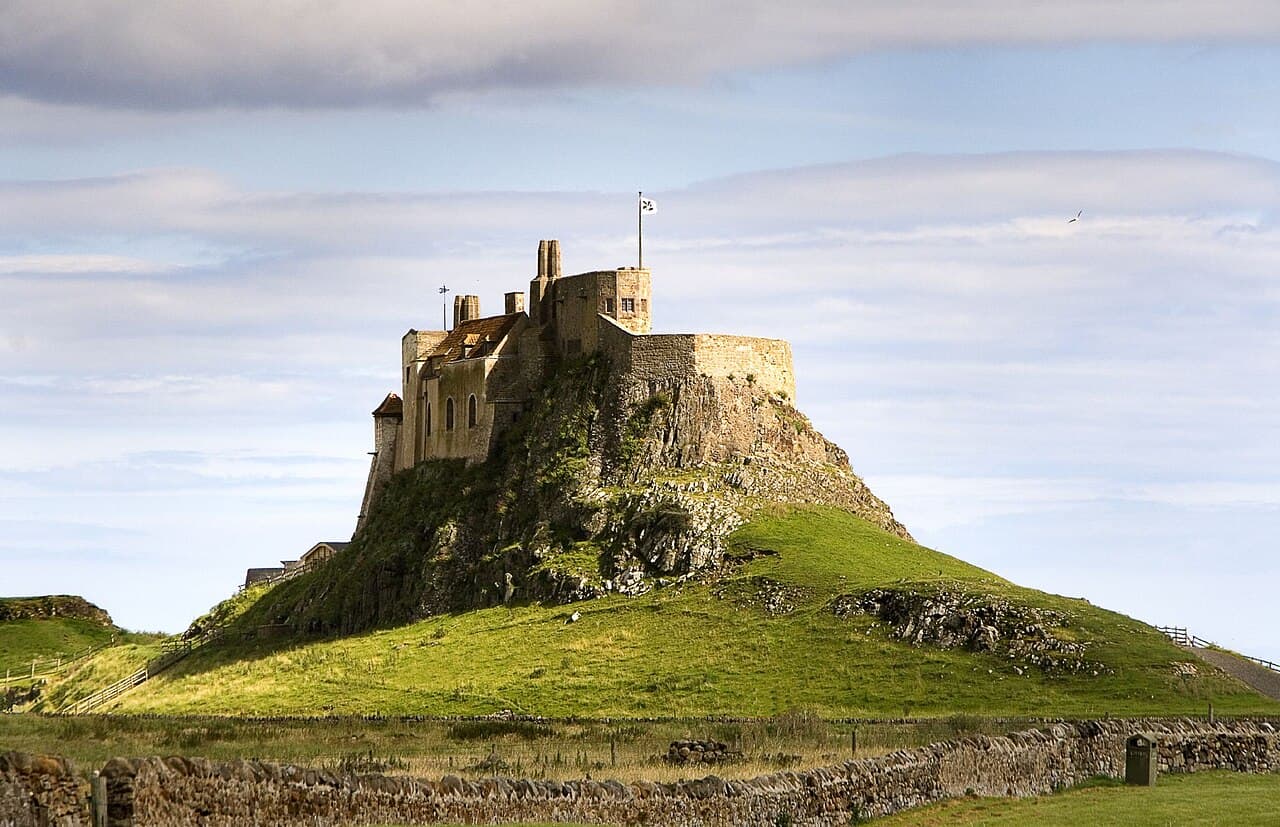
Lindisfarne Castle stands prominently on Beblowe Crag, the highest point of Holy Island, Northumberland, England. This 16th-century Tudor artillery fort was originally built to defend the island's natural harbour and the volatile Anglo-Scottish border during the Renaissance period. Today, it is renowned for its remarkable transformation by the celebrated architect Sir Edwin Lutyens in the early 20th century, who converted the fortress into an Edwardian country mansion while preserving much of its historic character.
The castle's strategic location on a steep, rocky outcrop rising 30 meters above sea level offers commanding views over the North Sea and surrounding landscape. Accessible only at low tide via a tidal causeway, Holy Island's isolation has long contributed to the castle's defensive importance. The site’s history is deeply intertwined with centuries of border conflicts, including frequent Viking raids and battles between England and Scotland.
Early history and military significance
The origins of Lindisfarne Castle date back to the mid-1500s, shortly after the Dissolution of Lindisfarne Priory under Henry VIII in 1537. Stones from the dissolved priory were repurposed to build initial fortifications. In 1542, Henry VIII ordered the Earl of Rutland to strengthen the site against Scottish invasion, and by 1547 the fort was armed with artillery, including a wheel-mounted demi-culverin and brass sakers. However, the first fortifications on Beblowe Crag itself were modest earth and timber works built in 1548.
By 1561, these early defenses had deteriorated, prompting Elizabeth I to commission a more substantial stone fortification. Construction began in 1565 and completed by 1571, costing over £1,000. This new fortification was designed primarily to house artillery to protect the island’s harbour and deter Scottish incursions. Despite the union of the English and Scottish crowns under James VI and I in 1603, the castle remained an active military site, manned and armed through the 17th and 18th centuries.
Role during the civil war and jacobite uprising
During the English Civil War, Lindisfarne Castle was held by Parliamentary forces and witnessed military activity, including a notable landing by Charles I in 1639. The castle's governor, Captain Rugge, was known for his hospitality despite the tense political climate. Later, in 1715, the castle was briefly captured by Jacobite rebels during their uprising. The garrison was small, and the rebels took advantage by posing as civilians to gain entry. However, the castle was quickly retaken by government troops, and the rebels escaped after hiding near nearby Bamburgh Castle.
Architectural features and edwardian transformation
Lindisfarne Castle is relatively small compared to other castles, reflecting its primary function as a coastal artillery fort rather than a grand residence. The original Tudor fortifications include turf ramparts, stone gun platforms, and vaulted chambers designed to support heavy artillery above. The castle’s masonry combines locally quarried whinstone with stones salvaged from the priory ruins, integrating natural rock formations with man-made structures.
In 1901, Edward Hudson, founder of Country Life magazine, leased the castle and commissioned Sir Edwin Lutyens to convert it into a summer home. Lutyens’ design is a masterful blend of the castle’s Tudor military origins with the Arts and Crafts movement aesthetics, emphasizing rustic simplicity and harmony with the landscape. He added a new upper floor by filling in gaps in the original structure to create additional bedrooms and a long gallery, inspired by Elizabethan and Jacobean precedents but on a more intimate scale.
The castle’s interior reflects a striking contrast between the austere Tudor fort and the warm, inviting Edwardian living spaces. The entrance hall features large stone pillars reminiscent of a church nave and a bare stone floor. The kitchen retains a large stone fireplace and a scullery with the original portcullis mechanism. The dining room boasts a vaulted ceiling, a large fireplace with an old bread oven, Neo-Gothic traceried windows, and walls painted in rich Prussian blue. Adjacent to it, the ship room is named for a large model Dutch ship suspended from the vaulted ceiling and contains dark wood furniture and faded upholstered seating.
The gardens and landscape
Approximately 500 meters from the castle lies the walled garden, originally a garrison vegetable plot. Between 1906 and 1912, it was redesigned by the renowned horticulturist Gertrude Jekyll, a frequent collaborator of Lutyens. The garden’s layout is an asymmetrical rectangle with a rounded corner and features a planting scheme restored in the early 21st century to Jekyll’s original plans. Unique garden sheds made from upturned herring fishing boats, known as herring busses, contribute to the site’s distinctive character. After two sheds were lost to arson in 2005, replacements were installed in 2006, with a third shed renovated by the National Trust.
Modern stewardship and visitor experience
The castle, gardens, and nearby lime kilns have been under the care of the National Trust since 1944. It is open to visitors, who typically begin their tour at the reception hut at the foot of Beblowe Crag. From there, visitors ascend a steep cobbled path to the castle’s only external entrance on the south side. Inside, a flight of steps leads to the Lower Battery with its gun emplacements, forming a forecourt to the castle.
The castle’s layout is an L-shape, with a passage carved through the living rock leading to the vaulted dining room and the ship room. A curving stone staircase ascends to the upper floors, including the Long Gallery and bedrooms added by Lutyens. The upper battery offers spectacular coastal views. Visitors can also explore the restored walled garden and enjoy the unique blend of military history and Edwardian domesticity.
Major restoration work was completed between 2016 and 2018, ensuring the preservation of both the castle’s historic fabric and its Edwardian features. The site continues to attract historians, architectural enthusiasts, and tourists drawn by its dramatic setting and fascinating history.
Cultural significance and legacy
Lindisfarne Castle’s unique combination of Tudor military architecture and Edwardian Arts and Crafts design has made it an iconic landmark in Northumberland. Its dramatic location on Holy Island, accessible only by a tidal causeway, adds to its mystique and appeal. The castle has influenced architectural designs beyond its immediate context, inspiring elements such as the Scottish Parliament Building in Edinburgh, designed by Enric Miralles, who drew inspiration from Lutyens’ use of upturned boats as garden sheds.
Today, Lindisfarne Castle stands as a testament to the layered history of the Anglo-Scottish border region, the evolution of military architecture, and the early 20th-century revival of historic buildings for residential use. Its preservation by the National Trust ensures that future generations can appreciate its rich heritage and architectural splendor.
Frequently asked questions (FAQ)
- How do I get to Lindisfarne Castle?
- Lindisfarne Castle is located on Holy Island and is accessible from the mainland via a tidal causeway at low tide. Visitors should check tide times before planning their visit to avoid being stranded.
- What is the historical significance of Lindisfarne Castle?
- Lindisfarne Castle was built in the 16th century to defend the volatile Anglo-Scottish border and later served as a Tudor artillery fort. It was transformed into an Edwardian country home by Sir Edwin Lutyens in the early 20th century.
- Can I visit the gardens at Lindisfarne Castle?
- Yes, the walled garden designed by Gertrude Jekyll is open to visitors and has been restored to reflect her original planting plans from the early 20th century.
- When is Lindisfarne Castle open to visitors?
- The castle is generally open daily from 10:00 to 16:00, but visitors should check the National Trust website for seasonal variations and special closures.
- Is Lindisfarne Castle suitable for families?
- Yes, the castle and its grounds offer an engaging historical experience suitable for families, including accessible paths, a garden to explore, and informative displays.
Photo gallery

Information
Opening hours
10:00-16:00, daily
Ticket prices
£8 adult, £4 child
Architect
Sir Edwin Lutyens
Current owner
National Trust
Website
Visit websiteSources & official resources
Verify the information above using these authoritative references.
Loading map...
Visitor reviews
No reviews yet. Been here? Write the first review and help other travelers!
Write the first reviewVisited this castle? Share your experience
Your review helps other travelers and adds first-hand knowledge to our encyclopedia.