Ballynahow Castle
Ballynahow Castle is a notable 16th-century Renaissance tower house located in County Tipperary, Ireland. Recognized as a National Monument, it represents a significant example of Irish fortified residences from the late medieval period transitioning into the Renaissance era. The castle stands as a testament to the architectural and social changes occurring in Ireland during the 16th century.
Historical context and significance
Constructed in the 16th century, Ballynahow Castle was built during a period when tower houses were commonly erected by the Irish gentry and Anglo-Irish lords. These structures served both as fortified residences and symbols of status. The Renaissance influence in Ireland, although more subtle than on the continent, began to appear in architectural details and the layout of such castles, reflecting changing tastes and the desire for greater comfort alongside defense.
Ballynahow Castle's designation as a National Monument underscores its importance in Irish heritage. It provides valuable insight into the living conditions, defensive strategies, and architectural trends of the time. The tower house form was widespread across Ireland, but each example has unique features that relate to its local context and the specific needs of its builders.
Architectural features of Ballynahow Castle
Structure and design
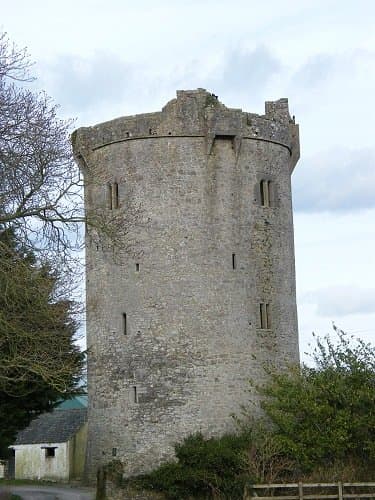
The castle is primarily a tower house, a type of fortified residence characterized by a vertical emphasis and compact footprint. Ballynahow Castle rises several stories, with thick stone walls designed to withstand attack. The building's footprint is rectangular, typical of tower houses, with defensive features integrated into its design.
Key architectural elements include narrow slit windows used for archery defense, a crenellated parapet at the roofline for protection during sieges, and a strong entrance door reinforced for security. Inside, the castle would have contained a great hall, living quarters, and storage areas, arranged vertically across floors connected by a spiral staircase.
Defensive features
Ballynahow Castle's defensive design reflects the turbulent political and social environment of 16th-century Ireland. The thick stone walls and limited window openings minimized vulnerabilities. The elevated entrance, often accessed by removable ladders or stairs, added an extra layer of security.
Additionally, the castle likely included features such as murder holes above the main entrance to defend against attackers, and possibly a bawn or walled courtyard for livestock and additional protection, although specific details about these are not well documented.
The Renaissance influence in Irish tower houses
While primarily functional, Ballynahow Castle exhibits elements influenced by Renaissance architectural trends. This includes more refined stonework and possibly decorative features around windows and doorways, signaling a shift towards aesthetics alongside military utility.
This period saw Irish noble families adopting continental styles to demonstrate their sophistication and align themselves with broader European cultural movements. However, the Renaissance influence in Ireland was often blended with traditional Gothic and medieval forms, creating a distinctive hybrid style evident in Ballynahow Castle.
Preservation and current condition
Today, Ballynahow Castle is classified as a well-preserved example of a Renaissance tower house. Its status as a National Monument ensures protection and recognition by the Irish government. Visitors can observe the castle's stone walls, defensive features, and overall structure, which remain largely intact despite centuries of exposure to weather and historical events.
Efforts to maintain the castle focus on preserving its structural integrity and preventing further decay. The site is accessible to the public, offering a tangible connection to Ireland's medieval and Renaissance past.
Visiting Ballynahow Castle
Located in County Tipperary, Ballynahow Castle can be reached by road from nearby towns. While specific visitor facilities may be limited due to its rural setting, the castle provides a compelling destination for those interested in Irish history, medieval architecture, and Renaissance influences.
Visitors should prepare for outdoor walking and bring appropriate footwear. The castle's remote location offers a peaceful environment to explore the remnants of Ireland's fortified residences.
Architectural and cultural legacy
Ballynahow Castle contributes to the broader understanding of tower houses in Ireland, which number in the thousands but vary widely in form and preservation. Its Renaissance features mark it as part of an important transitional phase in Irish castle architecture.
The castle also reflects the social history of the Irish gentry during the 16th century, illustrating how architecture served both defensive needs and social aspirations. Ballynahow Castle remains a valuable cultural asset, linking modern Ireland with its complex medieval and early modern heritage.
Frequently asked questions (FAQ)
- What is Ballynahow Castle and where is it located?
- Ballynahow Castle is a 16th-century Renaissance tower house located in County Tipperary, Ireland. It is designated as a National Monument.
- Can visitors explore the interior of Ballynahow Castle?
- While the castle is well preserved externally, access to the interior may be limited for safety reasons. Visitors can view the structure and its defensive features from outside.
- How do I get to Ballynahow Castle?
- Ballynahow Castle is located in County Tipperary, accessible by local roads. Visitors should use a car or local transport to reach the rural site.
- What are the key architectural features of Ballynahow Castle?
- Key features include thick stone walls, narrow slit windows for defense, a crenellated parapet, and a vertical tower house design typical of 16th-century Irish fortified residences.
- Why is Ballynahow Castle significant in Irish history?
- The castle exemplifies the transition from medieval to Renaissance architecture in Ireland and reflects the social and defensive needs of the Irish gentry in the 16th century.
Photo gallery

Information
Loading map...
Visitor reviews
No reviews yet. Been here? Write the first review and help other travelers!
Write the first reviewVisited this castle? Share your experience
Your review helps other travelers and adds first-hand knowledge to our encyclopedia.