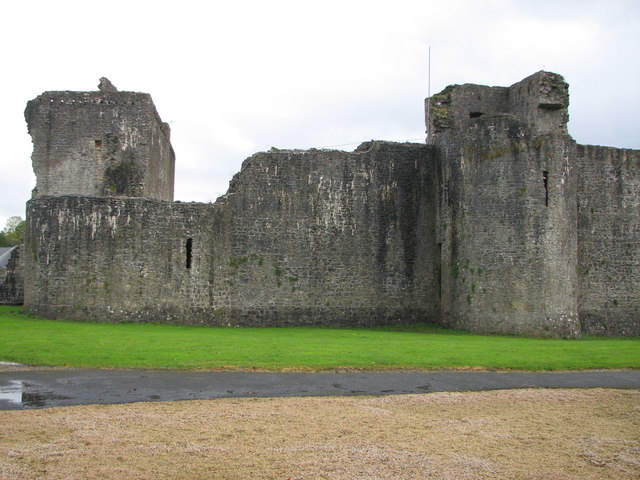
Ballymote Castle
Ballymote Castle is a remarkable example of a late medieval Norman fortress located in Carrownanty, Ballymote, in the province of Connacht, Ireland. Constructed around 1300 by Richard Óg de Burgh, 2nd Earl of Ulster—also known as the Red Earl—the castle was strategically built to secure newly acquired lands in County Sligo. It is distinguished as the last major Norman castle erected in Connacht, reflecting the military and architectural innovations of the period.
The castle is a large, rectangular keepless enclosure castle, notable for its symmetrical layout and imposing defensive features. Its design shares strong architectural affinities with Beaumaris Castle in Anglesey, Wales, a masterpiece of Edward I’s castle-building campaign. Ballymote’s thick curtain walls, measuring approximately three meters in thickness, enclose an interior courtyard roughly 30 square meters in area, emphasizing a balance between defense and internal space.
Architectural design and defensive features
The castle’s north entrance is marked by a formidable gatehouse flanked by twin D-shaped towers, which provided defenders with commanding fields of fire along the approach. Though much of the outer gatehouse has been lost to time, the surviving structures still convey the strength of its original design. The castle’s perimeter is reinforced by six towers: three-quarter round towers at each corner and additional towers at the midpoint of the east and west curtain walls. These towers allowed defenders to cover all angles and protect the walls effectively.
Within the thickness of the walls, narrow passages approximately three feet wide connect the towers and curtain walls. These passages facilitated the rapid movement of soldiers during attacks and provided protected routes for communication and defense. Although no internal domestic buildings remain, the castle’s robust fortifications and strategic layout highlight its primary role as a military stronghold rather than a residential palace.
A postern gate was planned for the south wall, accompanied by a small square tower, but construction was halted, likely due to the turbulent events of 1317 when the castle was captured by the O'Connors. This incomplete feature underscores the castle’s turbulent history and the ongoing conflicts in the region during the early 14th century.
Historical significance and ownership through the centuries
Ballymote Castle played a pivotal role in the power dynamics of medieval Connacht. Initially built by the Anglo-Norman de Burgh family to consolidate control, it frequently changed hands due to the shifting allegiances and conflicts characteristic of Irish medieval politics. In 1317, the castle fell to the O'Connors, a powerful Gaelic dynasty, marking the beginning of a series of transfers among prominent Irish families.
By 1347, the castle was under the control of the Mac Diarmada family, and by 1381 it had passed to the Mac Donaghs. The 16th century saw the castle in the possession of Tadhg MacDermot, the last ruler of Moylurg, before returning to the O'Connors by 1571, a tenure later ratified by King James I.
The late 1500s were marked by intense conflict as English forces sought to assert dominance over Connacht. The castle was briefly seized in 1577 and firmly controlled by Governor Richard Bingham in 1584. It endured a raid in 1588 by Irish clans including the O’Connor, O’Hart, and O’Dowd families. In 1598, it was surrendered to the Mac Donaghs and soon sold to Red Hugh O’Donnell, a key Gaelic leader who used Ballymote as a military base before the Battle of Kinsale in 1601.
By 1602, the castle had fallen into disrepair and was surrendered to English forces. The 17th century saw fluctuating ownership: the Taaffe family briefly held it from 1633, but it was seized by rebels during the 1641 Irish uprisings. Oliver Cromwell’s forces captured the castle in 1652 during their campaign in Ireland. Later, during the Williamite Wars, it was held for King James II by Captain Terence MacDonagh but was overcome by Williamite artillery in 1690. Following this, its defenses were dismantled, leading to its gradual decline into ruin.
Current condition and preservation efforts
Today, Ballymote Castle stands as an evocative ruin, retaining significant portions of its stone curtain walls and towers. The castle’s imposing silhouette continues to dominate the landscape, offering insight into the military architecture of the late medieval period in Ireland. Partial restoration work undertaken by the Irish Office of Public Works has helped stabilize the structure and preserve its historical integrity.
The castle remains an important cultural and heritage site, attracting visitors interested in Ireland’s Norman past and medieval fortifications. While no internal buildings survive, the layout and surviving defensive features provide a clear understanding of the castle’s original form and function.
Local legends and archaeological notes
Local folklore tells of underground tunnels linking Ballymote Castle to nearby religious sites such as Emlaghfad church and a Franciscan abbey. However, archaeological investigations have found no evidence to support these tales, classifying them as legend rather than fact. Nonetheless, such stories contribute to the castle’s mystique and cultural significance in the region.
Architectural comparisons and influences
Ballymote Castle’s design is often compared to Beaumaris Castle, built by King Edward I of England. Both castles share the keepless enclosure style, characterized by strong curtain walls and multiple towers without a central keep. This architectural approach reflects evolving military strategies in the late medieval period, emphasizing perimeter defense and overlapping fields of fire.
The castle’s symmetrical plan and robust towers illustrate the advanced Norman military engineering of the time. Its construction techniques and defensive features provide valuable insights into the adaptation of Norman castle design to the Irish landscape and political context.
Visiting information and accessibility
Ballymote Castle is accessible to the public, offering a fascinating glimpse into Ireland’s medieval heritage. Visitors can explore the ruins and appreciate the scale and sophistication of the fortress. While the site is primarily an outdoor ruin, it is advisable to wear suitable footwear due to uneven terrain. Interpretation panels and guided tours may be available seasonally, enhancing the visitor experience.
The castle’s location near the town of Ballymote makes it a convenient destination for those interested in Irish history and Norman architecture. Nearby attractions include other medieval sites and natural landscapes typical of County Sligo.
Best time to visit
The most favorable time to visit Ballymote Castle is during the late spring to early autumn months when weather conditions are mild. This period offers the best opportunity to explore the ruins comfortably and enjoy the surrounding scenery.
Information
Loading map...
Visitor reviews
No reviews yet. Been here? Write the first review and help other travelers!
Write the first reviewVisited this castle? Share your experience
Your review helps other travelers and adds first-hand knowledge to our encyclopedia.