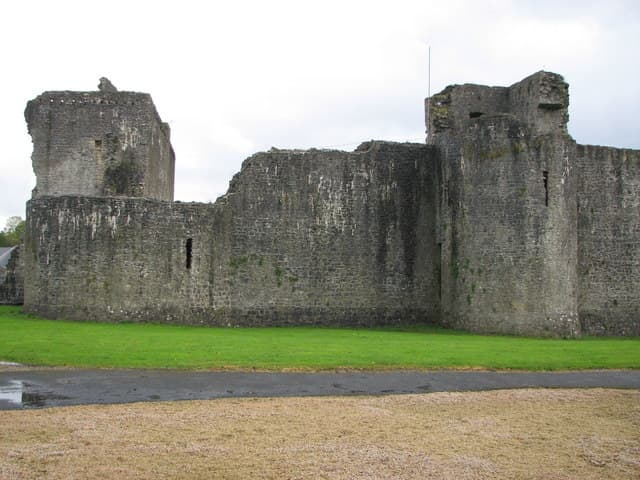
Ballymote Castle
Ballymote Castle (Irish: Caisleán Bhaile an Mhóta) is a significant example of a high medieval Norman fortress located in County Sligo, Ireland. Constructed around the 13th century, specifically circa 1300, this large rectangular keepless castle stands on the outskirts of the town of Ballymote in the townland of Carrownanty. The castle occupies a strategic position historically known as Átha Cliath an Chorainn, meaning "The Ford of the Hurdles of Corann," reflecting its importance in controlling local river crossings and routes.
Historical context and purpose
Ballymote Castle represents the last of the Norman castles established in the province of Connacht. It was likely commissioned by Richard Óg de Burgh, 2nd Earl of Ulster, also known as the Red Earl, to consolidate and protect the extensive territories he had recently acquired in County Sligo. This construction was part of a broader Norman strategy to fortify their holdings in western Ireland during the turbulent high medieval period.
The castle replaced earlier fortifications such as the motte-and-bailey structures common in the initial Norman incursions. Its location some distance from an earlier motte indicates a shift toward more permanent and defensible stone castles that could serve as administrative centers as well as military strongholds.
Architectural features and layout
Ballymote Castle is notable for its rectangular plan and the absence of a central keep, which is unusual for Norman castles of this era. Instead, the castle's defense relied on robust curtain walls and corner towers, which provided comprehensive coverage of the perimeter. The walls are constructed of locally sourced stone, exhibiting the typical thick and high masonry designed to withstand siege engines and assaults.
The castle includes a gatehouse that controlled access and was likely equipped with defensive features such as a portcullis and murder holes. Inside, the courtyard would have contained essential buildings such as barracks, storerooms, and a great hall for administrative and residential purposes. The keepless design suggests a focus on communal defense and possibly a more advanced layout for garrison and lordly functions.
Defensive innovations
Unlike many earlier Norman castles featuring a dominant keep or donjon, Ballymote's design reflects evolving military architecture trends of the late 13th century. The reliance on strong curtain walls and well-positioned towers allowed defenders to cover all approaches effectively. The castle's elevated position on a hill provided natural defensive advantages, enhancing visibility and control over the surrounding landscape.
Role in regional history
Throughout its history, Ballymote Castle played a pivotal role in the power struggles of Connacht. It served as a base for the de Burgh family and their successors, who were influential Norman lords in Ireland. The castle witnessed various conflicts, including local Gaelic resistance and later English crown efforts to maintain control over Ireland.
Its strategic location near important routes and river crossings made it a valuable military asset. Over the centuries, the castle's military significance declined, but it remained a symbol of Norman authority in the region.
Preservation and current condition
Today, Ballymote Castle stands as a partially preserved medieval ruin. While much of the original structure remains, including significant portions of the curtain walls and towers, some areas have deteriorated due to centuries of exposure and limited restoration. The site is accessible to visitors interested in medieval architecture and Irish history.
Efforts to maintain the castle focus on preserving its structural integrity and enhancing public understanding of its historical importance. Interpretive signage and guided tours help contextualize the castle within the broader narrative of Norman expansion in Ireland.
Visiting Ballymote Castle
The castle is located just outside the town of Ballymote, making it easily reachable for tourists exploring County Sligo. Visitors can explore the ruins and enjoy panoramic views of the surrounding countryside from the elevated site. The castle's setting offers insight into medieval defensive strategies and Norman settlement patterns in Ireland.
Nearby attractions
County Sligo is rich in historical and natural sites, including other Norman castles, ancient monuments, and scenic landscapes. Visitors to Ballymote Castle often combine their trip with visits to nearby heritage sites and the vibrant town center of Ballymote.
Frequently asked questions (FAQ)
- What is the historical significance of Ballymote Castle?
- Ballymote Castle is a 13th-century medieval fortress that played a crucial role in the history of Ireland, particularly during the medieval period. It served as a strategic stronghold for the Anglo-Normans and was later associated with various Irish clans, making it a site of cultural and historical importance.
- When was Ballymote Castle built?
- Ballymote Castle was constructed in the late 12th century, around 1200 AD. Its design reflects the architectural styles of the time, showcasing the defensive structures typical of Norman castles.
- Can I visit Ballymote Castle?
- Yes, Ballymote Castle is open to visitors who wish to explore its historic ruins and learn about its rich history. While there are no formal guided tours, informative signs are placed around the site to enhance your visit.
- What are the opening hours for Ballymote Castle?
- Ballymote Castle is generally open year-round, allowing visitors to enjoy the site at any time of the day. However, it is recommended to check local resources for any seasonal variations or events that may affect access.
- Is it possible to access Ballymote Castle with mobility aids?
- Ballymote Castle has uneven terrain and some steep surfaces, which may pose challenges for visitors with mobility aids. However, the site is partially accessible, and visitors are encouraged to explore at their own pace while taking necessary precautions.
- What is the best time to visit Ballymote Castle?
- The best time to visit Ballymote Castle is during the spring and summer months when the weather is milder and the landscape is lush. This period also offers longer daylight hours, providing ample time to explore the grounds and enjoy the surroundings.
- Are there any nearby attractions to visit?
- Yes, Ballymote Castle is located near several attractions, including the picturesque town of Ballymote and the scenic landscapes of County Sligo. Visitors can also explore other historical sites and enjoy local culture and hospitality in the area.
- What are the ticket prices for visiting Ballymote Castle?
- There is no entrance fee to visit Ballymote Castle, making it a free attraction for all visitors. Donations are appreciated to help maintain the site and support local heritage initiatives.
Photo gallery

Information
Loading map...
Visitor reviews
No reviews yet. Been here? Write the first review and help other travelers!
Write the first reviewVisited this castle? Share your experience
Your review helps other travelers and adds first-hand knowledge to our encyclopedia.



