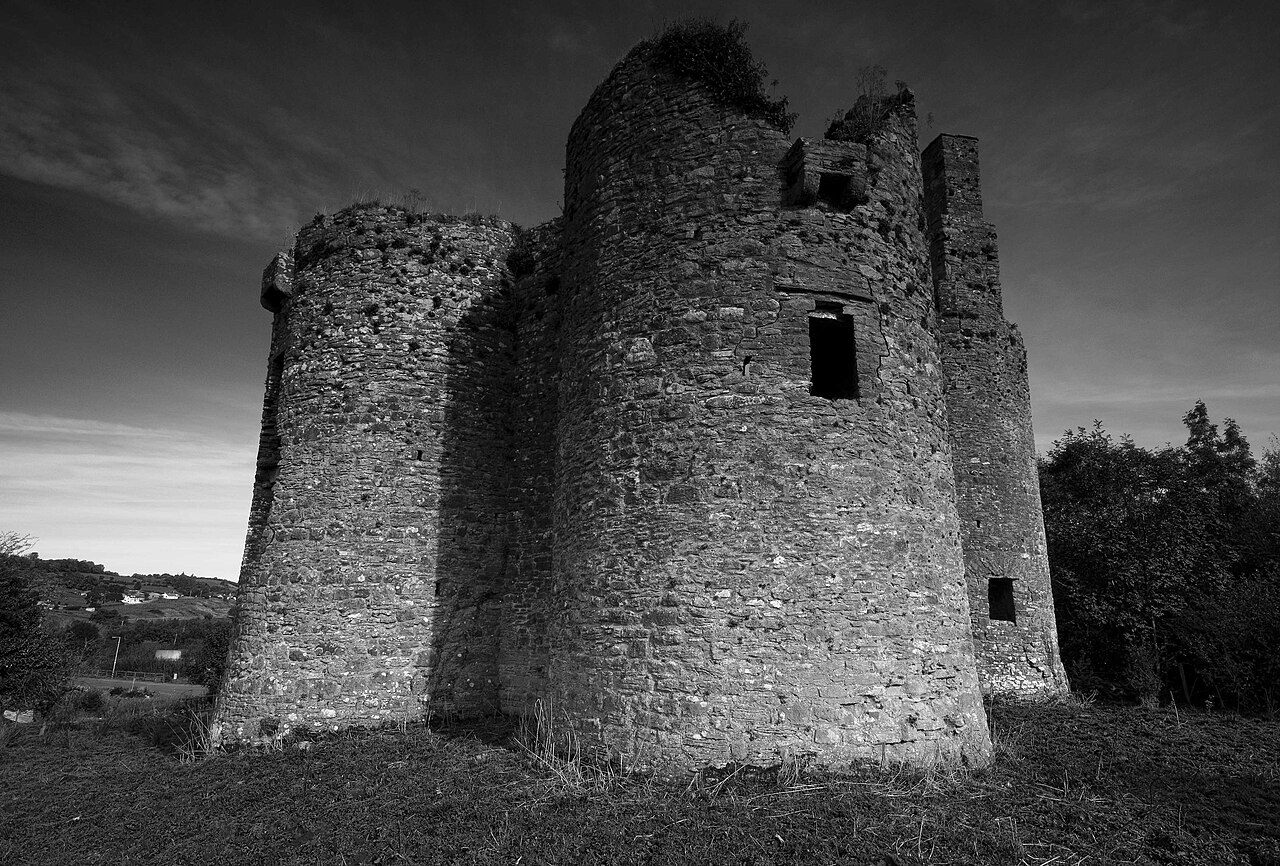
Ballinafad Castle
Ballinafad Castle is a notable example of a 16th-century Elizabethan blockhouse located in the scenic region of Northern Ireland, near the village of Ballinafad. Constructed during the turbulent Nine Years' War (1593–1603), it was strategically positioned to control a vital mountain pass through the Curlew Hills overlooking Lough Arrow. This fortress reflects the military architecture and political struggles of the late Renaissance period in Ireland.
The castle was built in 1590 by Captain John St. Barbe, an English soldier granted the land by King James VI and I. Its primary function was to secure English control over this strategic route during a period of intense conflict between English forces and Irish Gaelic lords. The small garrison of about ten men maintained a presence here, underscoring the castle's role as a tactical outpost rather than a large-scale fortress.
Historical context and military significance
The construction of Ballinafad Castle came at a time when English authorities were consolidating power in Ireland. The Nine Years' War was a defining conflict pitting Gaelic Irish chieftains, notably Hugh Roe O'Donnell, against English expansion. In 1595, the castle was partially destroyed during an assault led by O'Donnell, highlighting its strategic importance and the fierce resistance it faced.
Later, during the Wars of the Three Kingdoms in 1641–1642, Ballinafad Castle was besieged again amid widespread unrest across Ireland, Scotland, and England. The defenders endured a siege that ultimately forced surrender due to lack of water. Following these events, the castle gradually fell into disuse and was abandoned by around 1680, marking the end of its active military role.
Architectural features and layout
Ballinafad Castle exemplifies the design of Elizabethan blockhouses of the late 16th century, characterized by a compact, defensible plan. The fortress is built around a small courtyard enclosed by four massive corner towers. These towers are distinctive for their rounded exterior walls that curve inward toward the courtyard, creating a unique inward-facing shape uncommon in other contemporary fortifications.
The castle originally rose to three stories, with three of the corner towers housing square chambers for various practical uses. The northern tower was uniquely designed with a round interior and contained a wooden spiral staircase providing access to the roof and upper defensive positions. The main entrance was located on the first-floor level of the northwestern wall, a defensive feature that complicated direct assault by attackers.
Constructed primarily from local stone, the castle's walls remain largely intact despite centuries of decay. Visitors today can view the interior through openings in the walls, which have been secured with iron grilles to protect the ruins. The castle sits atop a hill, offering commanding views of the surrounding landscape, including Lough Arrow and the marshy Carrick-na-Shannon area, emphasizing its original role in controlling the surrounding territory.
Current condition and visitor information
Today, Ballinafad Castle stands as a ruined fortress and a designated National Monument in Ireland. The ruins are accessible year-round, with no entrance fees or guided tours available. Visitors can park in a small car park at the foot of the hill and follow a pathway leading to the castle entrance, which is secured by an iron gate.
While entry into the castle interior is not permitted for safety reasons, the structure can be appreciated from the exterior and through the iron-grilled breaches in the walls. Interpretive signage near the site provides historical context for visitors, enhancing the educational experience of this evocative military relic.
The legacy of Ballinafad Castle
Ballinafad Castle remains a poignant symbol of the Elizabethan military presence in Ireland and the broader geopolitical struggles of the late 16th and early 17th centuries. Its architectural form offers valuable insights into Renaissance military design adapted to the Irish landscape and the challenges of frontier warfare.
As a preserved ruin, the castle continues to attract historians, architects, and visitors interested in Ireland's turbulent past and the evolution of fortification architecture. Its commanding hilltop location and distinctive blockhouse design make it a notable example of defensive construction during a formative period in Irish history.
Visitors to Ballinafad Castle not only encounter the physical remnants of a bygone era but also gain an appreciation for the complex history of English-Irish relations and the enduring legacy of conflict and cultural exchange that shaped the region.
Frequently asked questions (FAQ)
- How do I get to Ballinafad Castle?
- Ballinafad Castle is located near the village of Ballinafad in Northern Ireland. Visitors can reach the site by car and park in a small car park at the foot of the hill. From there, a pathway leads up to the castle ruins.
- What is the historical significance of Ballinafad Castle?
- Ballinafad Castle was built in 1590 during the Nine Years' War to control a strategic mountain pass in the Curlew Hills. It played a key role in English military efforts to secure the region against Irish Gaelic forces.
- Can I enter Ballinafad Castle?
- Entry into the castle interior is not permitted due to safety concerns. However, visitors can view the ruins from outside and through iron-grilled openings in the walls.
- When was Ballinafad Castle built?
- Ballinafad Castle was constructed in 1590 under the command of Captain John St. Barbe during the Elizabethan era.
- Is there an entrance fee to visit Ballinafad Castle?
- There is no entrance fee to visit Ballinafad Castle. The ruins are open to the public year-round with no guided tours available.
Information
Address
Castle View, United Kingdom of Great Britain and Northern Ireland
Loading map...
Visitor reviews
No reviews yet. Been here? Write the first review and help other travelers!
Write the first reviewVisited this castle? Share your experience
Your review helps other travelers and adds first-hand knowledge to our encyclopedia.