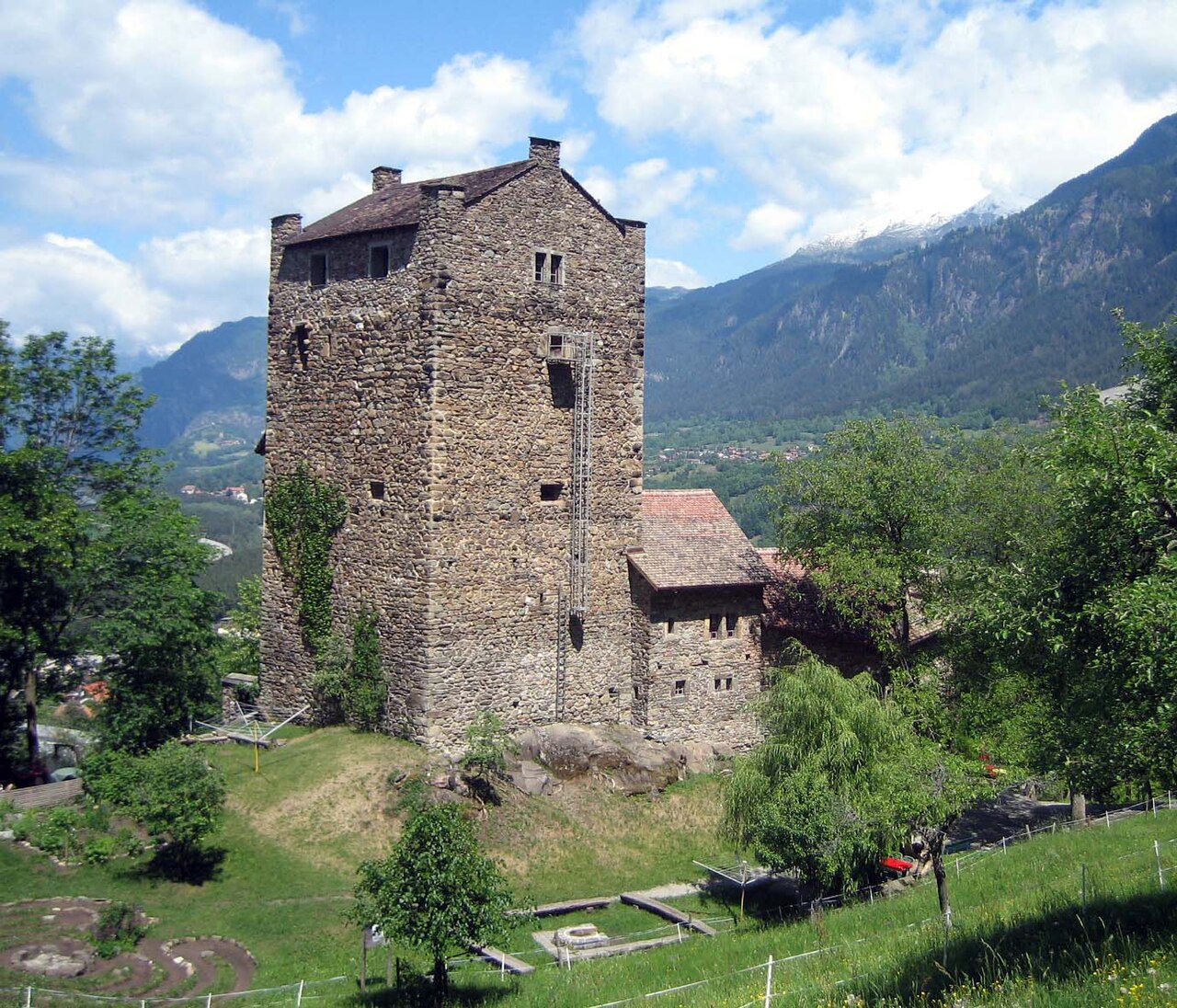
Bishop's Castle

Bishop's castle in fürstenau, switzerland
Fürstenau, Switzerland
Post-Renaissance (17th–18th c.)
Well Preserved

Bishop's Castle in Fürstenau, Switzerland, is a notable historic site with origins dating back to the mid-to-late 13th century. The castle's initial construction served as a fortified residence for ecclesiastical authorities, reflecting the strategic and administrative importance of the location during the medieval period. Although the original medieval structure was established in the 1200s, the castle as it stands today primarily reflects the architectural style and construction of the early 18th century, a period that saw significant rebuilding and modernization efforts.

Historical background and significance

The site of Bishop's Castle has long been associated with the Prince-Bishops who governed the region, combining both religious and secular power. Fürstenau itself is one of the oldest towns in the canton of Graubünden, and the castle played a central role in the administration and defense of the area. The original medieval fortress was likely built to assert the bishop's authority and to serve as a secure seat amidst the political complexities of the High and Late Middle Ages.

By the 18th century, the castle underwent extensive reconstruction, reflecting the transition from purely defensive architecture to a more comfortable residence suitable for administrative and residential use. This transformation aligns with the broader European trend during the Post-Renaissance period, where many medieval fortifications were adapted for modern needs.

Architectural features and style

The current structure of Bishop's Castle is characterized by its Post-Renaissance architectural elements, typical of early 18th-century Swiss castle renovations. The castle features a compact, rectangular plan with a robust stone construction. While much of the medieval defensive character was softened, the castle retains elements such as thick walls and limited window openings that hint at its fortified origins.

The roofline and window designs reflect the Baroque influence prevalent in the region during the early 1700s, with symmetrical facades and restrained decorative details. The castle includes a central courtyard, which would have been a vital space for both practical and social functions. Interior spaces were likely remodeled to enhance comfort and administrative efficiency, moving away from the austere medieval style.

Defensive structures and layout

While the castle's defensive features are less pronounced than in its medieval incarnation, it still includes remnants of battlements and thick curtain walls. The position of Bishop's Castle in Fürstenau, on a slight elevation, provided a strategic vantage point over the surrounding valley and town. This location was essential for surveillance and control during conflicts in the region.

Cultural and heritage importance

Bishop's Castle remains an important cultural landmark in Fürstenau and the canton of Graubünden. It symbolizes the historical power of the Prince-Bishops and the evolution of castle architecture from medieval fortresses to more refined residential palaces. The castle is part of the town's heritage and contributes to understanding the region's ecclesiastical and political history.

Today, the castle is well preserved and serves as a reminder of the area's complex past. It attracts visitors interested in Swiss history, architecture, and the legacy of ecclesiastical principalities. The castle's preservation helps maintain the historical fabric of Fürstenau and offers insight into the architectural transitions from the medieval to the early modern era.

Visiting bishop's castle

Visitors to Bishop's Castle can appreciate its architectural features and historical context within the charming town of Fürstenau. While the castle is primarily a private or administrative property, guided tours or special events may occasionally be available, providing opportunities to explore its interiors and learn about its history.

The castle's location in the scenic landscape of Graubünden makes it a suitable destination for those interested in combining cultural heritage visits with outdoor activities such as hiking and exploring the nearby alpine environment.

Accessibility and visitor information

Fürstenau is accessible by regional transportation, and the castle is within walking distance from the town center. Visitors should check local tourism resources for current opening hours and tour availability. Due to the castle's historical nature, access may be limited to certain areas to preserve its condition.

Frequently asked questions (FAQ)

How do I get to Bishop's Castle?
Bishop's Castle is located in Fürstenau, Switzerland, easily accessible by public transportation or car. If you're driving, you can follow the A13 motorway and take the exit for Fürstenau. There are also local buses that connect to nearby towns, making it convenient for visitors.
What is the historical significance of Bishop's Castle?
Bishop's Castle dates back to the 12th century and served as a residence for the Bishops of Chur. Its strategic location allowed it to play a key role in the region's political and military history. Today, it stands as a testament to medieval architecture and the power of the ecclesiastical authorities of that era.
When was Bishop's Castle built?
Construction of Bishop's Castle began in the early 12th century, specifically around 1160. Over the centuries, it has undergone various renovations and expansions, reflecting the architectural styles of different periods. Its enduring structure allows visitors to step back in time and appreciate its historical evolution.
Can I take guided tours of Bishop's Castle?
Yes, guided tours are available for visitors who wish to learn more about the castle's history and architecture. These tours often include access to areas that are off-limits to the general public, providing a more in-depth experience. Be sure to check the schedule in advance, as tours may be limited on certain days.
Why is Bishop's Castle a popular destination for tourists?
Bishop's Castle attracts tourists for its rich history, stunning architecture, and breathtaking views of the surrounding landscape. Its well-preserved structure offers a glimpse into medieval life, making it an educational experience for visitors of all ages. Additionally, the castle often hosts cultural events and exhibitions, enhancing its appeal.
Is it possible to visit Bishop's Castle year-round?
Yes, Bishop's Castle is open to visitors throughout the year, although opening hours may vary by season. It's advisable to check the official website for the most current information on visiting hours before planning your trip. Visiting in the off-peak season can also provide a quieter experience.
What are the ticket prices for visiting Bishop's Castle?
Ticket prices for Bishop's Castle vary based on age and group size, with discounts available for children, students, and seniors. As of the latest information, adults typically pay around CHF 10 for entry. Special rates may apply for group bookings, so it's worth inquiring if you're visiting with a larger party.
What is the best time to visit Bishop's Castle?
The best time to visit Bishop's Castle is during the spring and early autumn when the weather is mild and the surrounding landscape is particularly beautiful. These seasons also tend to attract fewer crowds compared to the summer months. Additionally, the castle often hosts special events during these times, enhancing the visitor experience.
Are there any nearby attractions to visit after Bishop's Castle?
Yes, there are several nearby attractions that visitors can explore after touring Bishop's Castle. The charming town of Fürstenau offers quaint shops and local dining options, while the scenic hiking trails around the region provide stunning views. Additionally, the nearby Rhine Gorge and the city of Chur are also worth visiting for their historical and natural beauty.

Information

Hill Castle

Loading map...

Visitor reviews

No reviews yet. Been here? Write the first review and help other travelers!

Write the first review

Visited this castle? Share your experience

Your review helps other travelers and adds first-hand knowledge to our encyclopedia.

Write a review

(5/5)

0/2000 characters

Your review will be visible after admin approval

Nearby castles

1.6 km

Rietberg Castle

Pratval, Switzerland

Rietberg Castle is a prominent hill castle located in Pratval, Switzerland, with its origins tracing back to the 13th century. The castle's central tower, the oldest surviving structure, was constructed during this period, possibly incorporating an earlier 12th-century tower. This tower served as the stronghold for the Lords of Rietberg, who were initially vassals of the Freiherr von Sax-Misox in 1286. By the 14th century, their allegiance shifted to the Bishop of Chur, under whose authority the castle and its surrounding estates were managed. Medieval origins and feudal significance The 13th-century construction of Rietberg Castle reflects the typical architectural style of high medieval hill castles in the region, characterized by a robust central keep designed for defense and residence. The castle's strategic location allowed the Lords of Rietberg to oversee their extensive holdings across Schams, Chur, and Oberhalbstein. As the bishop's representatives in Oberhalbstein and Oberengadin, they played a crucial role in local governance and administration during a period marked by feudal complexity and territorial disputes. Ownership transitions and political conflicts The lineage of the Lords of Rietberg ended with Johann von Reitberg, the last male heir, who died in 1349. Before his death, Johann sought to secure the castle's future by arranging its inheritance to his wife, Berta von Rhäzüns, and his relative, Hermann von Landenberg. However, these plans were contested by the Bishop of Chur, who asserted his claim over the castle and its estates. By 1353, the bishop successfully compelled the Landenbergs to relinquish their claims, though disputes persisted until 1388. To resolve these, the bishop compensated the Lords of Rhäzüns and Lumerins, consolidating his control over Rietberg Castle. Mortgaging and noble stewardship Throughout the late medieval period, the castle was frequently used as collateral for loans or as a reward for support by the bishopric. Notable mortgage holders included Jakob von Castelmur in 1398, Conradin Rambach and the cathedral chapter in 1409, Bartolomäus Planta in 1426, and Hans Wellenberg in 1447. The castle passed through various noble families, reflecting the complex financial and political networks of the time. By 1450, it was mortgaged to Hans Ringg, whose family retained it into the late 15th century. Renaissance and early modern period ownership In the 16th century, ownership of Rietberg Castle transitioned to Anton von Travers around 1530, followed by Hercules von Salis in 1554. The Planta family acquired it in 1617, marking a significant chapter in the castle's history. This period was marked by religious and political turmoil in the region, culminating in the Bündner Wirren conflicts between Catholics and Protestants. The murder of pompeius planta One of the castle's most notable historical events was the assassination of Pompeius Planta in 1621. He was killed by Jörg Jenatsch, a prominent figure in the Bündner Wirren, during the intense religious and political struggles that shaped the region's early modern history. This event underscored the castle's role not only as a noble residence but also as a focal point of regional power struggles. Architectural features and preservation Rietberg Castle retains significant elements of its high medieval architecture, especially its central tower, which exemplifies the defensive and residential design typical of the era. The castle's position as a hill castle provided natural defensive advantages, with thick stone walls and limited access points. Over the centuries, modifications and restorations have been made, yet the castle remains a well-preserved example of medieval fortification in the Swiss canton of Graubünden. Castle layout and defensive structures The castle's layout includes a fortified keep, surrounding curtain walls, and ancillary buildings that supported the daily functions of the noble household and its administrative duties. The elevated site allowed for surveillance of the surrounding valleys and control over important transit routes. Defensive features such as battlements and narrow windows for archers contributed to its security during periods of conflict. Cultural significance and modern status Today, Rietberg Castle stands as a testament to the region's feudal history and the shifting allegiances of medieval and early modern Switzerland. Its association with notable families and historical events like the Bündner Wirren enhances its cultural importance. The castle is a valuable heritage site within the canton of Graubünden, attracting visitors interested in medieval architecture and Swiss history. While not extensively renovated for tourism, the castle's preservation allows scholars and visitors to appreciate its architectural and historical context. It remains a symbol of the complex political landscape of the Swiss Alps during the Middle Ages and the Renaissance, reflecting the interplay between local nobility and ecclesiastical power.

High Medieval (11th–13th c.)
Details
2 km

Baldenstein Castle

Sils im Domleschg, Switzerland

Baldenstein Castle stands as a significant high medieval fortress located in Sils im Domleschg, Switzerland. Its origins trace back to the 13th century, when it was established as the family seat of the Knights of Baldenstein, first documented in 1246. The castle's central tower, a key defensive and residential structure, was constructed around this time. Although detailed records of the Baldenstein family are scarce, the castle's early history reflects the turbulent feudal dynamics of the region.The early history and ownership transitionsBy 1289, ownership of Baldenstein Castle had passed to the Freiherr von Löwenstein. However, during local conflicts, the castle was lost in a war to the Freiherr von Rhäzüns. The peace treaty of that year restored Baldenstein to Löwenstein, with the condition that Schwarzenstein Castle be ceded to Rhäzüns. This exchange highlights the strategic importance of Baldenstein within the region's power struggles.In 1349, the castle came under the control of the Übercastel family. Wilhelm von Übercastel sought to expand and fortify the castle, but his plans were initially blocked by the Bishop of Chur. Eventually, Wilhelm granted the Bishop certain rights, allowing the castle's fortifications to be enhanced. This interaction underscores the influence of ecclesiastical authorities in medieval castle affairs.Architectural evolution and expansionsOriginally, Baldenstein Castle featured a rectangular bergfried, a tall tower typical of medieval fortifications, serving as a last refuge and symbol of lordly power. During the late Middle Ages, an administrative and residential wing was added to the west of the bergfried, reflecting the castle's dual role as a military stronghold and noble residence.Around 1400, the castle passed to the Freiherr von Stein. Through marriage in 1453, it transferred to the von Ringg family, later known as Ringg von Baldenstein. In 1562, Luzius Ringg sold the castle to Jakob Ruinelli, whose family resided there for several generations, marking a period of relative stability and continued development.The Ruinelli family and the Bündner WirrenJakob Ruinelli's grandson, also named Jakob, played a notable role during the Bündner Wirren, a series of conflicts in the early 17th century in the Grisons region. In 1621, he accompanied Jürg Jenatsch to Rietberg Castle to assassinate Pompeius Planta, a key political figure. This event was part of the complex religious and political upheavals of the time. Tragically, Jakob Ruinelli was killed in 1627 during a drunken brawl among officers, illustrating the volatile nature of the period.Following his death, the castle passed to the Rosenroll family. During the 16th and 17th centuries, the castle saw further expansion, including the replacement of the medieval residential wing with a larger new wing. The original medieval ring wall was also replaced by a crenelated defensive wall, enhancing the castle’s fortifications to meet evolving military needs.Later ownership and restorationIn 1738, the castle was acquired by the Salis-Sils family, who held it for nearly fifty years. Subsequently, in 1782, it was inherited by Francesco Conrado from Chiavenna, Italy. Conrado became a member of the Senate of the Helvetic Republic following the French invasion of Switzerland in 1798, linking the castle’s history with broader European political changes.The Conrado family, later adopting the name Conrad, still owns Baldenstein Castle today. In 1877, a fire destroyed much of the residential wing, which was subsequently rebuilt, giving the castle its current appearance. This restoration preserved the castle's historic character while adapting it for continued use.Architectural significance and featuresBaldenstein Castle exemplifies the architectural evolution of a high medieval hill castle adapted over centuries to meet changing defensive and residential needs. The bergfried remains a dominant feature, symbolizing medieval military architecture. The later residential wing and crenelated walls reflect Renaissance and early modern modifications, indicating the castle’s ongoing strategic and domestic importance.The castle's location in Sils im Domleschg situates it within the historically contested region of the Grisons, where noble families, ecclesiastical powers, and emerging states vied for control. Its layered history of ownership and architectural adaptation provides valuable insights into the region’s feudal and political history.Visiting Baldenstein CastleToday, Baldenstein Castle remains privately owned by the Conrad family and is not generally open to the public. Its well-preserved structures offer a visible link to the high medieval period and subsequent centuries of Swiss history. The castle's enduring presence enriches the cultural landscape of Graubünden and serves as a testament to the region's complex past.

High Medieval (11th–13th c.)
Details
2.8 km
Ehrenfels Castle — Switzerland castle

Ehrenfels Castle

Sils im Domleschg, Switzerland

Ehrenfels Castle stands as a remarkable example of a high medieval hill castle located near the village of Sils im Domleschg in Switzerland. Constructed in the first half of the 13th century, this fortress was initially built to serve as a stronghold for local nobility, notably the Lords of Ehrenfels, whose presence is first documented in 1257. The castle's strategic position on a prominent rocky spur provided natural defenses and commanded views over the surrounding valley, typical of hill castles designed for both protection and control of the region. Medieval origins and early history The original core of Ehrenfels Castle was a robust four-story bergfried, a tall defensive tower characteristic of medieval fortifications. This tower featured an elevated entrance on its northern side, accessible directly to the second floor, a defensive architectural element intended to prevent easy access by attackers. The bergfried served as the heart of the castle's defensive system and a symbol of feudal authority. By 1320, the castle was under the ownership of Burkhard and Rudolf von Schauenstein, who also adopted the name Ehrenfels or Herrenfels, indicating the castle's importance as a noble seat. Around this time, the castle underwent significant expansions, including the addition of residential spaces and a ring wall encircling the bergfried. This ring wall likely featured multiple layers of defensive walls, enhancing the castle's fortifications during a period marked by regional conflicts and the need for robust defenses. Ownership transitions and architectural evolution By the early 15th century, the castle was recorded as owned by Hermann von Ehrenfels. In the late 15th or early 16th century, ownership transferred to Cazis Monastery, although the Ehrenfels-Schauenstein family continued to occupy the castle. This dual ownership reflects the complex feudal and ecclesiastical relationships typical of the period. During the 16th century, the castle was renovated to improve residential comfort, transforming the austere medieval fortress into a more habitable noble residence. This included the construction of a palas, or residential building, adjacent to the bergfried, reflecting the Renaissance-era shift in castle architecture from pure defense to domestic comfort. Decline and ruin Despite these improvements, Ehrenfels Castle was abandoned around 1600. Over the following centuries, the castle fell into ruin, with parts of its stonework quarried for other construction projects. By the 18th century, the castle was largely a ruin, and the male line of the Ehrenfels-Schauenstein family ended in 1742, leading to the property passing to the Buol family. The castle's decline mirrors the broader trend of medieval fortresses losing their military and residential relevance in the early modern period. 20th-century restoration and adaptive reuse In 1933, the Schweizerische Burgenverein (Swiss Castle Association) acquired the ruins and initiated restoration efforts under the guidance of architect Eugen Probst. These efforts included clearing dense vegetation, stabilizing remaining structures, and partially leveling the ground. However, the restoration was conducted without formal archaeological investigation, resulting in some loss of historical context. The castle was transformed into a youth hostel, a function it continues to serve today, managed by the Swiss Foundation for Social Tourism. The hostel offers 38 beds, integrating heritage preservation with modern adaptive reuse. Architectural features and current remains The castle's remains prominently feature the well-preserved bergfried, which retains much of its original height and defensive character. The tower's elevated entrance was later modified to include access from the courtyard side facing the valley, and a southern entrance was added in the 1960s to facilitate modern use. Surrounding the bergfried are fragments of the ring wall, which exhibit evidence of multiple defensive layers, characteristic of 14th-century fortification enhancements. The 16th-century palas adjacent to the bergfried, though partially ruined, reflects the castle's evolution from a military fortress to a noble residence emphasizing comfort. The castle's two-level layout on the rocky spur provided natural defensive advantages and controlled access points, typical of hill castles designed to maximize terrain benefits. Today, Ehrenfels Castle stands as a testament to the layered history of medieval fortifications in Switzerland. Its preservation as a youth hostel allows visitors to experience a unique blend of historical ambiance and contemporary hospitality, making it a significant cultural and heritage site in the region. Visitor experience and cultural significance Visitors to Ehrenfels Castle can explore the ruins while staying overnight in the converted youth hostel, offering a rare opportunity to immerse themselves in medieval history within a functional modern setting. The castle's location in the scenic Domleschg valley adds to its appeal, providing panoramic views and a connection to the region's rich historical landscape. The castle's transformation from a feudal stronghold to a youth hostel exemplifies successful adaptive reuse of historic structures, preserving architectural heritage while meeting contemporary needs. Its management by the Swiss Foundation for Social Tourism underscores the importance of cultural tourism and heritage conservation in Switzerland.

High Medieval (11th–13th c.)
Details