Baghras Castle
Baghras Castle, also known as Bagras Castle or locally as Bakras Kalesi, is a remarkable medieval fortress perched on a rocky hilltop near the village of Ötençay in the province of Hatay, Turkey. This castle holds a significant place in the military and architectural history of the region, especially during the Byzantine and Crusader periods. Strategically positioned to guard the vital mountain pass known as the Syrian Gates (Belen pass) through the Nur Mountains, Baghras Castle was a key defensive stronghold controlling access to the important city of Antioch and the Cilician plains.
Constructed originally in the 10th century during the reign of Byzantine Emperor Nikephoros II Phokas, the fortress was built atop a naturally defensible rocky summit with steep slopes, providing commanding views over the surrounding valley. The site had earlier historical significance, noted by ancient geographers such as Strabo, who identified the area as a natural stronghold near the ancient town of Gindarus. The castle’s location was critical for controlling the north-south route through the Amanus (Nur) Mountains, a strategic corridor between Anatolia and the Levant.
Byzantine origins and early strategic importance
The initial construction of Baghras Castle dates to approximately 965–968 CE, when the Byzantine Empire reinforced its eastern frontier against Arab incursions. Emperor Nikephoros II Phokas stationed a substantial garrison of infantry and cavalry here to secure the Syrian Gates, a narrow mountain pass that was vital for military and commercial traffic. The fortress was designed to exploit the natural topography, with multiple terraced levels adapting to the rugged terrain and steep cliffs providing natural defenses on several sides.
The crusader era and the Knights Templar
Following the capture of Antioch by the Crusaders in 1098 during the First Crusade, Baghras Castle came under the control of the Principality of Antioch. It was during the early 12th century that the fortress was transferred to the Knights Templar, who are first recorded as owners around 1153. The Templars undertook significant rebuilding and fortification efforts, adapting the castle to the evolving military technologies and siege tactics of the time.
The castle was known to the Crusaders as Gaston Castle, and it played a pivotal role in the defense of the principality’s southern approaches. Its position allowed the Templars to monitor and control movement through the Amanus Mountains, particularly the crucial Belen pass. The fortress was heavily contested in the turbulent political and military struggles of the 12th century, changing hands multiple times between the Crusaders, the Armenian Kingdom of Cilicia, and Muslim forces.
Conflict and control in the 12th and 13th centuries
In 1171, the castle was seized by the Armenian baron Mleh, a renegade lord who challenged Crusader authority in the region. After Mleh’s death in 1175, the Templars regained control. However, in 1188, the castle was captured by the famed Muslim leader Saladin during the campaigns of the Third Crusade. Recognizing the threat posed by the approaching forces of the Holy Roman Emperor Frederick I Barbarossa, Saladin ordered the dismantling of the castle in 1190 to deny its use to the Crusaders.
In 1191, Leo II, Prince of the Armenian Kingdom of Cilicia, took possession of the damaged fortress and undertook reconstruction efforts. Control of Baghras became a point of contention between Leo II, the Principality of Antioch, and the Templars. After prolonged negotiations, the castle was returned to the Knights Templar in 1216, cementing their role in the region’s defense.
Later history and decline
Baghras Castle continued to hold strategic importance until the mid-13th century. In 1268, following the fall of Antioch to the Mamluk Sultan Baibars of Egypt, the small Templar garrison at Baghras abandoned the fortress after partially destroying it to prevent its capture. Baibars subsequently repaired the castle and used it as a military base.
Despite its military significance, the castle was gradually abandoned by the late 17th century as changes in warfare and political control rendered it obsolete. The fortress fell into ruin, though its remains continued to bear witness to the complex history of the region’s medieval conflicts.
Architectural features and remains
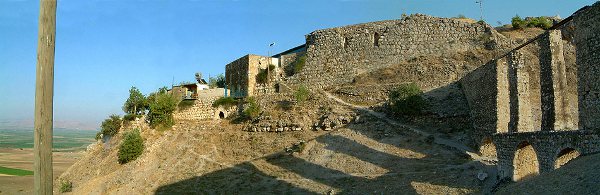
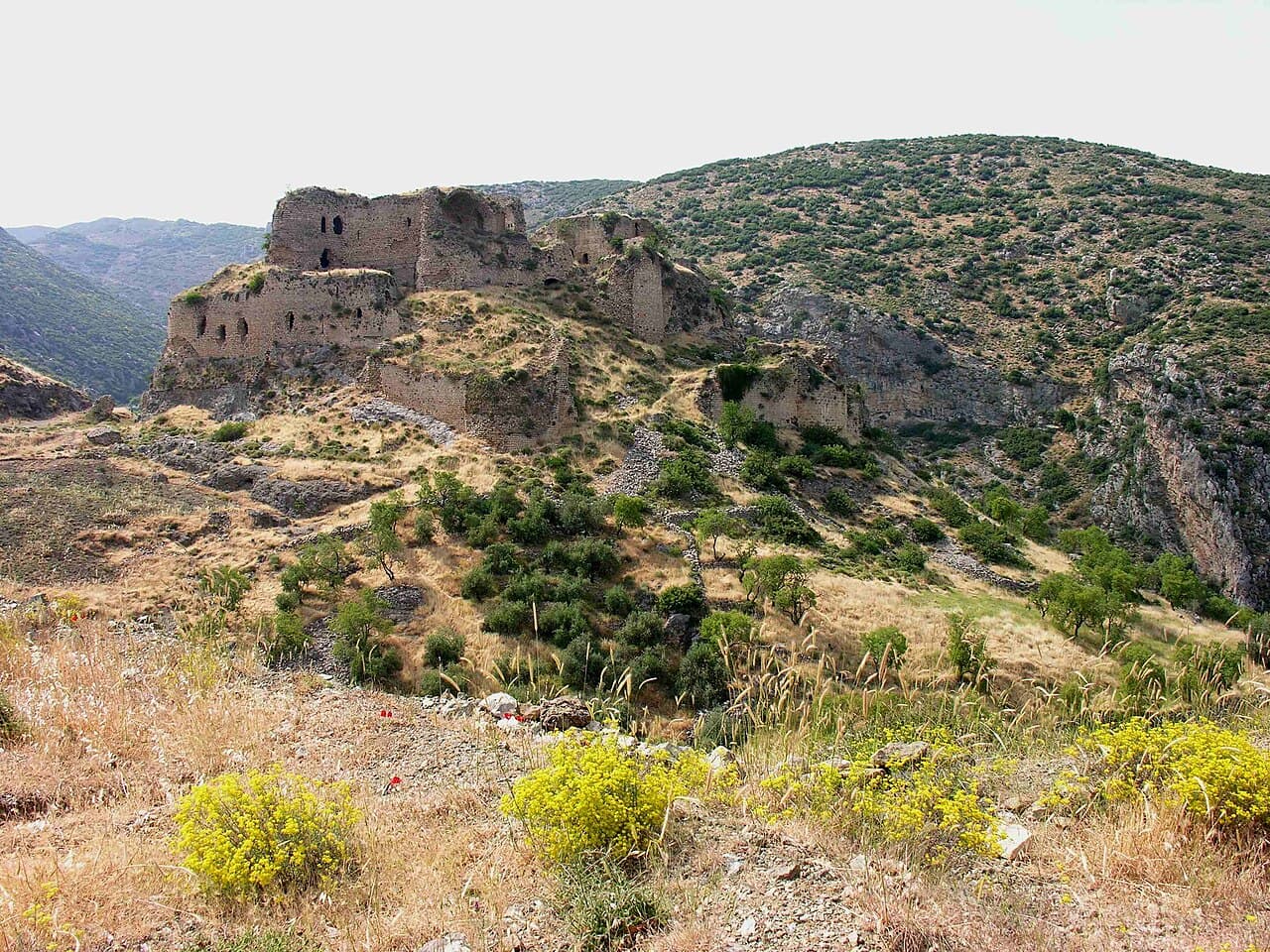
The ruins of Baghras Castle today reveal a complex multi-level fortress built to adapt to the rugged mountainous terrain. The castle is arranged across three terraced levels, hosting over thirty chambers, halls, and defensive structures tightly integrated into the rocky outcrop. The main entrance was accessible only from the east via a narrow, steep path along a cliff face, protected by a robust rectangular keep tower designed to control access.
Significant architectural elements include a large assembly hall with broad windows, a chapel with an unusual flat eastern wall rather than a traditional apse, and extensive underground chambers supported by strong columns, likely used for garrison quarters and storage. The defensive walls feature multiple lines of fortification, including outer walls protecting the lower terraces, enhancing the castle’s defensibility.
Remarkable hydraulic engineering is evident in the remains of an aqueduct system that supplied water from mountain springs located west of the castle. This aqueduct crossed a valley at a height of approximately 18 meters, feeding a spring known in medieval times as the "Fountain of Gastin" at the fortress base, ensuring a reliable water source during sieges.
Construction techniques and influences
The masonry of Baghras Castle exhibits characteristics typical of Armenian craftsmanship, especially visible in the use of small, irregular stones with rounded and protruding bosses. This style resembles that of the nearby Armenian castle of Sis, suggesting significant Armenian architectural influence during the 12th and 13th-century reconstruction phases under the Armenian Kingdom of Cilicia.
The castle’s layered construction reflects its complex history of occupation and rebuilding by various powers, including the Byzantines, Crusaders, Armenians, and Mamluks. Despite these modifications, Baghras was never fully integrated into the broader Armenian defensive network in Cilicia, standing instead as a contested frontier fortress.
Modern significance and preservation
Today, Baghras Castle stands as an evocative archaeological site, freely accessible to visitors interested in medieval military architecture and the Crusader history of the Levant. The extensive ruins, including the keep, halls, chapel, chambers, and aqueduct remains, offer a tangible connection to the castle’s storied past.
The region suffered severe damage during the 2023 Turkey-Syria earthquake, and it is likely that the castle sustained some impact, although detailed assessments are pending. Preservation efforts remain important to safeguard the site’s historical and cultural legacy.
Baghras Castle is a must-see for those exploring the rich tapestry of medieval fortifications in Turkey, illustrating the strategic importance of mountain strongholds in the military history of the Crusades and Byzantine frontier defense.
Frequently asked questions (FAQ)
- What is the historical significance of Baghras Castle?
- Baghras Castle was a strategic fortress built in the 10th century by the Byzantines to control the Syrian Gates and later played a key role during the Crusader period and conflicts involving the Knights Templar, Armenians, and Muslim forces.
- Can visitors access Baghras Castle today?
- Yes, the ruins of Baghras Castle are freely accessible to visitors. The site offers views of the extensive remains including the keep, halls, chapel, and aqueduct, providing insight into medieval military architecture.
- What are some notable architectural features of Baghras Castle?
- The castle features a multi-terraced layout with over thirty chambers, a large assembly hall, a chapel with a flat eastern wall, a rectangular keep tower guarding the entrance, and an ancient aqueduct system supplying water from mountain springs.
- When was Baghras Castle built and by whom?
- Baghras Castle was originally built in the 10th century by the Byzantine Emperor Nikephoros II Phokas to secure the eastern frontier and control the Syrian Gates mountain pass.
- How did the Knights Templar influence Baghras Castle?
- The Knights Templar took control of Baghras Castle in the 12th century and undertook significant reconstruction, enhancing its defenses and adapting it to the military needs of the Crusader states in the region.
Photo gallery

Photo by No machine-readable author provided. Godfried Warreyn assumed (based on copyright claims).•CC BY 2.5
Information
Sources & official resources
Verify the information above using these authoritative references.
Loading map...
Visitor reviews
No reviews yet. Been here? Write the first review and help other travelers!
Write the first reviewVisited this castle? Share your experience
Your review helps other travelers and adds first-hand knowledge to our encyclopedia.