Baconsthorpe Castle
Baconsthorpe Castle, nestled in the picturesque countryside of Norfolk, England, stands as a remarkable example of a fortified manor house that evolved over several centuries. Constructed initially in the mid-15th century by Sir John Heydon, a prominent lawyer and soldier, the castle reflects the ambitions and rising status of the Heydon family during the turbulent Late Medieval period. Its architecture and history reveal a fascinating blend of defensive features and domestic refinement, illustrating the transition from medieval fortification to Renaissance manor living.
The castle is strategically positioned in a valley carved by the River Glaven, north of the village center of Baconsthorpe. Accessed via a raised causeway from the south, the complex is divided into three main courts: an inner moat-surrounded court, an adjoining outer court, and a further outermost court that functioned as a working farmyard. This layout underscores the castle’s dual role as a defensive stronghold and a prosperous agricultural estate.
Historical development and heyden family legacy
The origins of Baconsthorpe Castle trace back to around 1460, when William Heydon likely began construction. His son, John Heydon I, a politically active lawyer, expanded the site, aligning himself with powerful figures such as William de la Pole, Duke of Suffolk, and later John Dudley, Earl of Warwick. The castle served as a fortified home symbolizing the Heydon family's rising social and political ambitions during the mid-15th century.
By the late 15th century, the Heydons had transitioned from legal professionals to wealthy sheep farmers. Sir Henry Heydon, knighted in 1485, completed significant additions including the main house and service court. These expansions marked a shift from purely defensive architecture to a more refined courtyard-style residence, reflecting the family's growing wealth and changing tastes.
Throughout the 16th century, the Heydons capitalized on the lucrative wool trade, exporting cloth to the Netherlands. Sir John Heydon II adapted part of the castle into a wool factory, incorporating industrial functions within the estate. His successor, Sir Christopher I, further enhanced the property by adding an outer gatehouse and barn. In 1561, he secured a royal license to fortify the site with battlements (crenellation) and established a 300-acre deer park, signifying both status and leisure pursuits.
Financial difficulties emerged toward the end of the 16th century. Sir William Heydon II mortgaged the property and attempted to sell lands, but a 1593 legal dispute prevented demolition, preserving the castle for his son, Sir Christopher II. The younger Heydon invested in landscaping, creating formal gardens and commissioning a decorative mere (man-made pond), enhancing the estate's aesthetic appeal.
During the English Civil War (1642–1651), Sir John Heydon III supported the Royalist cause. Following Parliament’s victory, he was declared delinquent in 1646. Around 1650, he began dismantling the castle to sell its stonework, a common practice in the post-war economy. Despite this, the outer gatehouse was converted into a private residence, occupied until 1920.
The estate changed hands in the 19th century, acquired by John Thruston Mott in 1801 and later by Sir Charles Mott-Radclyffe. In 1940, the site was entrusted to the Ministry of Public Works. Mid-20th-century efforts focused on archaeological clearing and conservation. Further excavations and restoration of the mere occurred in 1972. Today, the ruins are managed by English Heritage and protected as Grade I and Grade II listed structures and a scheduled monument.
Architectural features and layout
Site and defensive structures
Baconsthorpe Castle occupies a valley shaped by the River Glaven, with access via a raised causeway. The castle’s design centers on an inner court roughly 65 meters wide, encircled by a water-filled moat approximately 15 meters across. The courtyard itself measures about 55 by 56 meters and is enclosed by a curtain wall up to 5 meters tall.
The curtain wall is fortified with seven towers of mixed square and round shapes, equipped with numerous gun loops—small openings designed for firing firearms, reflecting adaptations to early modern military technology. Notable features include six double embrasures west of the gatehouse, a gun loop in the northwest tower, and larger firing loops in the northern wall. The cellar beneath the great hall also contains gun loops aimed at protecting the main entrance.
Gatehouse and residential quarters
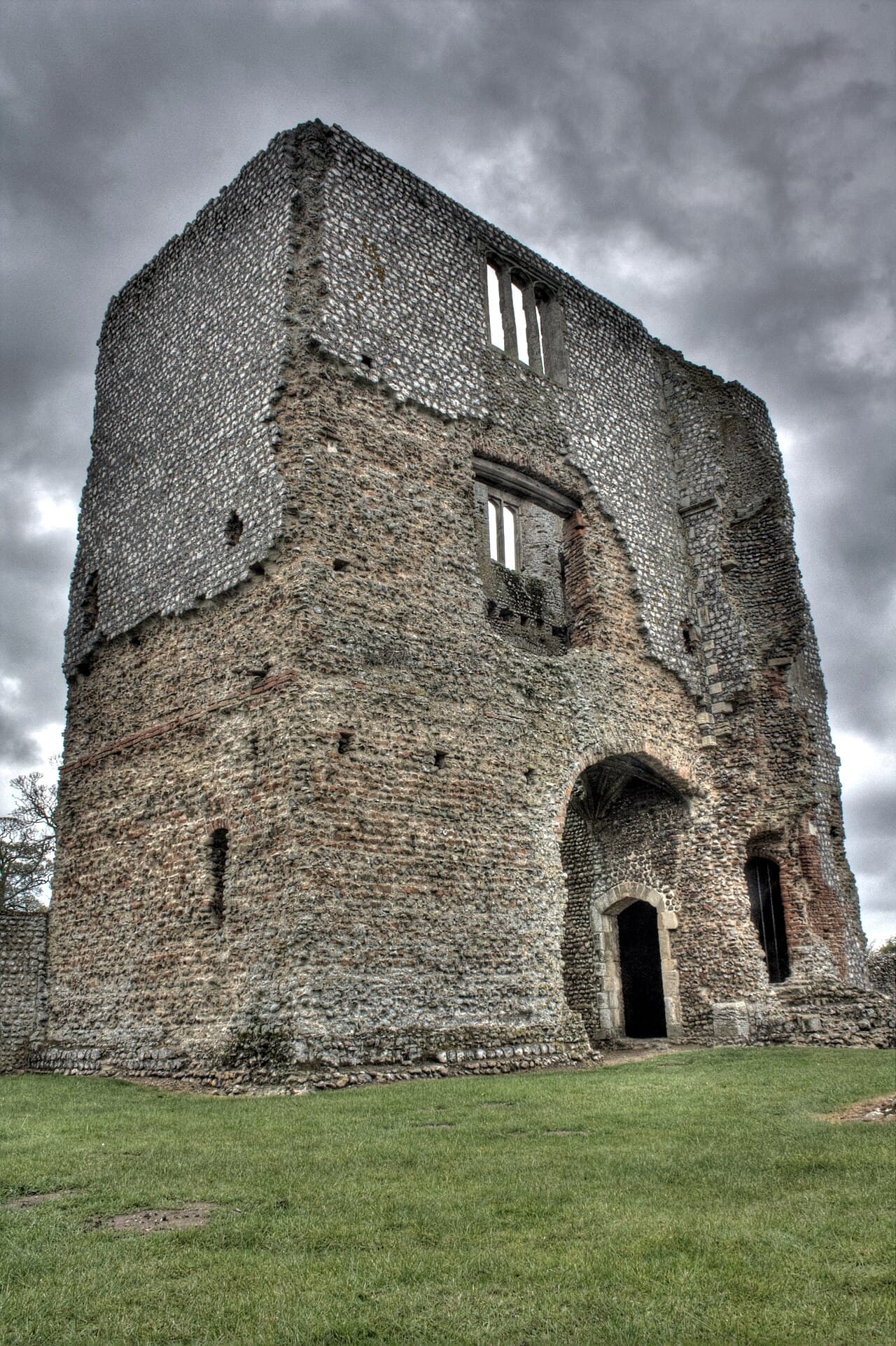
The three-storey gatehouse guarding the inner court is constructed from flint rubble and brick with knapped flint facing. It served both defensive and residential purposes. The vaulted gate passage spans two levels, flanked by chambers likely used by the steward and porter. Above, residential spaces include fireplaces, garderobes (medieval toilets), and a small chapel, demonstrating attention to comfort and spiritual needs within a secure environment.
Attached to the southwest corner of the inner court is a courtyard-style house incorporating the great hall, the main living and social space. The northeast side of the inner court formed the service area, including kitchens and a well supplying water.
Industrial and agricultural facilities
In the 16th century, part of the eastern curtain wall was adapted for wool manufacturing. A long, two-storey building measuring 38 by 8 meters housed a turnstile for shearing sheep. The upper floor contained spaces for weaving and finishing cloth, with possible areas for washing or drying wool. The northeast tower, rising three storeys, supported wool processing through fulling, a method that cleans and softens cloth by stamping it in soapy water.
The outermost court to the south functioned as a working farmyard. It was divided by a low wall and featured a large 16th-century barn on its western edge. Though currently 32 by 8 meters, the barn may have once extended up to 69 meters in length. It includes three large cart doors and high-quality facings on the south and east sides, intended to impress visitors with the estate’s prosperity.
Outer gatehouse and access
The outer gatehouse, built in the Perpendicular Gothic style using knapped flint, guarded the southern approach. It features a gate passage flanked by octagonal turrets and contained a sizeable chamber on the first floor. In the 17th century, it was converted into a private home, with additions such as a three-storey porch and battlements, some of which were later removed.
A bridge connecting the inner and outer courts on the south side originally incorporated a drawbridge, emphasizing security. The northern central tower contained a small postern gate, a discreet secondary doorway leading to a northern bridge now fallen into ruin.
Gardens and landscape design
To the southeast of the inner courtyard lie the earthworks of a formal garden laid out on a raised platform about 80 by 65 meters. The garden featured a raised walkway encircling a square pond approximately 35 by 32 meters, reflecting Renaissance influences on landscape design during the castle’s later occupation.
Preservation and visitor experience
Today, Baconsthorpe Castle is managed by English Heritage and stands as a peaceful and evocative ruin. It offers visitors a vivid glimpse into the life of a medieval fortified manor house that also embraced industrial and agricultural functions. The surviving outer gatehouse and extensive ruins invite exploration, while the moat, towers, and gardens evoke the castle’s historical grandeur.
The site is protected as a scheduled monument and includes Grade I and Grade II listed structures. It provides valuable insights into the architectural evolution from medieval fortification to Renaissance manor and the socio-economic history of the Heydon family and their wool trade enterprise. Visitors can appreciate the blend of military, residential, and industrial elements that make Baconsthorpe Castle a unique heritage site in Norfolk.
Frequently asked questions (FAQ)
- What is the historical significance of Baconsthorpe Castle?
- Baconsthorpe Castle is a late medieval moated castle that showcases the architectural style of the 15th century. It was built by the Heydon family and played a crucial role in the local history of Norfolk, reflecting the feudal system and the power dynamics of the time.
- When was Baconsthorpe Castle built?
- Construction of Baconsthorpe Castle began in the early 15th century, around 1450, and continued until the 16th century. The castle was primarily completed by the Heydon family, who were influential landowners in the area.
- What are the opening hours for Baconsthorpe Castle?
- Baconsthorpe Castle is generally open to visitors from April to September, with specific hours varying by day. It is advisable to check the official website for the most current opening hours and any seasonal changes before planning your visit.
- Can I visit Baconsthorpe Castle with children?
- Yes, Baconsthorpe Castle is a family-friendly destination, and children are welcome to explore the grounds. The castle's open spaces and historical features make it an educational experience for young visitors.
- Is it possible to access Baconsthorpe Castle for individuals with mobility issues?
- Baconsthorpe Castle has limited accessibility due to its historical nature and the layout of the grounds. Visitors with mobility issues should contact the site in advance to inquire about specific accommodations and to ensure a comfortable visit.
- What are the ticket prices for visiting Baconsthorpe Castle?
- Ticket prices for Baconsthorpe Castle can vary, with discounts available for children, seniors, and families. It's best to check the official website for the latest pricing information and any special offers that may be available during your visit.
- When is the best time to visit Baconsthorpe Castle?
- The best time to visit Baconsthorpe Castle is during the spring and summer months when the weather is typically milder and the grounds are in full bloom. Additionally, visiting during these months allows you to enjoy various outdoor events and activities that may be scheduled.
- What nearby attractions can I visit while at Baconsthorpe Castle?
- While visiting Baconsthorpe Castle, you can explore nearby attractions such as the charming village of Baconsthorpe and the stunning North Norfolk coast. Other local historical sites and natural reserves provide great opportunities for a full day of exploration.
Photo gallery

Information
Website
Visit websiteSources & official resources
Verify the information above using these authoritative references.
Loading map...
Visitor reviews
No reviews yet. Been here? Write the first review and help other travelers!
Write the first reviewVisited this castle? Share your experience
Your review helps other travelers and adds first-hand knowledge to our encyclopedia.