Aurelian Walls
The Aurelian Walls (Italian: Mura aureliane) represent one of the most significant fortification projects of ancient Rome, constructed between AD 271 and AD 275 during the reign of the Roman Emperor Aurelian. These walls were built to defend the city against increasing external threats and superseded the earlier Servian Wall dating back to the 4th century BC. Spanning approximately 19 kilometers (12 miles) in length, the walls enclosed an extensive area of about 1,400 hectares (3,500 acres), including all the seven hills of Rome, the Campus Martius, and the Trastevere district on the right bank of the Tiber River.
Historical context and purpose
During the 3rd century AD, the Roman Empire faced increasing pressure from external invasions and internal instability. The traditional city defenses, primarily the Servian Wall, were no longer sufficient to protect Rome's expanded urban area. Emperor Aurelian initiated the construction of these new fortifications to provide a robust defensive perimeter, reflecting the changing military and political realities of the Late Roman Empire. The walls marked a shift from the earlier Republican-era fortifications, adapting to the needs of a larger and more vulnerable city.
Architectural features and construction
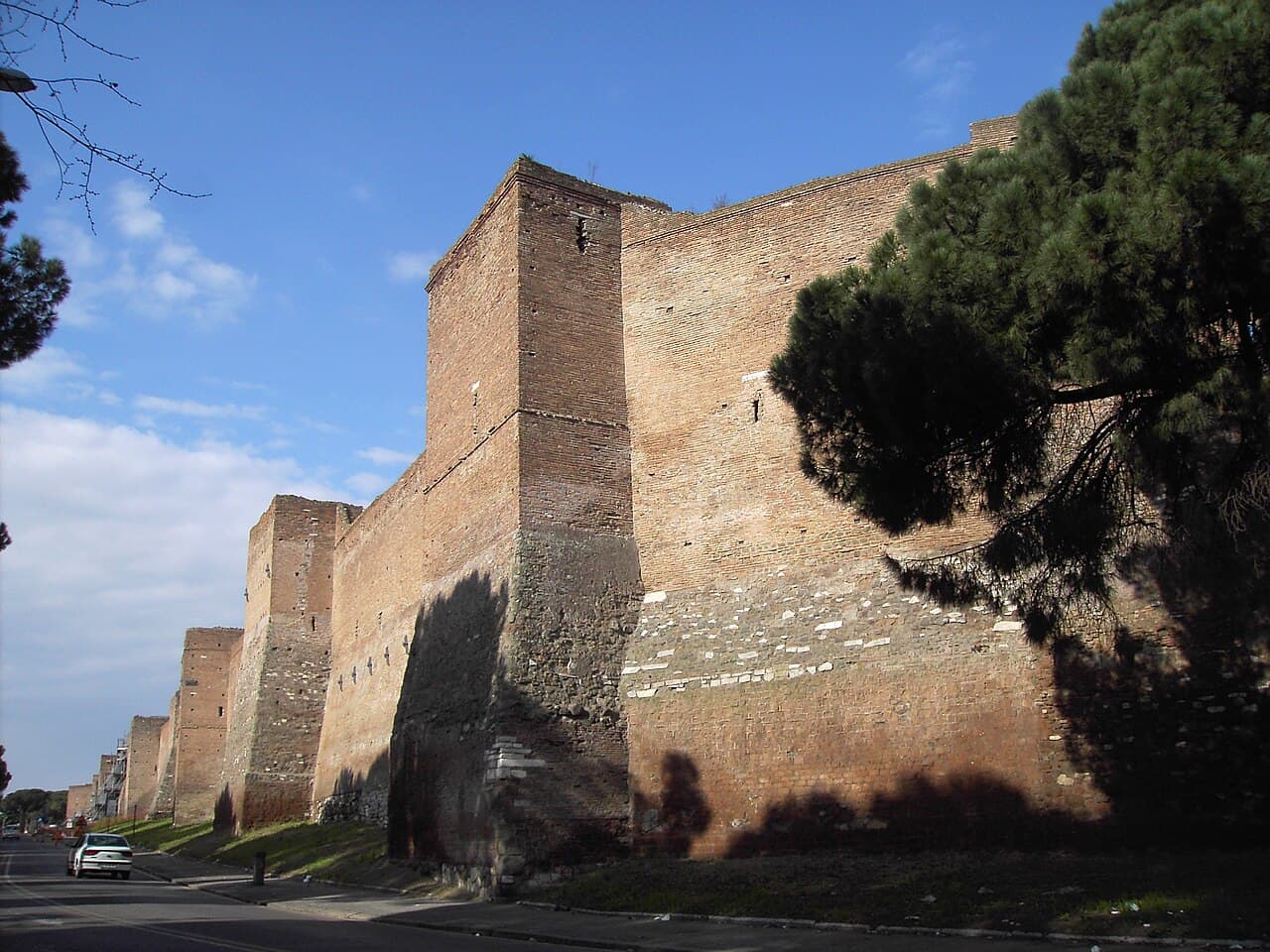
The Aurelian Walls were designed as a bastioned fortress, featuring a continuous stone and brick curtain wall approximately 3.5 to 4.5 meters (11 to 15 feet) thick and up to 8 meters (26 feet) high in its original form. The walls were reinforced with semi-circular towers spaced at regular intervals of about 30 meters (98 feet), providing vantage points for defenders and enabling flanking fire along the curtain. The construction incorporated concrete-faced brickwork, a hallmark of Roman engineering, ensuring durability and strength.
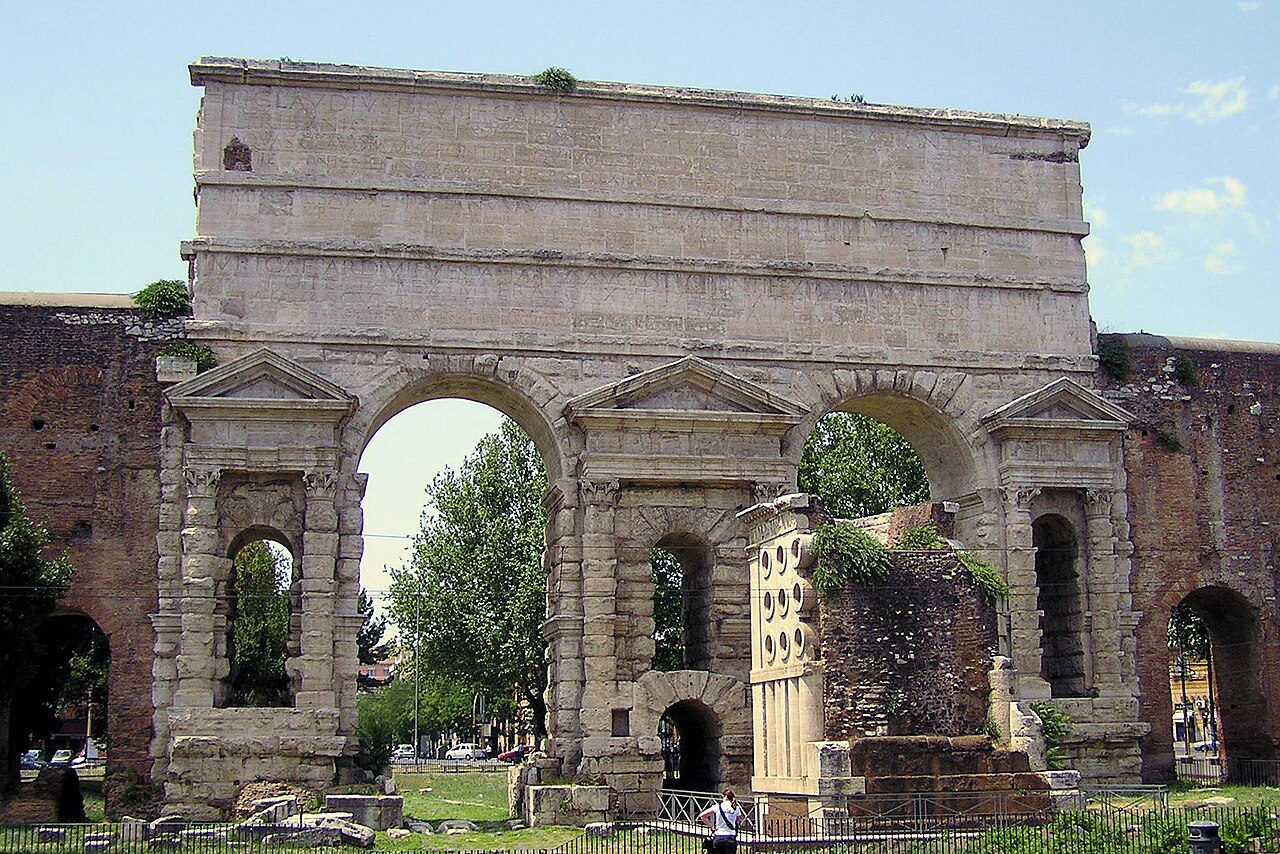
The walls included 18 main gates, each strategically placed to control access to the city and connected to major roads leading in and out of Rome. Notable gates include the Porta San Sebastiano, Porta Maggiore, and Porta Pia. Many of these gates were later modified or rebuilt during the Renaissance and Baroque periods, reflecting the walls' long-standing military and civic importance.
In addition to the walls and towers, a ditch or moat was excavated outside the walls in many sections to impede attackers. The walls also incorporated battlements and walkways for soldiers to patrol and defend the perimeter.
Geographical scope and urban impact
The walls enclosed an area significantly larger than the earlier Servian Wall, reflecting Rome's growth over the centuries. The inclusion of the Campus Martius and the Trastevere district on the west bank of the Tiber was particularly important, as these areas housed vital civic and residential zones. The riverbanks within the city limits were largely left unfortified, except where the Campus Martius was protected, indicating strategic choices based on natural barriers and urban density.
The construction of the walls required cutting through already populated neighborhoods, demonstrating the urgent need for defense over urban continuity. Contemporary accounts, such as those by Pliny the Elder, describe the extent of the city's inhabited areas, which stretched approximately 2.8 kilometers (1.7 miles) from the Golden Milestone in the Roman Forum.
Later modifications and preservation
Over the centuries, the Aurelian Walls underwent numerous repairs, modifications, and additions. During the Medieval and Renaissance periods, the walls were adapted to new military technologies and urban developments. Some sections were heightened, and additional bastions and gates were constructed or rebuilt. The walls also played a role in the Papal States' defense system until the unification of Italy.
Today, the Aurelian Walls are among the best-preserved ancient fortifications in Rome and serve as a visible reminder of the city's imperial past. Large stretches remain intact, allowing visitors to appreciate the scale and engineering prowess of Roman military architecture. The walls have been designated as a protected archaeological site, with ongoing conservation efforts to maintain their structure and historical integrity.
Significance in Roman military architecture
The Aurelian Walls exemplify the evolution of Roman defensive architecture from the Republican to the Late Imperial period. Their design reflects the need for rapid construction, robust defense, and integration with the urban fabric. The use of bastions and regular towers was innovative for the time and influenced later medieval fortifications across Europe.
As a bastioned fortress, the walls combined traditional Roman building techniques with adaptations to new military challenges, including the threat of barbarian invasions. The walls' scale and complexity highlight the strategic importance of Rome even as the empire faced decline.
Visitor information and cultural heritage
Visitors to Rome can explore many sections of the Aurelian Walls, including prominent gates and towers that have been incorporated into the city's urban landscape. Walking tours often include the Porta San Sebastiano and the Porta Appia, where museums and exhibitions provide insights into the walls' history and construction.
The walls are a key component of Rome's cultural heritage, reflecting the city's continuous habitation and strategic importance over two millennia. Preservation efforts ensure that this monumental structure remains accessible and informative for future generations.
Frequently asked questions (FAQ)
- What is the historical significance of the Aurelian Walls?
- The Aurelian Walls were built in the 3rd century AD to protect Rome from external invasions during a period of increased military threats. They represent a major development in Roman defensive architecture and enclosed the expanded city area.
- Can I visit the Aurelian Walls today?
- Yes, many sections of the Aurelian Walls are accessible to the public in Rome. Visitors can walk along parts of the walls and explore notable gates such as Porta San Sebastiano, which also houses a museum.
- When were the Aurelian Walls constructed?
- The walls were constructed between AD 271 and AD 275 under Emperor Aurelian's orders as a response to growing external threats to Rome.
- Are the Aurelian Walls fully intact?
- The walls are partially preserved with large sections still standing, but some areas have deteriorated or been incorporated into later buildings. Conservation efforts continue to maintain their condition.
- What architectural features characterize the Aurelian Walls?
- The walls feature a thick stone and brick curtain wall with semi-circular bastioned towers spaced regularly. They include multiple gates controlling city access and defensive battlements along the top.
Photo gallery

Photo by user:Lalupa•Public domain
Information
Opening hours
Variable, generally daylight hours
Ticket prices
Free
Current owner
Municipality of Rome
Loading map...
Visitor reviews
No reviews yet. Been here? Write the first review and help other travelers!
Write the first reviewVisited this castle? Share your experience
Your review helps other travelers and adds first-hand knowledge to our encyclopedia.