Athenry Castle
Athenry Castle stands as a prominent example of a 13th-century Anglo-Norman tower house in the town of Athenry, Ireland. Known locally as "King John's Castle" despite being built two decades after King John's reign, this castle embodies the architectural and historical significance of medieval Ireland under Anglo-Norman influence. Its strategic location on a natural rise overlooking the River Clarin ford highlights its role in controlling vital transit routes and regional defense.
Architectural features and design
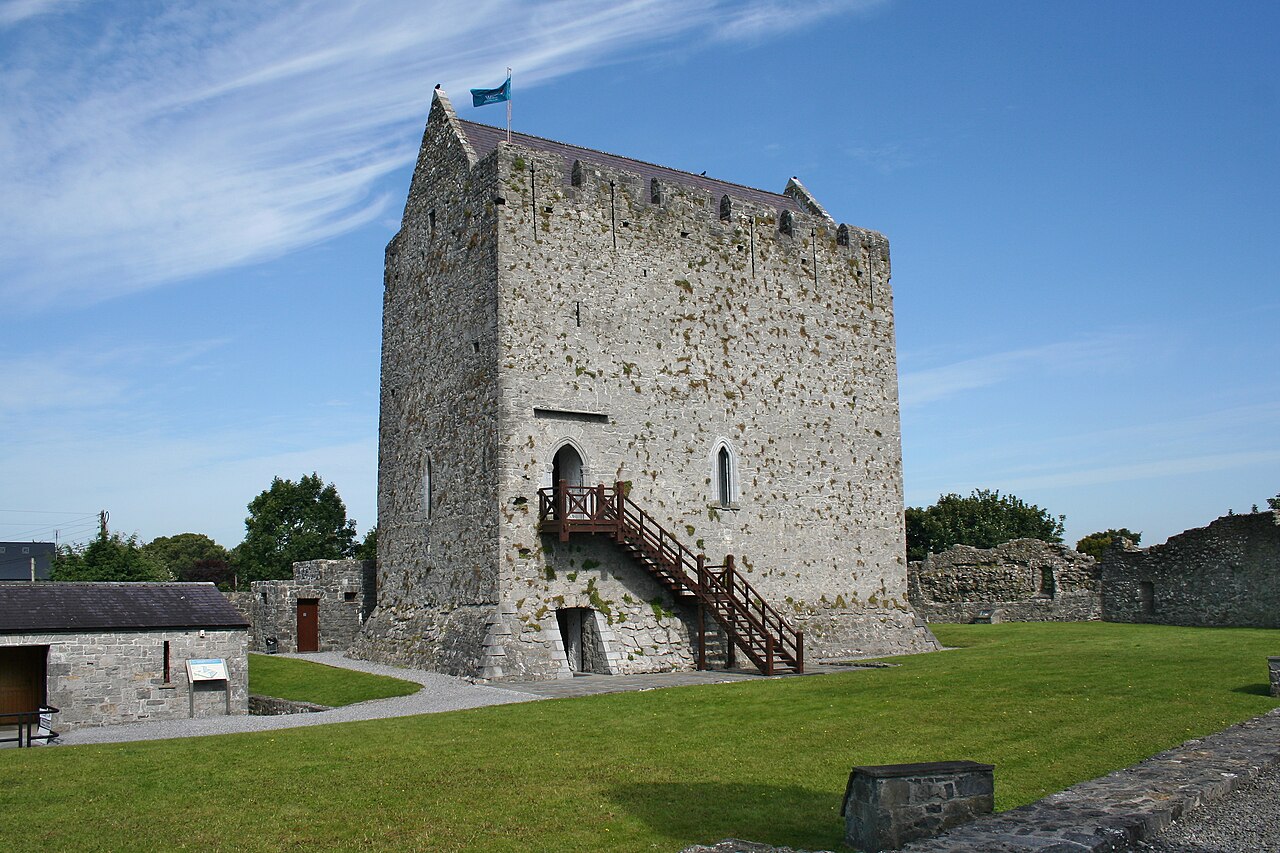
The castle is a large rectangular tower house characterized by battered walls that slope outward at the base, a defensive technique typical of the high medieval period. This feature strengthened the structure against siege tactics and made scaling the walls more difficult for attackers. Originally, the castle was designed with a single large hall on the upper floor, which served as the main living and gathering space, while the ground floor was used for storerooms and practical functions.
The main entrance was located on the first-floor level and accessed via an external wooden staircase, a common defensive measure to restrict direct entry from ground level. Inside, a built-in staircase within the thickness of the walls provided discrete vertical circulation to the upper levels. The castle's battlements date from the 13th century, featuring tall arrow slits set into the merlons of the parapet, which allowed defenders to fire upon attackers while remaining protected.
In the 15th century, modifications were made to the castle’s roofline when the parapets at the north and south ends were incorporated into gabled structures to support a new roof. Functional elements such as a garderobe (medieval latrine) are positioned diagonally opposite the main entrance, reflecting thoughtful spatial planning within the keep. The castle was heated by a brazier placed centrally in the hall, with smoke vented through a louver in the roof above.
Decorative stone carvings embellish the castle’s doorway and two window openings. These carvings display floral motifs characteristic of the School of the West, an artistic style that marks the transition from Romanesque to late Gothic influences in western Ireland. These surviving carvings are valued as fine examples of medieval stone craftsmanship.
Historical context and significance
Constructed between 1235 and 1240 by Anglo-Norman settlers, Athenry Castle served as the stronghold of the Bermingham family, who played a key role in overseeing the surrounding lands and securing important transit points. The castle's alternate name, "King John's Castle," reflects local tradition rather than historical accuracy, as it postdates King John's reign by about twenty years.
In the mid-13th century, Meyler de Bermingham expanded the castle, enhancing its size and defensive capabilities, marking the beginning of its prominence in the region. The early 14th century brought conflict; in 1316, the castle was attacked during regional unrest involving Irish clans. This event prompted the construction of fortified walls around the town of Athenry, underscoring the escalating tensions and the need for enhanced protection.
By the 15th century, the Bermingham family shifted their residence to a townhouse near the marketplace, indicating a change in their lifestyle and local power dynamics. However, the castle retained military importance into the late 16th century. During the Nine Years' War in 1596, it was seized by the O'Donnell clan, reflecting its continued strategic significance in the struggle for Irish independence from English rule.
Throughout its history, the castle's owners held the noble title of Barons of Athenry. Its location on a rise overlooking the west bank of the River Clarin allowed control over a crucial ford, reinforcing its administrative and military role in the region.
Surviving structures and preservation
Today, Athenry Castle remains a well-preserved example of medieval defensive architecture. The large rectangular tower house retains its characteristic battered walls and battlements with tall arrow slits. The 15th-century adaptations to the roofline and parapets are still evident, showcasing the castle's architectural evolution over centuries.
Remnants of the original enclosure wall survive, including defensive towers at the northeast and southeast corners, and a fortified gate at the southwestern corner. These features illustrate the layered defensive system that protected the castle and its inhabitants.
The castle's position on a natural rise overlooking the river ford not only provided military advantages but also contributed to its prominence in the landscape. Conservation efforts, including a restoration completed in 2005, have helped preserve the castle's historical fabric, making it a significant national monument in Ireland.
Cultural and architectural legacy
Athenry Castle exemplifies the architectural and historical legacy of Anglo-Norman settlement in Ireland. Its combination of defensive features, residential spaces, and artistic stonework reflects the multifaceted role of castles as military fortresses, noble residences, and symbols of power.
The castle's stone carvings, particularly those associated with the School of the West, contribute to our understanding of regional artistic developments during the transition from Romanesque to Gothic styles. As a national monument, Athenry Castle continues to attract visitors interested in medieval architecture, Irish history, and the complex social dynamics of the high medieval period.
Frequently asked questions (FAQ)
- What is the historical significance of Athenry Castle?
- Athenry Castle is a remarkable example of 13th-century military architecture and played a crucial role in the defense of the region. It symbolizes the rich medieval history of Ireland and has been a focal point in various historical events, including battles and sieges.
- When was Athenry Castle built?
- Athenry Castle was constructed in 1241 by the Anglo-Norman settlers. Its strategic location and formidable design were key to its function as a fortification during the medieval period.
- What are the opening hours for Athenry Castle?
- Athenry Castle is open to visitors from 10 AM to 5 PM, Monday through Saturday. On Sundays, the castle opens at 12 PM and closes at 5 PM, but it is recommended to check for any seasonal variations.
- Is it possible to access Athenry Castle with a wheelchair?
- Yes, Athenry Castle is committed to being accessible to all visitors. There are provisions in place to assist those with mobility challenges, although some areas may have limited access due to the castle's historic structure.
- Can I purchase tickets in advance for Athenry Castle?
- Yes, tickets for Athenry Castle can be purchased in advance online, which is highly recommended during peak tourist seasons. This ensures you have guaranteed entry and can skip any potential queues at the ticket office.
- When is the best time to visit Athenry Castle?
- The best time to visit Athenry Castle is during the spring and early autumn months when the weather is mild and the scenery is particularly picturesque. Additionally, these times tend to be less crowded than the peak summer months.
- What nearby attractions should I consider visiting?
- In addition to Athenry Castle, visitors can explore the nearby Athenry Heritage Centre and the picturesque countryside of County Galway. The vibrant town of Athenry also offers quaint shops and local restaurants worth exploring.
- What are the ticket prices for Athenry Castle?
- The ticket prices for Athenry Castle are generally affordable, with discounts available for children, students, and seniors. Family tickets are also offered, making it a budget-friendly option for visitors.
Information
Website
Visit websiteSources & official resources
Verify the information above using these authoritative references.
Loading map...
Visitor reviews
No reviews yet. Been here? Write the first review and help other travelers!
Write the first reviewVisited this castle? Share your experience
Your review helps other travelers and adds first-hand knowledge to our encyclopedia.