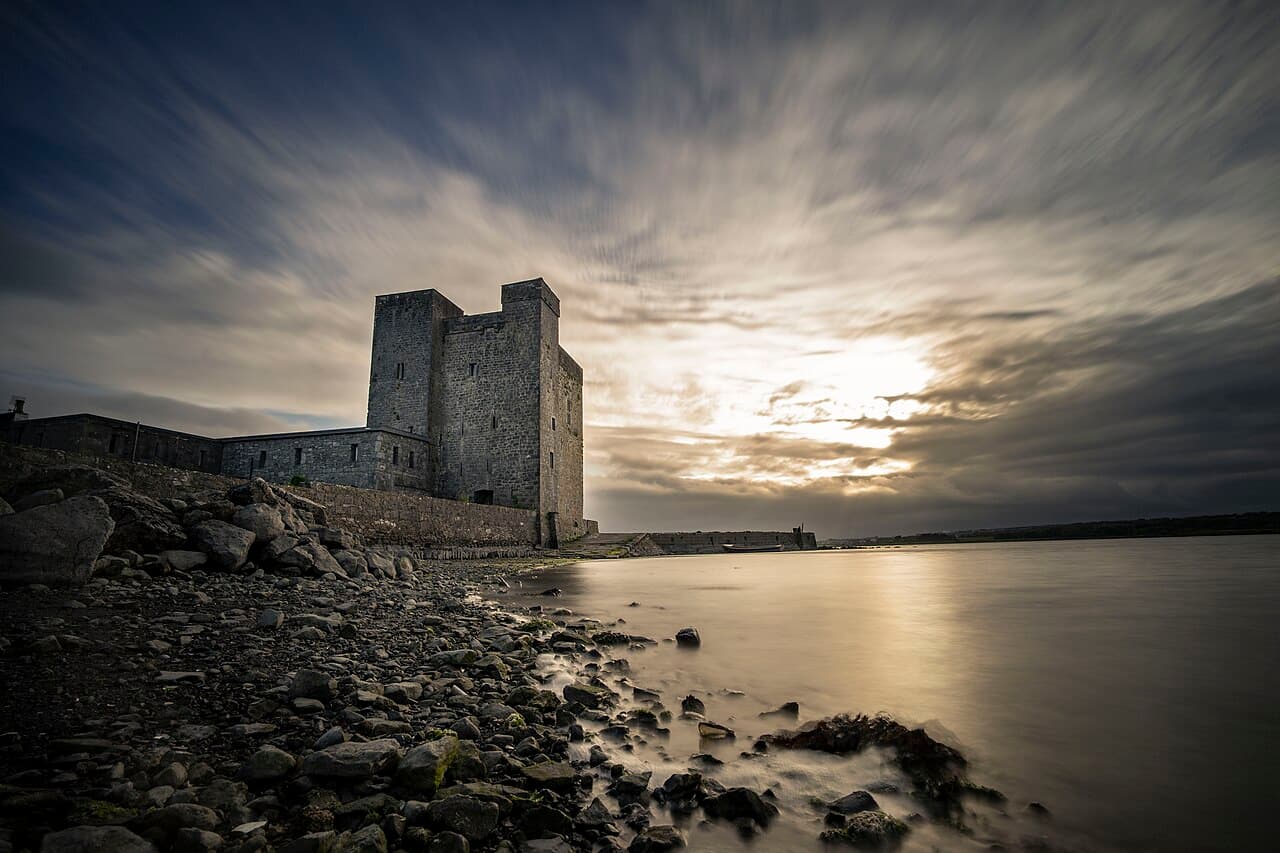
Oranmore Castle — Ireland castle

Oranmore Castle

Oranmore Castle, County Galway, Ireland
Oranmore, Ireland
Late Medieval (14th–15th c.)
Well Preserved

Oranmore Castle is a prominent late medieval hill castle located in Oranmore, County Galway, Ireland. Constructed in the 15th century, it exemplifies the typical defensive architecture of the period, strategically positioned to oversee the surrounding landscape and protect the local territory.

Historical context and origins

The castle was built during a time of significant political and social upheaval in Ireland, when local chieftains and Anglo-Norman lords fortified their holdings to assert control and defend against rival clans and invaders. Oranmore Castle's construction reflects the late medieval emphasis on strong fortifications with thick stone walls and limited entrances to enhance defense.

Originally owned by the Clanricarde family, a powerful Anglo-Norman dynasty in the west of Ireland, Oranmore Castle served as a key stronghold in the region. The castle's location near the coast provided strategic advantages for monitoring maritime activity and controlling access to Galway Bay.

Architectural features and design

The castle is a classic example of a tower house, a type of fortified residence common in Ireland during the late medieval period. It features a tall, rectangular stone tower rising several stories, with battlements crowning the top. The thick stone walls are punctuated by narrow slit windows designed for archers and later gunports for firearms.

The entrance is typically narrow and defensible, often accessed via a removable wooden staircase or a small gatehouse, enhancing security. Inside, the castle originally contained multiple floors with living quarters, storage rooms, and a great hall for gatherings and administrative functions.

The presence of a spiral staircase within the thick walls allowed defenders to move quickly between floors while limiting attackers' movement. The castle's design prioritized vertical defense and surveillance, with the upper floors offering commanding views of the surrounding countryside.

Later history and preservation

Over the centuries, Oranmore Castle witnessed various conflicts and changes in ownership. It suffered damage during the Cromwellian conquest of Ireland in the 17th century but remained largely intact. In modern times, the castle has been preserved as a significant historical monument, reflecting Ireland's medieval heritage.

Today, Oranmore Castle stands as a well-preserved example of a 15th-century tower house. Its survival offers valuable insights into the defensive strategies and domestic arrangements of late medieval Irish nobility.

Visiting Oranmore Castle

The castle is accessible to visitors interested in medieval architecture and Irish history. Its location in County Galway makes it a convenient site for tourists exploring the west of Ireland. While the interior may be limited in access due to preservation efforts, the exterior and surrounding grounds provide ample opportunity for photography and historical interpretation.

Visitors should check local resources for opening hours and any guided tours that may be available to enhance their understanding of the castle's historical significance.

Frequently asked questions (FAQ)

How do I get to Oranmore Castle?
Oranmore Castle is located just outside the village of Oranmore in County Galway, Ireland. The castle is easily accessible by car, with ample parking available nearby. Public transport options, including buses from Galway City, also provide convenient access to the area.
What is the historical significance of Oranmore Castle?
Oranmore Castle dates back to the 15th century and is an important example of medieval Irish architecture. It was originally built by the O'Flaherty clan and has served various functions throughout its history, including as a defensive stronghold. Today, it stands as a reminder of Ireland's rich history and feudal past.
When was Oranmore Castle built?
Oranmore Castle was constructed in the late 15th century, around 1490. Its strategic location near the sea made it a vital defensive structure during the turbulent periods of Ireland's history. Over the years, the castle has undergone various modifications but retains much of its original charm.
Can I visit Oranmore Castle?
Yes, visitors are welcome to explore the grounds of Oranmore Castle. However, access to the interior may be limited, as the castle is privately owned. It is recommended to check for any guided tours or special events that may provide a more in-depth experience.
Why is Oranmore Castle a popular tourist attraction?
Oranmore Castle attracts visitors due to its historical importance and picturesque setting. The castle's striking architecture and scenic surroundings make it a perfect spot for photography and exploration. Additionally, its proximity to Galway City adds to its appeal for tourists looking to experience Irish history.
Is it possible to host events at Oranmore Castle?
Hosting events at Oranmore Castle is possible, but arrangements must be made in advance with the property owners. Given the castle's historical significance and unique ambiance, it can be an enchanting venue for weddings, gatherings, and other special occasions. Contacting the management for availability and details is recommended.
What are the opening hours for Oranmore Castle?
The opening hours for Oranmore Castle can vary based on the season and any special events. Generally, the grounds are accessible during daylight hours, but it's advisable to check the official website or contact local tourism offices for the most accurate and current information.
What are the ticket prices for visiting Oranmore Castle?
There is typically no entrance fee to explore the grounds of Oranmore Castle, making it an affordable option for visitors. However, special guided tours or events may have associated costs. Always verify ahead of your visit for any potential charges related to specific activities.
What is the best time to visit Oranmore Castle?
The best time to visit Oranmore Castle is during the spring and summer months when the weather is generally milder and gardens are in full bloom. However, autumn also offers beautiful scenery with changing leaves. Consider visiting during weekdays to avoid larger crowds, especially in peak tourist season.
Are there any nearby attractions to explore while visiting Oranmore Castle?
Yes, there are several nearby attractions worth exploring, including the picturesque village of Oranmore itself. Visitors can also enjoy walking along the scenic coastline or visiting the nearby Galway Bay. A short drive will take you to the vibrant city of Galway, known for its rich culture and lively atmosphere.

Photo gallery

Oranmore Castle
Click to view

Photo by KevinSchnippkoweit•CC BY-SA 4.0

1 photo • Click any image to view in full screen

Information

Hill Castle

Loading map...

Visitor reviews

No reviews yet. Been here? Write the first review and help other travelers!

Write the first review

Visited this castle? Share your experience

Your review helps other travelers and adds first-hand knowledge to our encyclopedia.

Write a review

(5/5)

0/2000 characters

Your review will be visible after admin approval

Nearby castles

4.4 km

Merlinpark Castle

, United Kingdom

Merlinpark Castle is a significant example of a 15th-century Irish tower house, located approximately four kilometers east-northeast of Galway city center in the townland of Merlinpark, County Galway, Ireland. The castle embodies the architectural and historical characteristics of late medieval Irish fortified residences, built primarily for defense and domestic use by prominent Gaelic families during the late medieval period. Historical background and origins The site of Merlinpark Castle has a recorded history dating back to the 12th century, when it is believed to have been the location of an earlier fortification established by Tairrdelbach Ua Conchobair, the King of Connacht and High King of Ireland. This original fortification likely served as a strategic stronghold in the region, laying the foundation for the later construction of the tower house. The castle's initial name was Doughiske Castle, a designation used until the 18th century before the site became commonly known as Merlinpark Castle. The present structure dates to the 15th or 16th century, a period notable for the widespread construction of tower houses across Ireland. These buildings functioned as fortified homes for Gaelic and Anglo-Irish families, combining residential comfort with military defense. In the 16th century, Merlinpark Castle came under the ownership of the Lynch family (Ó Loingsigh), a prominent Galway family known for their influence and stewardship of the castle and its surrounding lands. Merlinpark Castle remained a residence until the mid-19th century, after which it ceased to be inhabited. Over time, the castle has gained recognition as a national monument due to its architectural significance and well-preserved state. Architectural features and structure Merlinpark Castle is a classic example of the Irish tower house typology, characterized by its vertical, rectangular stone tower design. The castle rises several stories high, with multiple floors stacked to maximize defensive capabilities and residential space within a compact footprint. This vertical emphasis was typical of tower houses, which needed to balance strong fortification with the practical needs of daily living. The castle’s stone walls remain largely intact, showcasing the sturdy masonry techniques employed during its construction. Defensive features likely included narrow windows and arrow slits, designed to provide protection against attackers while allowing occupants to observe and defend the surrounding area. Inside, the floors would have been divided into functional spaces such as a great hall, private chambers, storage rooms, and possibly a kitchen area, although detailed descriptions of the internal layout are limited. The tower house would have been accessed via a single main entrance, often protected by a fortified doorway and possibly a bawn (walled courtyard) surrounding the tower for additional defense. The sheela na gig carving One of the most notable features of Merlinpark Castle is the presence of a sheela na gig carving on the second floor. Sheela na gigs are stone carvings depicting a female figure, often in a crouching position with exaggerated anatomical features. These carvings are found on various medieval buildings across Ireland and Britain and are traditionally believed to serve as protective talismans against evil spirits and misfortune. The sheela na gig at Merlinpark Castle remains in situ and is an important cultural and historical artifact. Its presence indicates the castle’s connection to traditional Irish beliefs and practices, adding a layer of intangible heritage to the site's architectural significance. Historical significance and preservation Merlinpark Castle stands as a well-preserved monument to the medieval Gaelic Irish aristocracy and their architectural legacy. The castle’s survival into the present day provides valuable insight into the construction methods, defensive strategies, and domestic arrangements of tower houses in Ireland during the late medieval period. Its designation as a national monument ensures ongoing protection and recognition of its cultural importance. Despite the lack of extensive restoration work, the castle remains structurally sound and retains much of its original fabric, allowing visitors and scholars to appreciate its historical context firsthand. Located near Galway, a city with a rich medieval heritage, Merlinpark Castle contributes to the broader understanding of Ireland’s feudal past and the role of tower houses in regional power dynamics. The castle’s association with the Lynch family further ties it to the social and political history of Galway and the surrounding region. Visiting merlinpark castle Today, Merlinpark Castle is accessible to visitors interested in medieval Irish architecture and history. While the interior may not be fully developed for tourism, the castle’s exterior and surrounding landscape offer a glimpse into the defensive and residential design of tower houses. Visitors can explore the site’s stone walls, view the sheela na gig carving, and appreciate the castle’s setting within the Irish countryside. Its proximity to Galway makes it a convenient destination for those seeking to explore Ireland’s medieval heritage beyond urban centers.

Late Medieval (14th–15th c.)
Details
7.5 km

Kilcolgan Castle

, United Kingdom

Kilcolgan Castle stands as a remarkable example of neo-Gothic architecture set against the rich historical backdrop of County Galway, Ireland. This castle uniquely blends its early medieval origins with 19th-century romantic revival styles, reflecting centuries of architectural evolution and local history. The castle is built on the site of an original 11th-century stronghold established by Irish clans, which laid the foundation for the present structure. The site’s initial fortress was a typical medieval stronghold, constructed to assert control and provide defense for the surrounding lands. Over the centuries, this strategic location witnessed the passage of different ruling families and architectural influences. The original tower, parts of which survive within the current building, was integral to the defensive needs of the region during the early medieval period. The st george family and 19th-century transformation In 1801, Christopher St George, a prominent member of a Norman-Irish noble family, commissioned the construction of the present-day Kilcolgan Castle as a country residence. The St George family had a significant presence in the region, and Christopher’s lineage reflected the complex history of Norman influence in Ireland. His earlier work included commissioning Tyrone House in 1779, designed by the noted architect John Roberts, indicating the family’s taste for refined architecture. The new castle was built directly on the medieval site, integrating the remains of the original 11th-century tower into its structure. This fusion of old and new created a residence that honored its historical roots while embracing the romantic ideals of the neo-Gothic style popular in the early 19th century. The castle remained in the St George family estate for generations, symbolizing their enduring legacy in the area. Architectural features and design elements Neo-gothic style and medieval inspiration Kilcolgan Castle is distinguished by its neo-Gothic architectural style, characterized by pointed arches, crenellated battlements, and ornamental stonework. The castle’s most striking feature is its three-story tower, which consists of two main compartments and is capped with a distinctive pyramidal roof shaped like a spire. This vertical emphasis echoes medieval tower designs, creating a visual link to the site’s ancient origins. Materials and decorative details The castle’s construction primarily utilizes slate and limestone, materials traditionally favored in Irish building for their durability and aesthetic qualities. The use of cast iron in certain structural elements reflects the integration of industrial materials available during the castle’s 19th-century construction period. The limestone surfaces are richly decorated with carved reliefs and embossed horizontal bands, adding texture and artistic detail to the solid walls. Architectural features such as square pilasters and buttresses enhance both the structural integrity and the visual complexity of the castle. Windows with sharply pointed Gothic arches, especially prominent on the front and eastern towers, are connected by intricately carved stonework, showcasing skilled craftsmanship. Additional architectural elements Elements of Tudor-style arches are incorporated into the design, reflecting a nod to later medieval architectural traditions. The castle’s entrance is marked by richly ornamented gates, emphasizing its grandeur and status as a country residence rather than a purely defensive fortress. The battlements along the roofline feature crenellations and pointed openings, typical of neo-Gothic design and medieval defensive architecture. These features, preserved through restoration, contribute to the castle’s imposing silhouette and historic character. Restoration and preservation efforts In recent decades, Kilcolgan Castle has undergone restoration efforts led by W. N. Gustavson von Hillerstam and his daughter Karren, who sought to preserve the castle’s architectural heritage and maintain its structural condition. These efforts have been crucial in retaining the neo-Gothic features and the medieval elements embedded within the castle’s fabric. The restoration work ensures that Kilcolgan Castle remains a significant cultural and historical landmark in County Galway, offering visitors a glimpse into Ireland’s layered architectural history and the legacy of the Norman-Irish aristocracy. Historical significance and cultural heritage Kilcolgan Castle embodies the complex history of Ireland, from its early medieval clan-based society through the Norman invasion and into the romantic revival of the 19th century. Its architectural evolution tells a story of adaptation and continuity, blending defensive medieval features with the aesthetic aspirations of the neo-Gothic movement. Today, the castle stands not only as a private residence but also as a monument to the historical narratives of County Galway and the broader Irish context. Its preservation contributes to the cultural heritage of the region and serves as a valuable resource for understanding Ireland’s architectural and social history.

Details
9.7 km

Menlo Castle

Galway, United Kingdom

Menlo Castle stands as a striking example of a 16th-century Irish tower house located just outside Galway City on the banks of the River Corrib. This historic ruin, also known as Blake Castle, has a rich history intertwined with the prominent Blake family, who occupied the estate for over three centuries. Although the castle is now abandoned and overgrown with vegetation, it remains a significant cultural landmark visible from across the river, near the National University of Ireland, Galway. The castle’s origins date back to the mid-1500s, a period when fortified tower houses were commonly constructed by Gaelic and Anglo-Irish nobility throughout Ireland. The earliest confirmed construction phase began in 1569, when the castle was built as a defensive residence typical of the era. Historical records from 1574 indicate that Thomas Colman was an early occupant, emphasizing the castle’s role as a noble dwelling from its inception. By the turn of the 17th century, the castle came into the possession of the Blake family, influential landowners in Galway and surrounding counties, who maintained residence at Menlo Castle until the early 20th century. Architectural evolution and features The original structure of Menlo Castle was a square, turreted stone tower house designed for both defense and habitation. This style was typical of Irish tower houses, featuring thick stone walls, narrow windows for archers, and a fortified entrance. The castle’s strategic riverside location on the River Corrib provided natural protection and control over river access, an important consideration in the turbulent political landscape of 16th-century Ireland. In the 18th century, the Blake family expanded the castle by adding a large two-bay, four-storey residential block attached to the tower house. This extension marked a shift from purely defensive architecture to a more comfortable and stately home, reflecting changing domestic needs and architectural trends of the time. The addition altered the castle’s silhouette, creating a distinctive blend of medieval fortification and Georgian residential style. The 1910 fire and its aftermath Menlo Castle’s long-standing history was tragically interrupted on 26 July 1910, when a devastating fire engulfed the building. At the time, Sir Valentine Blake, 14th baronet, and Lady Blake were away in Dublin. The fire destroyed much of the castle’s interior and original furnishings. The most poignant loss was that of their disabled daughter, Eleanor Blake, who is believed to have perished in the fire; her body was never recovered, adding a layer of mystery and sorrow to the castle’s story. Following the fire, the castle was abandoned and gradually fell into ruin. The Blake estate was partitioned by the Irish Land Commission in 1923, breaking up the family holdings. Eventually, in July 2000, Galway City Council acquired the castle and surrounding lands through a compulsory purchase order, bringing the property under public ownership. Current condition and visitor experience Today, Menlo Castle remains a captivating ruin, its stone walls and turret still standing despite the passage of centuries and the ravages of fire. The castle is heavily overgrown with ivy and wild grapevines, which cloak the structure and blend it into the lush riverside environment. Visitors walking along the riverside path can glimpse the castle’s silhouette emerging from the greenery, accompanied by the ruins of a small stone hut nearby. The juxtaposition of the 16th-century defensive tower and the 18th-century residential extension offers a tangible narrative of architectural evolution, from medieval fortress to Georgian manor. The castle’s position on the riverbank remains a defining feature, providing insight into its original strategic importance. While Menlo Castle is not fully restored, its ruinous state preserves the historic fabric and atmosphere of the site. It serves as a poignant reminder of Ireland’s feudal past, the Blake family’s legacy, and the dramatic events that shaped the castle’s history. The site is accessible to the public, offering a quiet, reflective experience amidst Galway’s natural and historic landscape. Historical significance and cultural legacy Menlo Castle is a notable example of the Irish tower house tradition, which played a crucial role in the social and military history of Ireland during the 16th and 17th centuries. The castle’s continuous occupation by the Blake family for over 300 years highlights the stability and influence of Anglo-Irish nobility in the region. The tragic fire of 1910 and the subsequent abandonment of the castle add a layer of human drama and historical poignancy to the site. The story of Eleanor Blake’s disappearance has become part of local folklore, contributing to the castle’s mystique and cultural resonance. Today, Menlo Castle stands as a protected heritage site under the stewardship of Galway City Council. It is valued both for its architectural qualities and its role in the historical narrative of Galway and Ireland. The castle attracts historians, architecture enthusiasts, and visitors interested in Ireland’s medieval and early modern past. Architectural details The original tower house features thick stone walls typical of defensive structures, with narrow slit windows for archery and surveillance. The turreted corners provided vantage points for defense and observation. The 18th-century extension includes large sash windows and a more domestic layout, reflecting Georgian architectural influences. The castle’s riverside location was strategic for controlling access and providing natural defense. The ruins today show the layered construction phases and materials, including dressed stone and rubble masonry. Visiting information Menlo Castle is accessible via a riverside path popular with local walkers and university students. The site is open year-round, offering a peaceful setting for exploration and photography. Due to its ruinous and overgrown condition, visitors should exercise caution when approaching the structure. There are no formal visitor facilities or guided tours, so visitors are encouraged to respect the site and its surroundings.

Late Medieval (14th–15th c.)
Details

