Athenry Castle — Ireland castle

Athenry Castle

Athenry Castle: historic 13th-century tower house in Ireland
Athenry, Ireland
High Medieval (11th–13th c.)
Well Preserved

Athenry Castle is a significant example of a 13th-century tower house located in the town of Athenry, County Galway, Ireland. Recognized as a National Monument, this castle reflects the architectural and historical developments of the High Medieval period in Ireland. It stands as an enduring symbol of medieval fortification and settlement in the region.

Historical context and significance

Constructed in the 13th century, Athenry Castle was built during a period of Norman expansion into Ireland. The castle was part of a broader strategy to secure and control the surrounding lands, serving both military and administrative functions. Athenry itself developed as a planned medieval town, with the castle playing a central role in its defense and governance.

The castle's establishment coincided with the consolidation of Norman power in Connacht, making it an important stronghold in the region. Its presence contributed to the town's growth and prosperity during the medieval era.

Architectural features of Athenry Castle

Design and structure

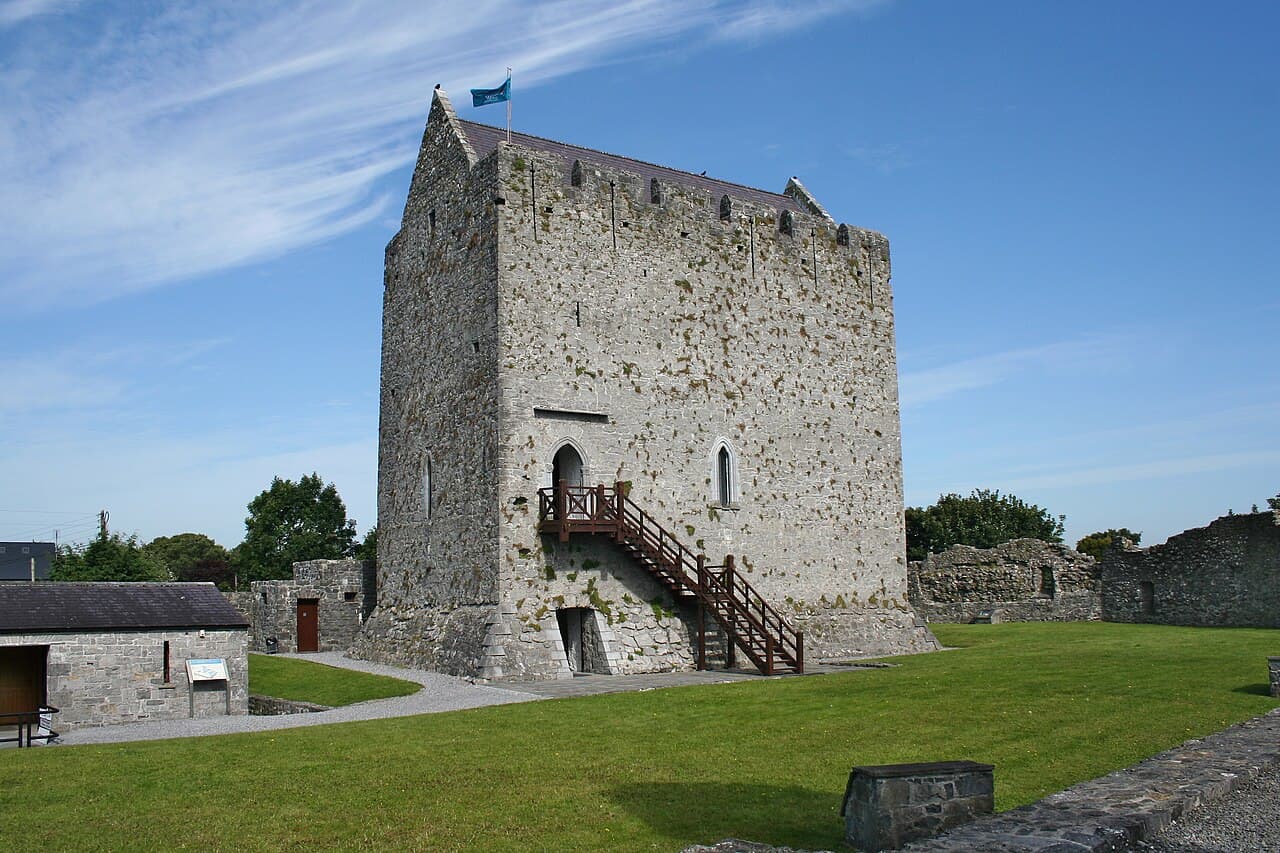
Athenry Castle exemplifies the typical characteristics of a High Medieval tower house. It is a rectangular stone structure, rising several stories high, designed primarily for defense and residence. The thick stone walls provided protection against attacks, while narrow windows and arrow slits allowed for surveillance and defense.

The castle features a prominent entrance doorway fortified with a murder hole and a , defensive elements common in medieval fortifications. Inside, the castle would have contained a great hall, private chambers, and storage areas, arranged vertically across the floors.

Defensive elements

The castle's elevated position on a slight hill enhances its defensive capabilities, allowing clear views of the surrounding landscape. The walls are reinforced with battlements and parapets to protect defenders. Although there is no surrounding moat, the natural terrain and constructed fortifications made it a formidable obstacle for attackers.

Role in local history and heritage

Throughout its history, Athenry Castle witnessed various conflicts and changes in ownership, reflecting the turbulent medieval and post-medieval periods in Ireland. It played a strategic role during local skirmishes and was a symbol of Norman authority in the region.

Today, the castle remains a key heritage site in Athenry, attracting visitors interested in medieval architecture and Irish history. Its preservation as a National Monument ensures ongoing protection and public access.

Preservation and visitor information

The castle is well preserved, with much of its original stonework and structural integrity intact. Restoration efforts have maintained its condition, allowing visitors to appreciate its medieval features firsthand.

Located within the town of Athenry, the castle is accessible to the public. Visitors can explore the exterior and some interior spaces, gaining insight into medieval defensive architecture and the lifestyle of its inhabitants.

Visiting tips

Visitors should check local opening hours and any guided tour availability. The castle is best visited during daylight hours to fully appreciate its architectural details and surrounding views.

Frequently asked questions

  • What is the historical importance of Athenry Castle? Athenry Castle is a key example of a 13th-century Norman tower house that played a central role in the defense and administration of medieval Athenry.
  • Can I visit inside Athenry Castle? Yes, visitors can access some interior areas, although parts may be restricted for preservation reasons.
  • When was Athenry Castle built? The castle was constructed in the 13th century during the High Medieval period.
  • What architectural style does Athenry Castle represent? It exemplifies High Medieval defensive architecture typical of Norman tower houses in Ireland.
  • Is Athenry Castle protected as a heritage site? Yes, it is designated as a National Monument, ensuring its preservation and protection.

Frequently asked questions (FAQ)

How do I get to Athenry Castle?
Athenry Castle is easily accessible by car and public transport. If you're traveling by train, the Athenry train station is just a short walk from the castle. There are also ample parking facilities nearby for those who prefer to drive.
What is the historical significance of Athenry Castle?
Athenry Castle, built in the late 12th century, is one of the best-preserved medieval castles in Ireland. It played a crucial role in the defense of the region and reflects the rich history of the medieval period in Ireland. The castle's architecture and its history offer a glimpse into the life and times of the Norman settlers.
When was Athenry Castle constructed?
Athenry Castle was constructed around 1241 AD by the Anglo-Norman lord, Meiler de Bermingham. It served as an important fortification for the area and has witnessed many historical events over the centuries. Its impressive structure has stood the test of time, making it a significant landmark.
Can I visit Athenry Castle year-round?
Yes, Athenry Castle is open to visitors throughout the year, although hours may vary seasonally. It’s advisable to check the official website for the latest information on opening hours and any special events. Guided tours are also available to enhance your experience.
Why is Athenry Castle a popular tourist attraction?
Athenry Castle attracts visitors for its historical importance and stunning medieval architecture. The castle is well-preserved, offering an authentic experience of Ireland's rich heritage. Additionally, its location in the picturesque town of Athenry adds to its appeal, with charming streets and local culture to explore.
Is it possible to take guided tours of Athenry Castle?
Yes, guided tours of Athenry Castle are available, providing visitors with in-depth insights into its history and architecture. These tours are led by knowledgeable guides who share fascinating stories about the castle's past. Reservations are recommended during peak tourist seasons to ensure availability.
What are the ticket prices for entering Athenry Castle?
Ticket prices for Athenry Castle are generally affordable, with discounts available for children, students, and seniors. Family tickets may also be offered for a better value. It's best to check the official website for the most current pricing and any special offers.
What is the best time to visit Athenry Castle?
The best time to visit Athenry Castle is during the spring and summer months when the weather is generally milder and more conducive to outdoor activities. These months also see a variety of events and festivals in the area. However, visiting in the off-peak season can offer a quieter, more intimate experience of the castle.
Are there any nearby attractions to Athenry Castle?
Yes, there are several attractions near Athenry Castle, including the historic town of Athenry itself, which features charming shops and cafes. Additionally, the nearby Athenry Heritage Centre offers more insights into the area's history. The scenic countryside surrounding the castle is perfect for leisurely walks and exploration.

Photo gallery

Athenry Castle
Click to view

Photo by Ingo Mehling•CC BY-SA 3.0

1 photo • Click any image to view in full screen

Information

Hill Castle

Loading map...

Visitor reviews

No reviews yet. Been here? Write the first review and help other travelers!

Write the first review

Visited this castle? Share your experience

Your review helps other travelers and adds first-hand knowledge to our encyclopedia.

Write a review

(5/5)

0/2000 characters

Your review will be visible after admin approval

Nearby castles

0.2 km

Athenry Castle

Athenry, United Kingdom

Athenry Castle stands as a prominent example of a 13th-century Anglo-Norman tower house in the town of Athenry, Ireland. Known locally as "King John's Castle" despite being built two decades after King John's reign, this castle embodies the architectural and historical significance of medieval Ireland under Anglo-Norman influence. Its strategic location on a natural rise overlooking the River Clarin ford highlights its role in controlling vital transit routes and regional defense. Architectural features and design The castle is a large rectangular tower house characterized by battered walls that slope outward at the base, a defensive technique typical of the high medieval period. This feature strengthened the structure against siege tactics and made scaling the walls more difficult for attackers. Originally, the castle was designed with a single large hall on the upper floor, which served as the main living and gathering space, while the ground floor was used for storerooms and practical functions. The main entrance was located on the first-floor level and accessed via an external wooden staircase, a common defensive measure to restrict direct entry from ground level. Inside, a built-in staircase within the thickness of the walls provided discrete vertical circulation to the upper levels. The castle's battlements date from the 13th century, featuring tall arrow slits set into the merlons of the parapet, which allowed defenders to fire upon attackers while remaining protected. In the 15th century, modifications were made to the castle’s roofline when the parapets at the north and south ends were incorporated into gabled structures to support a new roof. Functional elements such as a garderobe (medieval latrine) are positioned diagonally opposite the main entrance, reflecting thoughtful spatial planning within the keep. The castle was heated by a brazier placed centrally in the hall, with smoke vented through a louver in the roof above. Decorative stone carvings embellish the castle’s doorway and two window openings. These carvings display floral motifs characteristic of the School of the West, an artistic style that marks the transition from Romanesque to late Gothic influences in western Ireland. These surviving carvings are valued as fine examples of medieval stone craftsmanship. Historical context and significance Constructed between 1235 and 1240 by Anglo-Norman settlers, Athenry Castle served as the stronghold of the Bermingham family, who played a key role in overseeing the surrounding lands and securing important transit points. The castle's alternate name, "King John's Castle," reflects local tradition rather than historical accuracy, as it postdates King John's reign by about twenty years. In the mid-13th century, Meyler de Bermingham expanded the castle, enhancing its size and defensive capabilities, marking the beginning of its prominence in the region. The early 14th century brought conflict; in 1316, the castle was attacked during regional unrest involving Irish clans. This event prompted the construction of fortified walls around the town of Athenry, underscoring the escalating tensions and the need for enhanced protection. By the 15th century, the Bermingham family shifted their residence to a townhouse near the marketplace, indicating a change in their lifestyle and local power dynamics. However, the castle retained military importance into the late 16th century. During the Nine Years' War in 1596, it was seized by the O'Donnell clan, reflecting its continued strategic significance in the struggle for Irish independence from English rule. Throughout its history, the castle's owners held the noble title of Barons of Athenry. Its location on a rise overlooking the west bank of the River Clarin allowed control over a crucial ford, reinforcing its administrative and military role in the region. Surviving structures and preservation Today, Athenry Castle remains a well-preserved example of medieval defensive architecture. The large rectangular tower house retains its characteristic battered walls and battlements with tall arrow slits. The 15th-century adaptations to the roofline and parapets are still evident, showcasing the castle's architectural evolution over centuries. Remnants of the original enclosure wall survive, including defensive towers at the northeast and southeast corners, and a fortified gate at the southwestern corner. These features illustrate the layered defensive system that protected the castle and its inhabitants. The castle's position on a natural rise overlooking the river ford not only provided military advantages but also contributed to its prominence in the landscape. Conservation efforts, including a restoration completed in 2005, have helped preserve the castle's historical fabric, making it a significant national monument in Ireland. Cultural and architectural legacy Athenry Castle exemplifies the architectural and historical legacy of Anglo-Norman settlement in Ireland. Its combination of defensive features, residential spaces, and artistic stonework reflects the multifaceted role of castles as military fortresses, noble residences, and symbols of power. The castle's stone carvings, particularly those associated with the School of the West, contribute to our understanding of regional artistic developments during the transition from Romanesque to Gothic styles. As a national monument, Athenry Castle continues to attract visitors interested in medieval architecture, Irish history, and the complex social dynamics of the high medieval period.

High Medieval (11th–13th c.)
Details
13.2 km
Oranmore Castle — Ireland castle

Oranmore Castle

Oranmore, Ireland

Oranmore Castle is a prominent late medieval hill castle located in Oranmore, County Galway, Ireland. Constructed in the 15th century, it exemplifies the typical defensive architecture of the period, strategically positioned to oversee the surrounding landscape and protect the local territory. Historical context and origins The castle was built during a time of significant political and social upheaval in Ireland, when local chieftains and Anglo-Norman lords fortified their holdings to assert control and defend against rival clans and invaders. Oranmore Castle's construction reflects the late medieval emphasis on strong fortifications with thick stone walls and limited entrances to enhance defense. Originally owned by the Clanricarde family, a powerful Anglo-Norman dynasty in the west of Ireland, Oranmore Castle served as a key stronghold in the region. The castle's location near the coast provided strategic advantages for monitoring maritime activity and controlling access to Galway Bay. Architectural features and design The castle is a classic example of a tower house, a type of fortified residence common in Ireland during the late medieval period. It features a tall, rectangular stone tower rising several stories, with battlements crowning the top. The thick stone walls are punctuated by narrow slit windows designed for archers and later gunports for firearms. The entrance is typically narrow and defensible, often accessed via a removable wooden staircase or a small gatehouse, enhancing security. Inside, the castle originally contained multiple floors with living quarters, storage rooms, and a great hall for gatherings and administrative functions. The presence of a spiral staircase within the thick walls allowed defenders to move quickly between floors while limiting attackers' movement. The castle's design prioritized vertical defense and surveillance, with the upper floors offering commanding views of the surrounding countryside. Later history and preservation Over the centuries, Oranmore Castle witnessed various conflicts and changes in ownership. It suffered damage during the Cromwellian conquest of Ireland in the 17th century but remained largely intact. In modern times, the castle has been preserved as a significant historical monument, reflecting Ireland's medieval heritage. Today, Oranmore Castle stands as a well-preserved example of a 15th-century tower house. Its survival offers valuable insights into the defensive strategies and domestic arrangements of late medieval Irish nobility. Visiting Oranmore Castle The castle is accessible to visitors interested in medieval architecture and Irish history. Its location in County Galway makes it a convenient site for tourists exploring the west of Ireland. While the interior may be limited in access due to preservation efforts, the exterior and surrounding grounds provide ample opportunity for photography and historical interpretation. Visitors should check local resources for opening hours and any guided tours that may be available to enhance their understanding of the castle's historical significance.

Late Medieval (14th–15th c.)
Details
13.6 km

Kilcolgan Castle

, United Kingdom

Kilcolgan Castle stands as a remarkable example of neo-Gothic architecture set against the rich historical backdrop of County Galway, Ireland. This castle uniquely blends its early medieval origins with 19th-century romantic revival styles, reflecting centuries of architectural evolution and local history. The castle is built on the site of an original 11th-century stronghold established by Irish clans, which laid the foundation for the present structure. The site’s initial fortress was a typical medieval stronghold, constructed to assert control and provide defense for the surrounding lands. Over the centuries, this strategic location witnessed the passage of different ruling families and architectural influences. The original tower, parts of which survive within the current building, was integral to the defensive needs of the region during the early medieval period. The st george family and 19th-century transformation In 1801, Christopher St George, a prominent member of a Norman-Irish noble family, commissioned the construction of the present-day Kilcolgan Castle as a country residence. The St George family had a significant presence in the region, and Christopher’s lineage reflected the complex history of Norman influence in Ireland. His earlier work included commissioning Tyrone House in 1779, designed by the noted architect John Roberts, indicating the family’s taste for refined architecture. The new castle was built directly on the medieval site, integrating the remains of the original 11th-century tower into its structure. This fusion of old and new created a residence that honored its historical roots while embracing the romantic ideals of the neo-Gothic style popular in the early 19th century. The castle remained in the St George family estate for generations, symbolizing their enduring legacy in the area. Architectural features and design elements Neo-gothic style and medieval inspiration Kilcolgan Castle is distinguished by its neo-Gothic architectural style, characterized by pointed arches, crenellated battlements, and ornamental stonework. The castle’s most striking feature is its three-story tower, which consists of two main compartments and is capped with a distinctive pyramidal roof shaped like a spire. This vertical emphasis echoes medieval tower designs, creating a visual link to the site’s ancient origins. Materials and decorative details The castle’s construction primarily utilizes slate and limestone, materials traditionally favored in Irish building for their durability and aesthetic qualities. The use of cast iron in certain structural elements reflects the integration of industrial materials available during the castle’s 19th-century construction period. The limestone surfaces are richly decorated with carved reliefs and embossed horizontal bands, adding texture and artistic detail to the solid walls. Architectural features such as square pilasters and buttresses enhance both the structural integrity and the visual complexity of the castle. Windows with sharply pointed Gothic arches, especially prominent on the front and eastern towers, are connected by intricately carved stonework, showcasing skilled craftsmanship. Additional architectural elements Elements of Tudor-style arches are incorporated into the design, reflecting a nod to later medieval architectural traditions. The castle’s entrance is marked by richly ornamented gates, emphasizing its grandeur and status as a country residence rather than a purely defensive fortress. The battlements along the roofline feature crenellations and pointed openings, typical of neo-Gothic design and medieval defensive architecture. These features, preserved through restoration, contribute to the castle’s imposing silhouette and historic character. Restoration and preservation efforts In recent decades, Kilcolgan Castle has undergone restoration efforts led by W. N. Gustavson von Hillerstam and his daughter Karren, who sought to preserve the castle’s architectural heritage and maintain its structural condition. These efforts have been crucial in retaining the neo-Gothic features and the medieval elements embedded within the castle’s fabric. The restoration work ensures that Kilcolgan Castle remains a significant cultural and historical landmark in County Galway, offering visitors a glimpse into Ireland’s layered architectural history and the legacy of the Norman-Irish aristocracy. Historical significance and cultural heritage Kilcolgan Castle embodies the complex history of Ireland, from its early medieval clan-based society through the Norman invasion and into the romantic revival of the 19th century. Its architectural evolution tells a story of adaptation and continuity, blending defensive medieval features with the aesthetic aspirations of the neo-Gothic movement. Today, the castle stands not only as a private residence but also as a monument to the historical narratives of County Galway and the broader Irish context. Its preservation contributes to the cultural heritage of the region and serves as a valuable resource for understanding Ireland’s architectural and social history.

Details