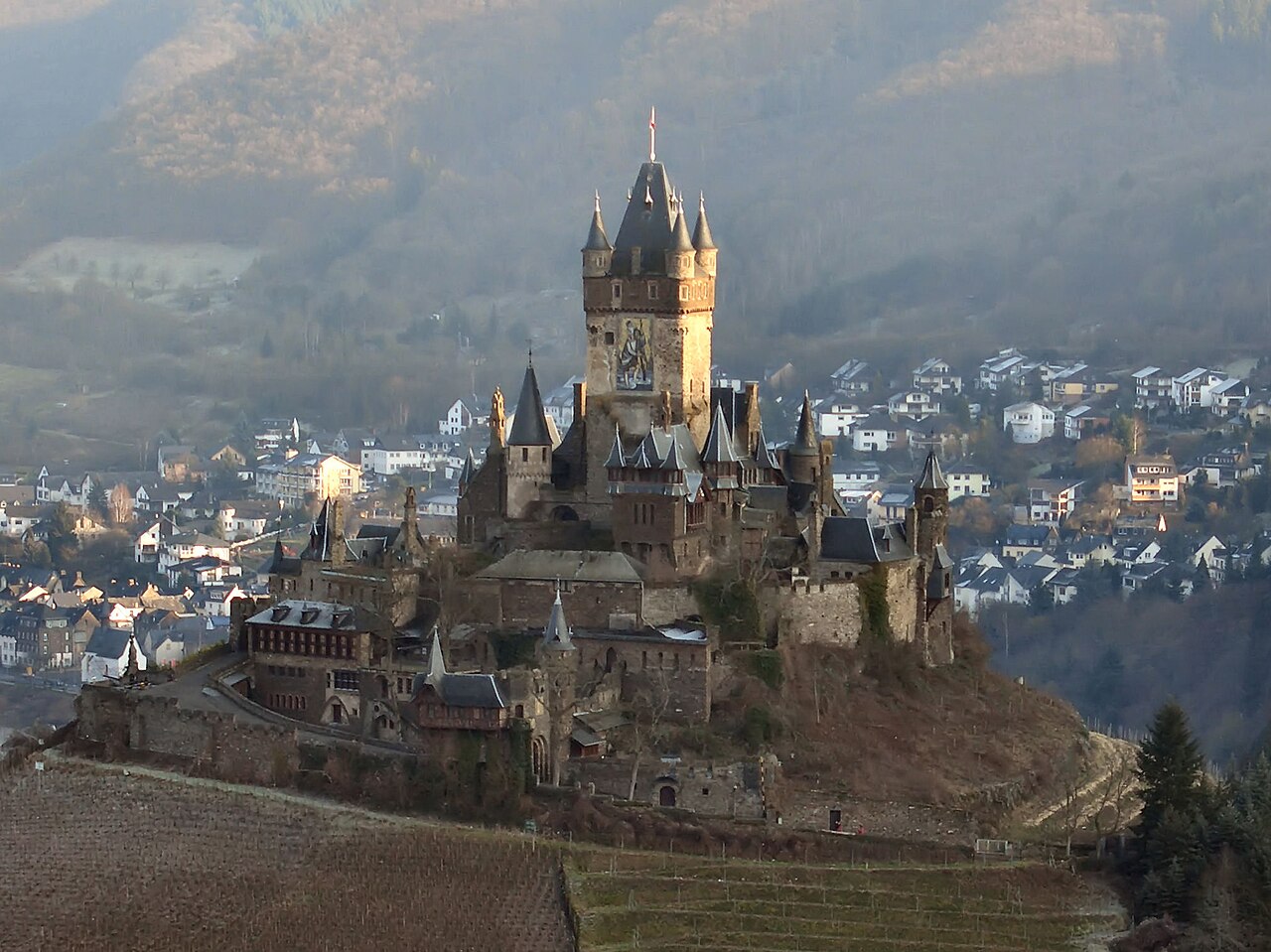
Arras Castle, located near the municipality of Alf in Germany, occupies a site with a long history of strategic importance along the Moselle River. The castle stands on the grounds of an ancient Roman hill fort, originally established as a fortified horse station during late antiquity. This location underscores the continuous military and administrative significance of the site from Roman times through the medieval period.
The castle's origins are traditionally linked to the 10th century, with the keep thought to have been constructed around 936 AD. However, historical documentation first mentions the castle in 1120, during the consecration of its chapel under the name "castrum atrebatum." The early 12th century marks the beginning of the castle's recorded history, with evidence of extensive fortifications including defensive ring walls, a gate, a chapel, a communal well, a moat, and multiple towers by around 1140. These features reflect the castle's role as a fortified noble residence and military stronghold.
Medieval history and ownership
During the medieval period, Arras Castle was held by prominent regional powers. Initially under the authority of the Palatinate counts, it later passed to the Archbishops and Electors of Trier, a major ecclesiastical principality. In 1137, the castle was seized by the Lords of Entersburg but was soon retaken by Archbishop Albero after a siege, reaffirming Trier's control.
From the late 12th century onward, the castle became the seat of the knightly family von Arras, with Hermann von Harras documented as a proprietor in 1179. Throughout the 15th century, the estate was divided among noble families such as Ludwig Zandt von Merl and the Metzenhausen lineage, who held it as fiefs granted by the Archbishop of Trier. By the late 17th century, part ownership passed through marriage to Adam Heinrich Freiherr von Breiten-Landenberg.
Destruction and decline in the 17th and 18th centuries
The military significance of Arras Castle ended during the Nine Years’ War (1688–1697), also known as the Palatinate War of Succession. In October 1689, French troops nearly destroyed the castle, sparing only the central keep, which withstood demolition efforts. This event marked a decisive end to the castle's active defensive role.
Following the French Revolutionary occupation in 1794, the castle ruins became state property. After the Congress of Vienna in 1815, the territory was transferred to Prussia, and the castle and surrounding lands were sold to private owners. The ruin remained largely neglected during this period.
Restoration and modern adaptation
In 1895, mining director Traugott Wilhelm Dyckerhoff acquired the property. Beginning in 1907, Dyckerhoff initiated extensive restoration work to preserve the surviving medieval structures, particularly the keep and curtain walls. The restoration was overseen by architect Peter Marx from Trier. Dyckerhoff was later buried on the site, honoring a medieval burial right that was officially recognized again in 1952.
Subsequent owners continued to restore and adapt the castle. In 1938, art dealer Ernst Rademacher and judge Theo Homburg took ownership. They rebuilt the Cavalier’s Wing in 1954, blending modern residential spaces with the medieval fabric. Between 1978 and 1984, Maria and Otto Keuthen converted the castle into a hotel and restaurant, ensuring its continued use and preservation.
Architectural features and layout
Arras Castle exemplifies a classic hill castle design, featuring a defensive ring wall, fortified gate structures, a chapel, and multiple towers. The central feature is a tall rectangular keep, approximately 20 meters high with walls up to four meters thick. While earlier scholarship attributed the keep to the Salian period, recent studies date it to the mid-13th century, based on its distinctive bossage stonework, likely constructed during the tenure of Archbishop Arnold II (1242–1259).
The keep's original high entrance led to living quarters on the upper floor, now sealed. Beneath the tower lies a cistern with a capacity of 3.6 cubic meters, designed to collect rainwater from the roofs. This was crucial since the main well, 34 meters deep, was located outside the castle walls, highlighting the strategic planning to secure water supply during sieges.
Additional defensive elements include well-preserved towers and a two-story dungeon situated under one of the wall towers, historically used as a prison. The surrounding curtain walls and remnants of a moat form the castle's defensive perimeter. Despite the near destruction in 1689, portions of these fortifications remain intact.
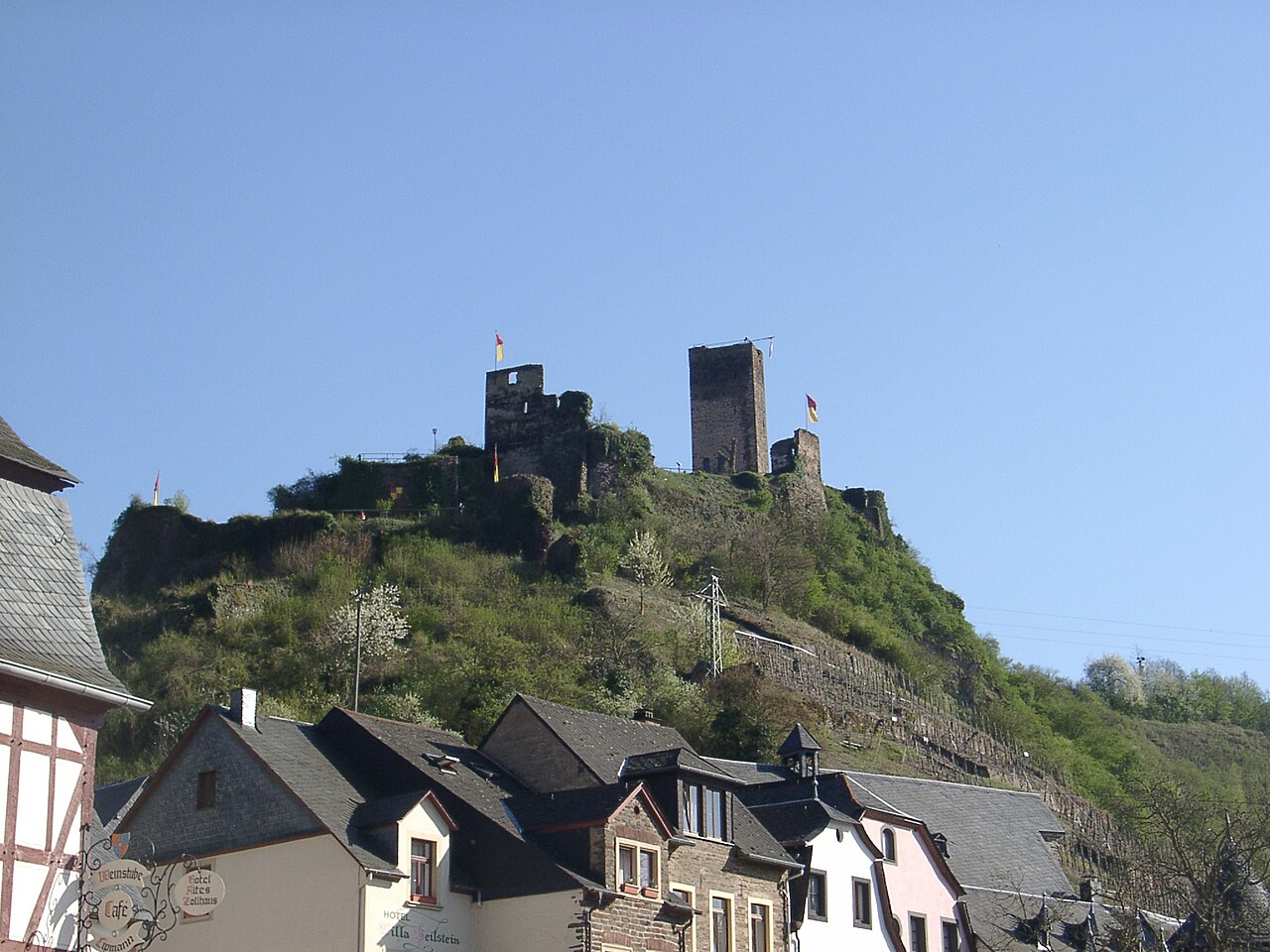
Nearby lie the ruins of Heideburg, another medieval fortress with remaining wall sections and a moat, illustrating the density of fortified sites in the region.
Cultural significance and current use
Today, Arras Castle functions as a hotel and restaurant, combining its rich medieval heritage with modern hospitality. The site preserves a unique medieval burial right, still recognized in the 20th century, linking past traditions with contemporary use. The castle's restoration and adaptive reuse demonstrate the value placed on historic preservation within Germany's Moselle region.
The castle's layered history, from Roman fortification to medieval stronghold and modern hospitality venue, offers visitors a tangible connection to over a millennium of European history. Its architectural features provide insight into medieval defensive strategies and noble residence design, while its survival through conflict and restoration reflects broader historical trends in castle conservation.
Frequently asked questions (FAQ)
- When was Arras Castle originally built?
- Arras Castle's origins likely date back to around 936 AD, with the first documented mention in 1120.
- What architectural features define Arras Castle?
- The castle features a tall rectangular keep with thick walls, defensive ring walls, towers, a chapel, a moat, and a cistern for water storage.
- Can visitors stay at Arras Castle today?
- Yes, Arras Castle operates as a hotel and restaurant, offering accommodations and dining experiences within the historic setting.
- What happened to Arras Castle during the Nine Years' War?
- The castle was nearly destroyed by French troops in 1689, with only the central keep surviving the demolition attempts.
- Who was responsible for the 20th-century restoration of the castle?
- Mining director Traugott Wilhelm Dyckerhoff initiated restoration in 1907, with architect Peter Marx overseeing the work.
Information
Sources & official resources
Verify the information above using these authoritative references.
Loading map...
Visitor reviews
No reviews yet. Been here? Write the first review and help other travelers!
Write the first reviewVisited this castle? Share your experience
Your review helps other travelers and adds first-hand knowledge to our encyclopedia.