Cochem Castle
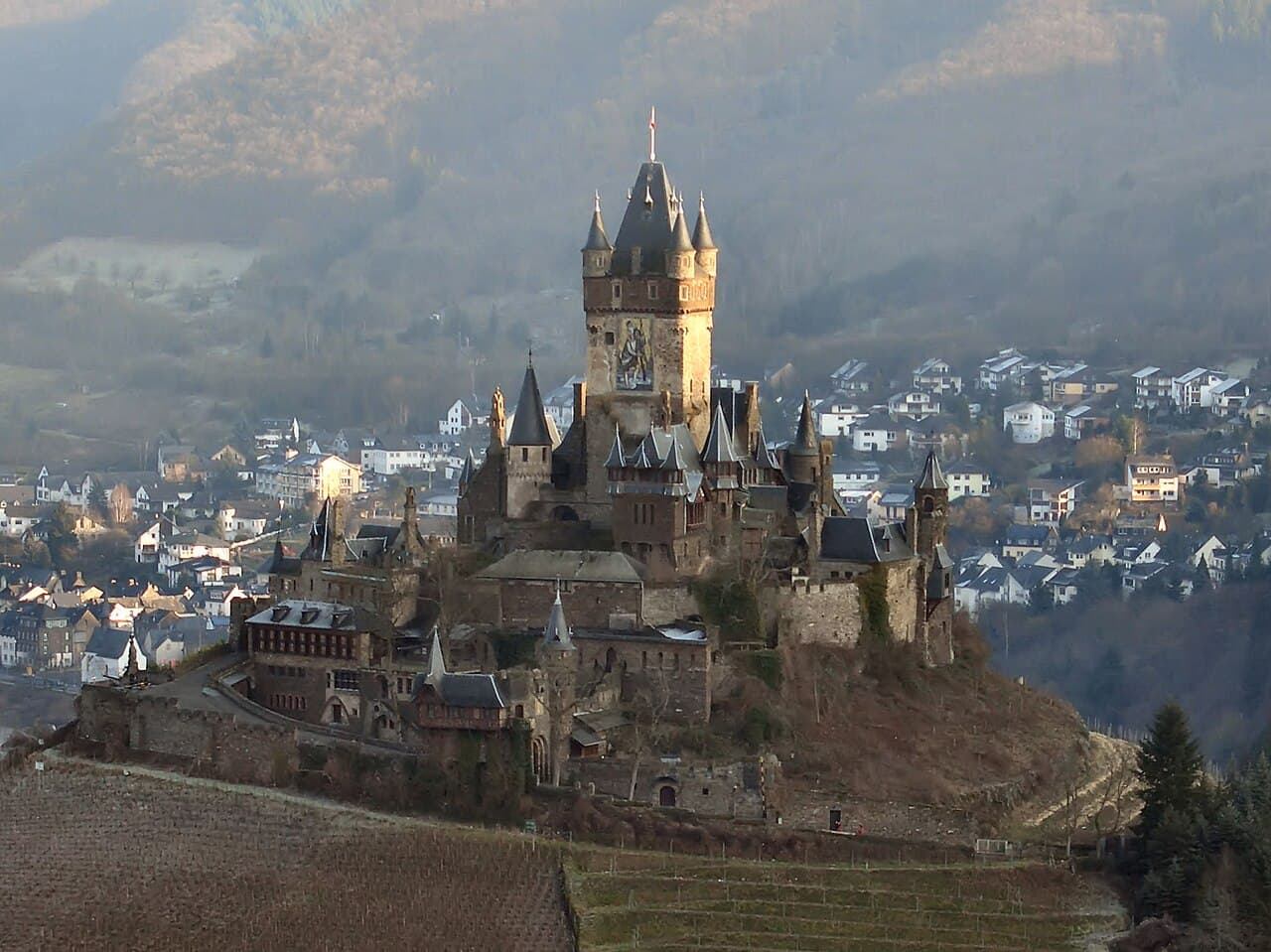
Cochem Castle, also known as Reichsburg Cochem, majestically crowns a hill overlooking the scenic Moselle River in the town of Cochem, Rhineland-Palatinate, Germany. Though the castle visible today is largely a 19th-century neo-Gothic reconstruction, its origins date back to the early 12th century, around 1100. The castle’s strategic location atop a steep hill about 300 feet above the river enabled it to control and collect tolls from passing river traffic, marking it as a crucial fortification in the region.
The original fortress had a long and turbulent history before its destruction in 1689 by French troops during the War of the Palatine Succession. This event left the castle in ruins for nearly two centuries until it was purchased and rebuilt by the wealthy Berlin merchant Louis Jacques Ravené beginning in 1868. Unlike a faithful restoration, Ravené’s vision transformed the castle into a romantic neo-Gothic summer residence, blending original medieval elements with imaginative 19th-century architectural features. This reconstruction reflects the 19th-century fascination with medieval revivalism and the romantic idealization of castles.
Early medieval origins and strategic importance
The earliest reliable mention of Cochem Castle dates to around 1130, attributed to Pfalzgraf Wilhelm von Ballenstedt. The castle’s initial construction is credited to Siegfried von Ballenstedt of the Ezzonen dynasty. Its primary function was to serve as a toll castle, controlling river traffic on the Moselle and asserting territorial authority.
In 1151, King Conrad III ended a dispute over the castle’s ownership by laying siege to it and subsequently incorporating it as an official Imperial Castle (Reichsburg). This elevated the castle’s status, making it a key administrative center for imperial estates in the Holy Roman Empire. Over the following centuries, the castle changed hands multiple times, including possession by the Habsburg King Rudolf in 1282 and later by King Adolf of Nassau in 1294, who pawned it to finance his coronation.
Administration under the Electorate of Trier
After King Adolf’s successor, Albrecht I, was unable to redeem the pledge, the castle was granted to the Archbishop and Electorate of Trier. From the 14th to the 16th century, the castle was expanded and fortified under Trier’s administration. The Electorate’s control brought wealth and power, largely derived from toll revenues on the Moselle River. The castle’s administration transitioned to civil bailiffs (Amtsmänner) in 1419, reflecting its growing role as a regional governmental center.
Destruction and decline in the late 17th century
The castle’s military significance made it a target during the turbulent conflicts of the late 17th century. French forces invaded the Rhine and Moselle regions in 1688 during the War of the Palatine Succession. Cochem Castle was conquered and deliberately destroyed in 1689 by French troops as part of a scorched-earth policy, which also devastated the town of Cochem and surrounding areas. The castle was subjected to burning, undermining, and explosions, leaving it a ruined shell.
Following the destruction, the castle remained a ruin for approximately 180 years. During this period, the region changed hands multiple times between France and Prussia until the Congress of Vienna in 1815 definitively assigned the Palatinate and Cochem to Prussia.
The ravené reconstruction and neo-gothic transformation
In 1868, Louis Jacques Ravené, a wealthy Berlin businessman and art lover, purchased the ruins of Cochem Castle. Rather than restoring the castle to its original Romanesque form, Ravené commissioned Berlin architects to rebuild it in a romanticized neo-Gothic style. Construction primarily took place between 1874 and 1877, with final interior work completed by his son Louis Auguste Ravené by 1890.
The reconstructed castle incorporated surviving medieval elements, notably the four-story octagonal tower and the Hexenturm (Witches’ Tower). The Hexenturm, named for its legendary use in witch trials, is a three-story round tower dating from the 14th or 15th century that survived the 1689 destruction. It features traces of Gothic wall paintings and a conical roof added during the 19th-century restoration.
The new castle was designed to serve as a summer residence and showcase a vast art collection assembled by the Ravené family, though much of the collection was lost during World War II. The castle’s layout includes a polygonal ring wall, multiple gates, a knights’ hall, a dining hall with a large carved buffet, and richly decorated rooms featuring Renaissance and Baroque furnishings.
Architectural features and defensive structures
The castle’s defensive system historically included four successive gates, thick curtain walls, and a powerful main tower with walls tapering from 3.5 meters thick at the base to 1.8 meters at the top. The castle controlled river traffic with a heavy chain operated from the fortress to regulate ships on the Moselle.
Among the noteworthy architectural elements is the large mosaic of Saint Christopher on the northwest side of the main tower. Originally created in 1877 by Italian artist Antonio Salviati, the mosaic was destroyed during the Nazi era and replaced in 1960 by a new mosaic designed by Ina Stein-Wiese.
Modern history and current status
During the Nazi period, the Ravené family was compelled to sell the castle to the Prussian Ministry of Justice in 1942, which converted it into a legal training center. After World War II, the castle became state property of Rhineland-Palatinate. In 1978, the town of Cochem purchased the castle, which is now administered by a private company, Reichsburg GmbH.
Today, Cochem Castle serves as a popular tourist attraction featuring guided tours, a falconry show, and a restaurant with panoramic views of the Moselle Valley. Visitors can explore the castle’s richly decorated interiors, climb the towers, and enjoy the stunning vistas of the surrounding vineyards and river landscape.
While some critics consider the castle’s 19th-century reconstruction to be more romantic fantasy than authentic medieval fortress, the site’s layered history and architectural evolution offer valuable insights into the region’s cultural heritage. The castle’s blend of original medieval structures and neo-Gothic revival elements make it a fascinating example of historic preservation and reinterpretation.
Visitor experience and practical information
The castle is accessible via a steep 20-minute walk from Cochem’s town center along a narrow paved road. Alternatively, visitors may take a shuttle bus or drive up Schlossstraße, though parking is limited near the castle. Entrance is by guided tour only, with tickets costing around 5 euros per adult. The castle’s Sonnenterrasse restaurant provides an excellent spot to relax and enjoy food and drink while taking in the breathtaking views.
Events such as falconry demonstrations add to the castle’s appeal, making it a lively cultural venue that connects visitors with the medieval and romantic past of the Moselle region.
Frequently asked questions (FAQ)
- How do I get to Cochem Castle?
- Cochem Castle is easily accessible by car and public transport. If you're traveling by train, you can take a train to Cochem and then enjoy a scenic walk or a short bus ride up to the castle.
- What is the historical significance of Cochem Castle?
- Cochem Castle, also known as Reichsburg Cochem, has a rich history dating back to the 11th century. It served as a royal residence and a strategic fortification, playing a significant role in the region's history during the Middle Ages.
- When was Cochem Castle built?
- Cochem Castle was first constructed in the early 11th century, around 1051. The castle has undergone several renovations and restorations over the years, especially after being destroyed in the 17th century and rebuilt in the 19th century.
- Can I take guided tours of Cochem Castle?
- Yes, guided tours are available at Cochem Castle, providing visitors with in-depth insights into its history and architecture. These tours are available in several languages and are a great way to enhance your visit.
- Why is Cochem Castle a popular tourist destination?
- Cochem Castle is popular due to its stunning hilltop location, breathtaking views of the Moselle River, and its well-preserved medieval architecture. Additionally, the castle's fascinating history and engaging tours attract many visitors each year.
- Is it possible to host events at Cochem Castle?
- Yes, Cochem Castle offers facilities for hosting various events, including weddings and corporate gatherings. The picturesque backdrop and historical ambiance make it a unique venue for special occasions.
- What are the opening hours for Cochem Castle?
- Cochem Castle is typically open to visitors from 9 AM to 5 PM during the main tourist season, but hours may vary in the off-season. It's advisable to check the official website for the most current opening times before your visit.
- What are the ticket prices for Cochem Castle?
- Ticket prices for Cochem Castle generally range from 7 to 10 euros for adults, with discounts available for children and families. Guided tours may have an additional fee, so be sure to check the details when planning your visit.
- When is the best time to visit Cochem Castle?
- The best time to visit Cochem Castle is during the spring or early fall when the weather is mild and the surrounding landscape is particularly beautiful. Additionally, visiting during weekdays can help you avoid larger crowds.
- Are there any nearby attractions to visit after Cochem Castle?
- Yes, after exploring Cochem Castle, you can visit the charming town of Cochem, stroll along the Moselle River, or take a wine tour in the surrounding vineyards. The region is known for its picturesque scenery and rich wine culture, making it a great area to explore further.
Photo gallery

Information
Website
Visit websiteSources & official resources
Verify the information above using these authoritative references.
Loading map...
Visitor reviews
No reviews yet. Been here? Write the first review and help other travelers!
Write the first reviewVisited this castle? Share your experience
Your review helps other travelers and adds first-hand knowledge to our encyclopedia.