Ark of Bukhara
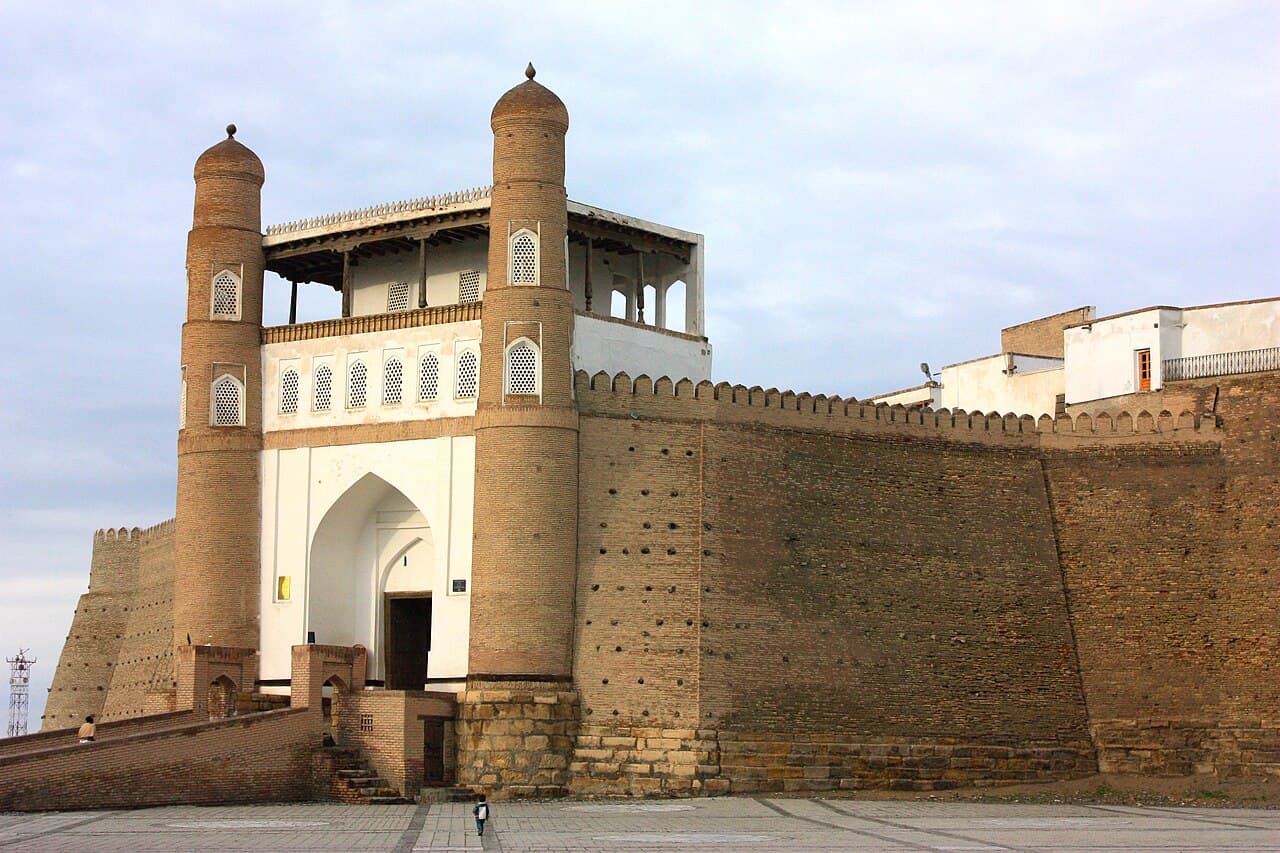
The Ark of Bukhara is a monumental bastioned fortress located in the historic city of Bukhara, Uzbekistan. Its origins trace back to the 5th century AD, making it one of the oldest fortresses in Central Asia. However, the fortress as it is known today largely developed during the 16th century under the rule of the Shaybanid Uzbek dynasty. The Ark served not only as a military stronghold but also as a fortified royal residence and administrative center, encompassing a self-contained town within its walls.
Historical development and significance
The Ark's initial construction began in the early medieval period, with archaeological evidence supporting its use from the 5th century AD. Over the centuries, it underwent numerous reconstructions and expansions, reflecting the changing political and military needs of the region. The most significant transformation occurred in the 16th century when the Shaybanids fortified the structure with bastions and thick defensive walls, adapting it to the evolving art of warfare during the Renaissance period.
Throughout its history, the Ark was the seat of power for various rulers who controlled Bukhara and its surrounding territories. It housed the emirs, their courts, military garrisons, and administrative offices. The fortress was central to the governance and defense of the region, symbolizing the authority and prestige of its rulers.
Architectural features and layout
The Ark is a classic example of a bastioned fortress, designed to withstand sieges and artillery attacks. Its massive walls are punctuated by large bastions that project outward, allowing defenders to cover all approaches with overlapping fields of fire. The fortress covers an extensive area and includes multiple layers of fortifications.
Inside the Ark, the layout resembles a small fortified town, with residential quarters, palatial buildings, mosques, and administrative halls. Key structures include the throne room, where the emir held court; the reception and coronation court, used for official ceremonies; and the court mosque, serving religious functions for the inhabitants.
The fortress also contains an archaeological museum showcasing artifacts from its long history, as well as a local history museum that provides insight into the cultural and political heritage of Bukhara and the surrounding region.
Military role and decline
As a military fortress, the Ark played a crucial role in the defense of Bukhara against invasions and internal conflicts. Its bastioned design was well-suited to resist the artillery and siege tactics of the late medieval and early modern periods. The fortress remained a key defensive position until the early 20th century.
In 1920, the Ark fell to the advancing forces of the Russian Red Army during the Soviet conquest of Central Asia. This marked the end of its military use. Subsequently, the fortress was preserved as a historic site and transformed into a museum complex.
Preservation and tourism
Today, the Ark of Bukhara is a prominent tourist attraction and an important cultural landmark in Uzbekistan. Restoration efforts have preserved many of its structures, allowing visitors to explore the fortress and its museums. The site provides a comprehensive view of the region's history, architecture, and cultural traditions.
Visitors can tour the throne room, court mosque, and various exhibition halls. The museums display a rich collection of artifacts, including ancient weaponry, manuscripts, and everyday items that illustrate life within the fortress over the centuries.
The Ark's commanding position overlooking the old city of Bukhara offers panoramic views, enhancing its appeal as a historical and architectural destination.
Frequently asked questions (FAQ)
- When was the Ark of Bukhara originally built?
- The Ark of Bukhara was initially constructed around the 5th century AD, with significant expansions in the 16th century under the Shaybanid dynasty.
- What architectural style characterizes the Ark of Bukhara?
- The fortress exemplifies a bastioned fortress style, typical of the Renaissance period, designed to withstand artillery with thick walls and projecting bastions.
- Can visitors tour the Ark of Bukhara today?
- Yes, the Ark is open to tourists and features several museums, including an archaeological museum, the throne room, and the court mosque.
- What was the Ark of Bukhara used for historically?
- Historically, the Ark served as a military fortress, royal residence, and administrative center housing the emir's court and garrison.
- How did the Ark of Bukhara fall under Russian control?
- The fortress fell to the Russian Red Army in 1920 during the Soviet conquest of Central Asia, ending its military role.

Information
Current owner
State museum
Loading map...
Visitor reviews
No reviews yet. Been here? Write the first review and help other travelers!
Write the first reviewVisited this castle? Share your experience
Your review helps other travelers and adds first-hand knowledge to our encyclopedia.