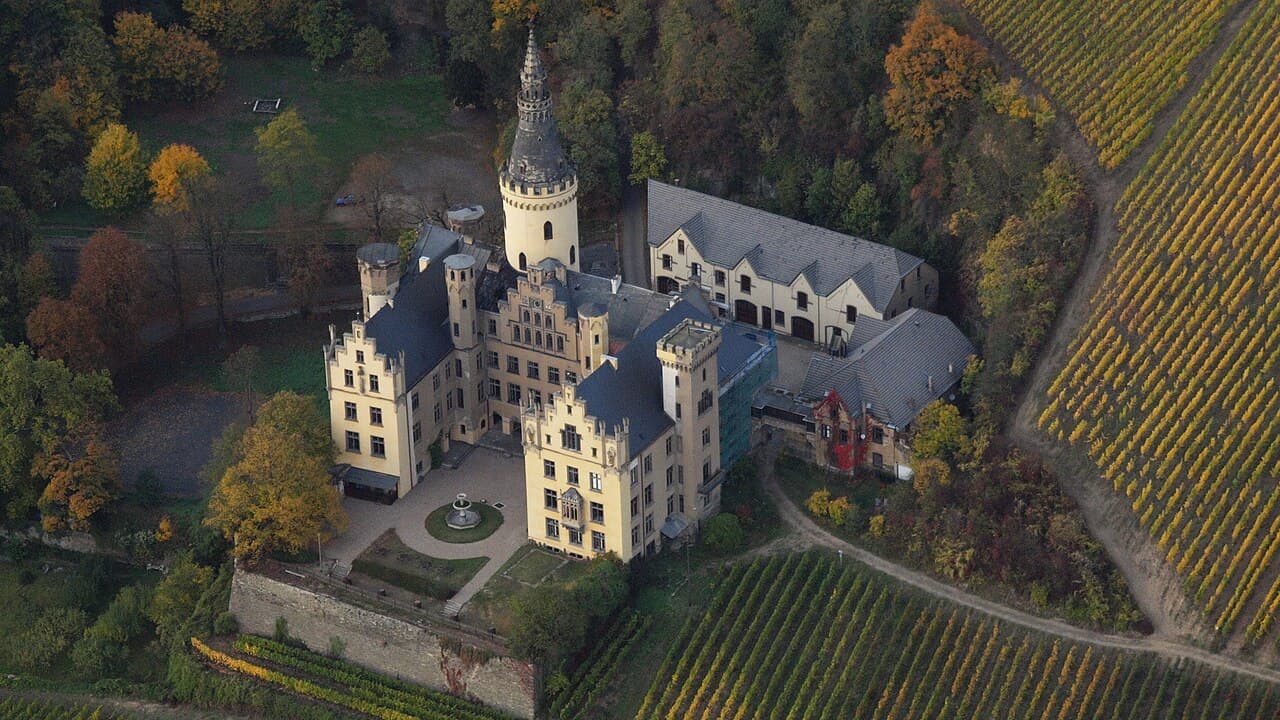
Arenfels Castle
Arenfels Castle stands as a striking example of neo-Gothic revival architecture nestled on a rocky plateau overlooking the Rhine River near Bad Hönningen, Germany. Its history spans from its origins as a 13th-century medieval fortress to a 16th-century Renaissance residence, culminating in a comprehensive 19th-century reconstruction that transformed it into the romantic "castle of the year". This castle's layered past reflects the shifting tides of European history, architectural styles, and noble ownership, making it a captivating subject for enthusiasts of castle architecture and German heritage.
Medieval foundation and early history
The origins of Arenfels Castle trace back to around 1258-1259, when Heinrich II von Isenburg or his son Gerlach established a fortress on the strategic rocky outcrop overlooking the Rhine. The earliest written mention appears in a 1259 marriage contract, which refers to "Burg Arenvelz" in connection with Gerlach von Isenburg and Countess Mechthild von Sayn. This document underlines the castle's importance as both a noble residence and a defensive stronghold during the High Middle Ages.
Initially, the castle served primarily military functions. It featured fortifications focused on protecting the northeast approach, a deep moat on the southern side, and a well reaching the Rhine's groundwater beneath the courtyard. The original structure was modest but strategically positioned to control the surrounding territory. After the extinction of the Isenburg-Arenfels family line in 1371, the castle briefly passed to the Electorate of Trier before being granted to the related Isenburg-Grenzau line.
Renaissance transformation and decline
In the late 16th century, Count Salentin von Isenburg-Grenzau initiated a significant transformation of Arenfels from a fortress into a Renaissance palace. The renovation expanded the complex by adding a main building with two wings and modifying or removing many defensive features. The moat was filled in, and parts of the old castle walls were integrated into the new residence, reflecting the era's shift towards comfort and status rather than pure military defense.
Despite these enhancements, the castle's fortifications were weakened, which led to its relatively easy capture by Swedish forces during the Thirty Years' War in the early 17th century. Following the death of Ernst von Isenburg-Grenzau in 1664, the Elector Archbishop of Trier confiscated Arenfels and granted it in 1670 to Baron Johann Carl Caspar von der Leyen zu Adendorf. Under von der Leyen's ownership, the castle gained new northern economic buildings and expanded the main residence, establishing it as a preferred summer estate.
19th-century neo-gothic reconstruction
The castle's most defining transformation occurred between 1849 and 1858 under the ownership of Reichsgraf Friedrich Ludolf von Westerholt-Gysenberg. He commissioned architect Ernst Friedrich Zwirner, renowned for his work on the Cologne Cathedral, to redesign Arenfels in a romantic neo-Gothic style inspired by medieval English and German castles.
This reconstruction introduced symbolic elements such as 365 windows, 52 doors, and 12 towers, representing the days, weeks, and months of the year, earning the castle its nickname, the "castle of the year". The design featured a horseshoe-shaped three-wing complex opening towards the Rhine, with a tall central tower crowned by a steep conical roof and an elaborate stone spire. Stepped gables adorned with statues of Jeanne d'Arc, Godfrey of Bouillon, and Richard the Lionheart linked the castle iconographically to medieval chivalry.
The castle's exterior was finished with light ochre-colored plaster, and the northern economic buildings, dating from the late 17th century, were enhanced with neo-Gothic tracery and iron beam supports. Inside, the castle boasted a remarkable three-story cast-iron staircase manufactured by the Sayner Hütte foundry, marble and Wedgwood porcelain fireplaces, and a knights' hall. These features combined medieval stylistic motifs with modern 19th-century building techniques.
20th-century challenges and restoration
In the early 20th century, architect Bodo Ebhardt undertook further restoration work starting in 1931. However, during World War II, Arenfels Castle suffered extensive damage from American artillery during the battles for the nearby Remagen bridge. The western wing's roof was destroyed, and the main keep and neo-Gothic gables were partially ruined. After American forces occupied the castle briefly in March 1945, it was left plundered and in disrepair.
Postwar restoration was initially limited due to financial constraints. A significant state-led restoration program began around 2000, focusing on repairing structural damage and restoring the castle's facades to their historic appearance. The castle's original furnishings were mostly lost during the war, with its weapons collection and library auctioned off in 1951. The library was later acquired and restored by the city archive of Bottrop.
Today, Arenfels Castle functions as a romantic venue for weddings, family celebrations, and corporate events, accommodating up to 200 guests. Its beautiful interiors, including the iconic cast-iron staircase, remain a highlight for visitors.
Architectural features and surviving elements
The current castle complex forms a horseshoe-shaped three-wing structure opening southward towards the Rhine. The main building rests on the foundations of the original medieval fortress, while the northern side hosts two-story economic buildings from the late 17th century. These buildings historically housed stables, carriage houses, and servants' quarters, and feature neo-Gothic tracery and iron beam supports.
The only surviving medieval element is the foundational walls of the bergfried or keep, central to the original defensive design. The Renaissance phase is recalled by a distinctive gable on the western facade. The main building rises four floors high, crowned by a tall tower with a conical roof and neo-Gothic stone spire.
Stepped gables on the west and east wings are adorned with statues sculpted by Christian Mohr from Cologne. The western gable features Jeanne d'Arc, while the eastern gable displays Godfrey of Bouillon and Richard the Lionheart. The northern entrance balcony bears the von Westerholt-Gysenberg family coat of arms, linking the castle to its 19th-century owners.
Inside, the castle retains portions of its neo-Gothic interior decoration, including the family living quarters on the ground floor and reception rooms on the first floor. The knights' hall, marble and Wedgwood porcelain fireplaces, and the cast-iron staircase from the Sayner ironworks are particularly notable features blending medieval aesthetics with industrial craftsmanship.
Frequently asked questions (FAQ)
- What is the historical significance of Arenfels Castle?
- Arenfels Castle, built in the 19th century, is a prime example of romantic architecture in Germany. It served as a royal residence and is notable for its picturesque views of the Rhine River, making it an important cultural landmark in the region.
- When was Arenfels Castle constructed?
- Arenfels Castle was constructed between 1846 and 1850. It was commissioned by Prince Salm-Reifferscheidt and reflects the ideals of the romantic movement in architecture during that period.
- What are the opening hours for Arenfels Castle?
- Arenfels Castle is typically open to visitors from April to October, with specific hours varying by season. It is advisable to check the castle's official website for the most accurate and up-to-date information before your visit.
- Can I take guided tours of Arenfels Castle?
- Yes, guided tours are available at Arenfels Castle, providing visitors with in-depth information about its history and architecture. It is recommended to book tours in advance, especially during peak tourist seasons.
- Is it possible to visit Arenfels Castle with limited mobility?
- Arenfels Castle has some accessibility options, but due to its historical architecture, certain areas may be challenging to navigate for those with limited mobility. Visitors are encouraged to contact the castle ahead of their visit to inquire about specific accommodations.
- What is the best time to visit Arenfels Castle?
- The best time to visit Arenfels Castle is during the spring and early autumn when the weather is mild and the surrounding landscape is particularly beautiful. This period also sees fewer crowds compared to the peak summer months.
- What are the ticket prices for Arenfels Castle?
- Ticket prices for Arenfels Castle vary depending on the type of tour and age of the visitor. Adults typically pay a standard entry fee, while discounts may be available for children and seniors, so it’s best to check the official website for current pricing.
- Are there any nearby attractions to visit when at Arenfels Castle?
- Yes, visitors to Arenfels Castle can explore other nearby attractions such as the charming town of Bad Hönningen and the scenic Rhine Valley. Additionally, there are various hiking trails and vineyards in the vicinity that enhance the overall experience.
Photo gallery

Information
Website
Visit websiteSources & official resources
Verify the information above using these authoritative references.
Loading map...
Visitor reviews
No reviews yet. Been here? Write the first review and help other travelers!
Write the first reviewVisited this castle? Share your experience
Your review helps other travelers and adds first-hand knowledge to our encyclopedia.



