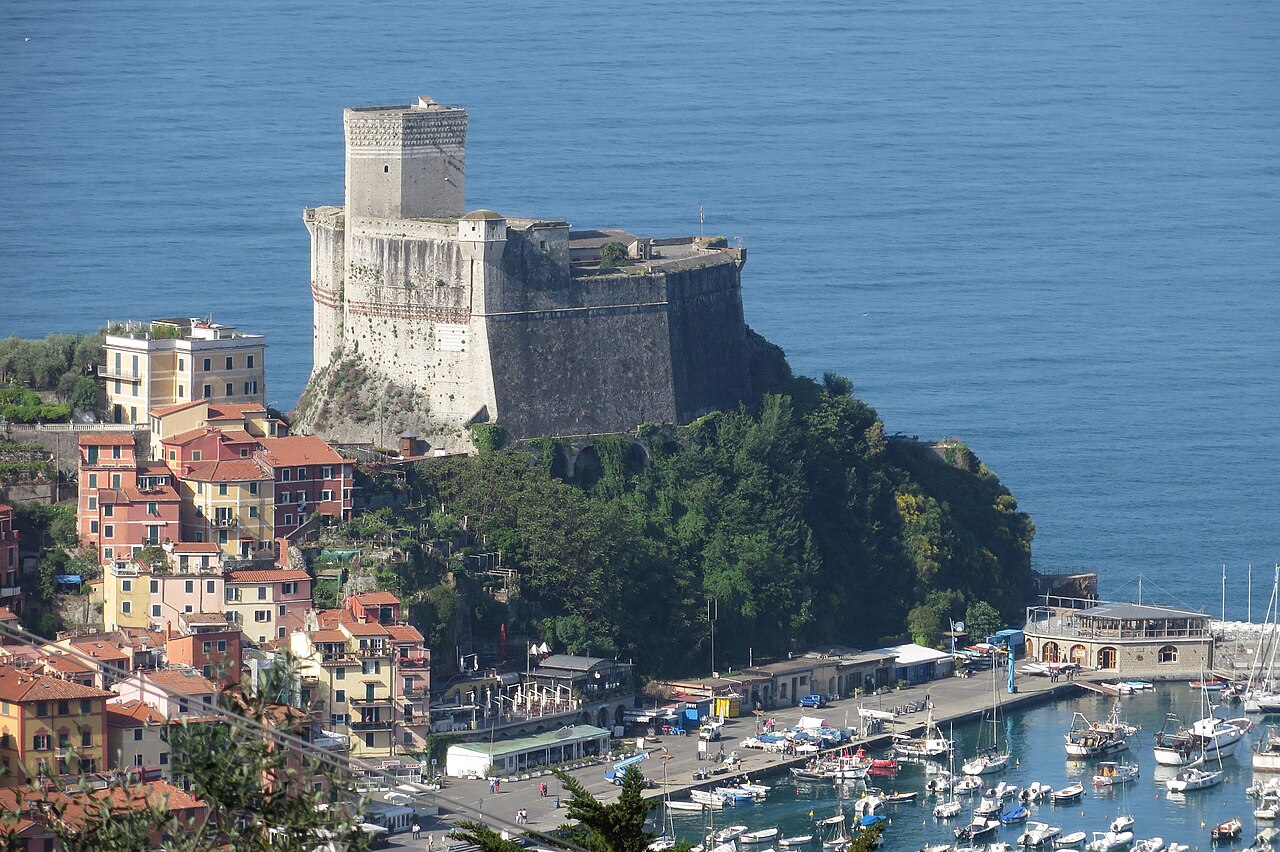
Arcola Castle
Arcola Castle stands prominently atop the hills overlooking the Gulf of La Spezia and the Magra valley in Liguria, Italy. This medieval hill castle was established in the 11th century by the noble Obertenghi family, who recognized the strategic importance of its elevated position. The castle's location provided commanding views of the surrounding landscape, including the Apuane Alps, which made it an essential defensive stronghold and naval lookout in the western Marca Ligure region.
The castle's original structure was centered around a tall pentagonal tower, known as the Obertenga tower, which remains the most visible remnant of the fortress today. This tower was deliberately constructed on the most vulnerable side of the castle, serving as a bastion to repel attackers. Its 25-meter height and pentagonal shape allowed defenders to cover multiple angles, with embrasures for archers and artillery to protect the two main entrances, including the critical Porta Sovrana.
Early history and feudal significance
During the early medieval period, the Obertenghi family, powerful feudal lords in northern Italy, established Arcola as a key defensive and administrative center. The castle was constructed amid a period of instability caused by Norman and Saracen incursions, which threatened the security of the region. By fortifying Arcola, the Obertenghi aimed to secure their holdings in the Val di Magra and control vital land and maritime routes.
In 1128, the castle passed into the hands of the monastery of San Venerio del Tino, reflecting the intertwined nature of religious and feudal power during this era. This transfer also indicates the castle's importance not only as a military fortress but also as a center of ecclesiastical influence.
Conflicts and changes of ownership
The 13th century was marked by intense regional conflicts involving the castle. The Malaspina family, another noble dynasty, took control of Arcola and the castle during this time. Their tenure was challenged by the Republic of Genoa, a rising maritime power. In 1278, Captain Oberto Doria led a siege against the castle, successfully capturing it and integrating it into Genoese territory.
Following this, the castle experienced a series of military occupations that reflected the shifting political landscape of northern Italy. In 1320, Castruccio Castracani, the lord of Lucca, seized the fortress as part of his expansionist campaigns. Later, in 1430, the condottiero Niccolò Piccinino took control of Arcola Castle on behalf of Duke Filippo Maria Visconti of Milan. However, Genoese forces regained the castle in 1436, after which it became the administrative center, or Podesteria, overseeing Arcola and the nearby town of Vezzano.
Architectural features and defensive design
The castle's design reflects typical high medieval military architecture, adapted to the hilltop terrain. Its most notable feature is the pentagonal tower, which functioned as the primary defensive bastion. The tower's corners were strategically angled to provide overlapping fields of fire, deterring attackers from approaching the vulnerable gate areas.
The fortress included robust curtain walls and battlements that enclosed the inner courtyard and living quarters. The walls were constructed using local stone and incorporated defensive elements such as arrow slits and machicolations to protect against siege warfare. The castle's position on a hill enhanced its natural defenses, making direct assaults difficult.
The wine-measuring basin
Among the unique features within the castle complex is a wine-measuring basin calibrated to half a barrel according to the 1601 Genoese unit of measure. This basin underscores the castle's role beyond military functions, highlighting its involvement in regulating local commerce and taxation, particularly concerning the wine trade in the region.
Damage, restoration, and modern use
The castle suffered significant damage during the Napoleonic wars in the late 18th century, when Franco-Genoese and Austro-Russian forces clashed in the area. Bombardments and military actions left parts of the fortress in ruins.
In 1884, a comprehensive restoration was undertaken by engineer Canini, who reinforced the structure and adapted it for civic use. Following restoration, the castle was repurposed as the town hall of Arcola, a role it continues to serve. This adaptation ensured the preservation of the castle as a vital cultural and historical landmark.
Current status and visitor experience
Today, Arcola Castle is recognized as a national monument and is open to visitors interested in exploring its rich history and architectural heritage. The imposing pentagonal tower dominates the town's skyline and serves as a symbol of Arcola's medieval past.
Visitors can explore the tower and the surrounding castle remnants near Piazza Ugo Muccini, gaining insight into the castle's defensive mechanisms and its role in regional politics over the centuries. The site offers panoramic views of the Ligurian landscape, including the sea and mountains, making it a popular destination for history enthusiasts and tourists alike.
The castle's blend of military and administrative history, combined with its preservation and adaptive reuse, provides a compelling narrative of medieval fortifications evolving into modern civic structures. Its enduring presence highlights the importance of preserving cultural heritage sites that connect contemporary communities with their historical roots.
Frequently asked questions (FAQ)
- How do I get to Arcola Castle?
- Arcola Castle is located in the town of Arcola, Liguria, Italy. It is accessible by road, and visitors can reach it by car or local bus services from nearby La Spezia.
- When was Arcola Castle built and by whom?
- Arcola Castle was built in the 11th century by the Obertenghi family, a noble lineage that established the fortress as a strategic stronghold in the region.
- Is Arcola Castle open to visitors?
- Yes, Arcola Castle is open to visitors. It is a national monument with access to the pentagonal tower and surrounding castle remains, offering historical insights and scenic views.
- What architectural style characterizes Arcola Castle?
- Arcola Castle features high medieval military architecture, with a distinctive pentagonal tower designed for defense and surveillance.
- Why is the pentagonal tower significant?
- The pentagonal tower was the focal point of the castle's defense system, strategically positioned to cover vulnerable approaches and equipped with embrasures for effective protection.
Information
Current owner
Municipality
Loading map...
Visitor reviews
No reviews yet. Been here? Write the first review and help other travelers!
Write the first reviewVisited this castle? Share your experience
Your review helps other travelers and adds first-hand knowledge to our encyclopedia.