Aragonese Castle of Taranto
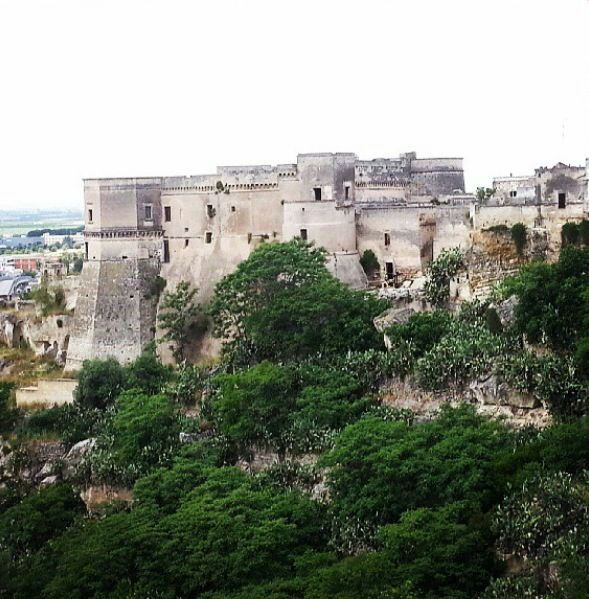
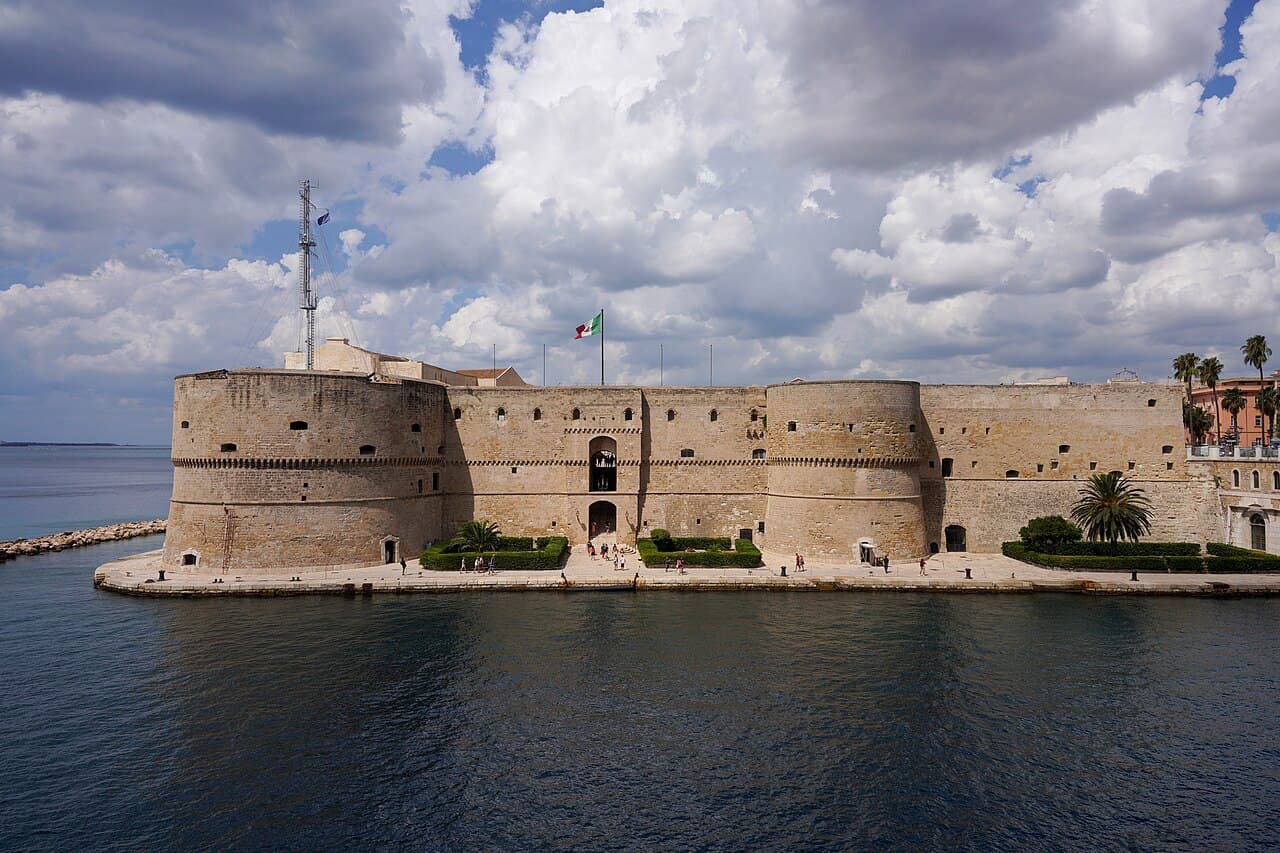
The Aragonese Castle of Taranto, also known as Castel San Angelo, stands as a monumental testament to centuries of military architecture and history in the coastal city of Taranto, Puglia, Italy. This fortress, perched on a natural rocky elevation, embodies a layered historical narrative spanning from the ancient Greek period through Byzantine, Norman, Swabian, Angevin, and ultimately to the late medieval era under the Aragonese crown. Its strategic location near the waterway connecting the Mar Grande and Mar Piccolo has made it a pivotal defensive structure for controlling naval access and protecting the city for nearly three millennia.
Ancient origins and early fortifications
The site of the Aragonese Castle has been continuously fortified since the 4th and 3rd centuries BC, beginning with Greek foundations that formed the base of later Byzantine fortifications. The early Byzantine fortress, constructed around the 10th century AD, was designed to defend the coastal settlement against Saracen raids and Venetian incursions. This initial structure featured tall, slender towers typical of early medieval military architecture, optimized for active defense with weapons such as lances, bows, and boiling oil.
Medieval transformations and the norman-swabian-angevin phases
Over the centuries, the fortress underwent significant modifications under the Normans, Swabians, and Angevins. The medieval castle was characterized by numerous tall, thin towers that contrasted sharply with the later Aragonese design. These towers were built atop the Byzantine foundations, reflecting the evolving defensive needs and architectural styles of the Middle Ages. However, by the late 15th century, the increasing power of artillery rendered these medieval fortifications obsolete, as their thin walls could not withstand cannon fire nor support the use of artillery by defenders.
The aragonese reconstruction: a response to artillery warfare
The fall of Otranto to the Turks in 1480 underscored the vulnerability of traditional fortresses and prompted King Ferdinand II of Aragon to reinforce the coastal defenses of his kingdom. Between 1487 and 1492, the castle was comprehensively rebuilt, likely following the designs of the renowned Sienese architect Francesco di Giorgio Martini. This reconstruction transformed the fortress into a robust artillery bastion, featuring a distinctive layout often described as resembling a scorpion.
The new fortress had five massive round towers at its corners, named San Cristoforo, San Lorenzo, Sant'Angelo, Annunziata, and Bandiera. These towers were significantly lower and broader than their medieval predecessors, with walls approximately 8 meters thick and towers measuring 18 meters in diameter, except for San Cristoforo which was wider. The uniform height of the towers and walls, about 21 meters, allowed for a continuous defensive perimeter capable of mounting heavy artillery.
To enhance defense towards the Great Sea (Mar Grande), a triangular outwork called the Rivellino was added in 1491. This feature, a precursor to the 16th-century bastion, was designed to protect the southern curtain wall and flank the expanded moat connecting the Mar Grande with the Mar Piccolo. The moat itself was a critical element, creating a water barrier that increased the fortress's defensive capabilities.
Spanish enhancements and military decline
Following the Aragonese, the Spanish took control of the Kingdom of Naples in 1502 and further modified the castle to accommodate the evolving demands of artillery warfare. They expanded the summit platforms of the towers to improve the maneuverability and deployment of cannons. Additionally, many intramural tunnels and upper casemates were filled with earth to reinforce the walls and create stable artillery positions atop the towers.
Despite these improvements, the fortress gradually lost its military significance due to rapid advancements in siege technology. Nevertheless, it played a crucial defensive role during several conflicts, notably repelling a Turkish assault in 1594. Over time, the castle's function shifted from military fortress to prison and barracks, leading to internal fragmentation, closure of passages, and extensive plaster and cement use to improve hygiene and adapt to residential needs.
The Torre Sant'Angelo, one of the key towers, was demolished in 1883 to make way for the construction of the Ponte Girevole (swing bridge), a vital maritime infrastructure that altered the fortress's original silhouette.
Modern restoration and archaeological discoveries
Since 1883, the castle has been under the custodianship of the Italian Navy. Beginning in 2003, the Navy initiated a systematic restoration aimed at returning the fortress to its Aragonese configuration. This work involves removing modern plaster and cement layers, reopening original corridors and rooms, and restoring the defensive functionality of the castle's architectural elements.
Archaeological excavations conducted in collaboration with the University of Bari and under the supervision of local heritage authorities have uncovered artifacts spanning nearly three thousand years. These include Greek foundations, Byzantine, Norman, Swabian, Angevin structures, medieval ceramics, and coins dating back to 1245. Such findings enrich the understanding of the castle's continuous occupation and evolution.
Architectural features and layout
The Castello Aragonese is a polygonal fortress located on the Isola del Borgo Antico, a small island at the heart of Taranto's old town. Its southern section is nearly rectangular, anchored by four massive corner towers: Torrione San Cristoforo, Torrione San Lorenzo, Torrione della Bandiera, and Torrione dell'Annunziata. These towers feature walls up to 8 meters thick and rise approximately 20 meters in height and diameter, designed to withstand artillery bombardment.
The towers are connected by broad wings enclosing a large internal courtyard open to the sky. The southern curtain wall facing the Mar Grande is fortified by the Rivellino, a triangular outwork that provided additional defense against naval attacks.
Access to the castle was controlled by two drawbridges: the Ponte del Soccorso, linking the fortress to the newer Borgo district, and the Ponte dell'Avanzata, connecting it to the older Borgo Antico. These bridges spanned an artificial moat, enhancing the castle's defensive perimeter.
Interior spaces and notable rooms
Inside the fortress stands the Saint Leonard Chapel, a space that has served various functions over the centuries. Originally a religious chapel, it was later used as a guardhouse and stable before being reconsecrated in 1933. The chapel houses the coat of arms of King Philip II of Spain and two stone slabs carved with depictions of a holy bishop and a medieval armed warrior, symbolizing the castle's intertwined spiritual and military heritage.
The castle also contains a torture chamber with a vaulted ceiling pierced by a central hole designed to amplify prisoners' cries, a grim reminder of its use in law enforcement and punishment.
Historical significance and cultural heritage
The Aragonese Castle of Taranto is a remarkable example of military architecture adapting to the evolution of warfare from the ancient Greek era through the Renaissance. Its transformation under Francesco di Giorgio Martini reflects the shift from medieval fortifications to artillery bastions, marking a critical period in fortification design.
The castle's role in repelling the 1594 Ottoman siege underscores its strategic importance in the defense of southern Italy against external threats. Its later use as a prison and naval headquarters illustrates the changing functions of such fortresses in response to political and military developments.
Today, the castle stands not only as a military monument but also as a cultural and archaeological site, offering insights into the complex history of Taranto and the broader Mediterranean region. Its restoration and ongoing archaeological work continue to reveal new layers of history, making it a vital heritage site for scholars and visitors alike.
Visiting the castle
The Castello Aragonese is open to the public for guided tours, allowing visitors to explore its extensive fortifications, interior chambers, and archaeological findings. The site provides a unique opportunity to witness the evolution of military architecture and to appreciate the rich historical tapestry of Taranto.
Frequently asked questions (FAQ)
- How do I get to the Aragonese Castle of Taranto?
- The Aragonese Castle of Taranto is easily accessible by public transport, with local buses connecting to the castle from various parts of the city. If you are driving, there are parking facilities nearby, but it is advisable to arrive early to secure a spot, especially during peak tourist season.
- What is the historical significance of the Aragonese Castle?
- The Aragonese Castle, originally built in the 15th century, played a crucial role in the defense of Taranto against invasions. Over the centuries, it has witnessed significant historical events and served various purposes, including as a royal residence and military fortress.
- When was the Aragonese Castle constructed?
- Construction of the Aragonese Castle began in 1492 under the rule of Ferdinand I of Aragon. The castle has undergone numerous renovations and restorations since then, reflecting the architectural styles of different periods.
- Can I take guided tours of the castle?
- Yes, guided tours of the Aragonese Castle are available and provide a deeper insight into its rich history and architectural features. It is recommended to book your tour in advance, especially during the summer months when visitor numbers peak.
- Why is the Aragonese Castle a popular tourist attraction?
- The Aragonese Castle attracts visitors for its stunning architecture, panoramic views of the surrounding area, and its rich historical narrative. Additionally, the castle hosts various cultural events and exhibitions throughout the year, enhancing its appeal to tourists.
- Is it possible to visit the castle with children?
- Yes, the Aragonese Castle is family-friendly and offers a fascinating experience for children and adults alike. The expansive grounds allow for exploration, and the historical context can be educational for younger visitors.
- What are the opening hours of the Aragonese Castle?
- The opening hours of the Aragonese Castle vary by season, typically operating from 9:00 AM to 7:00 PM during the summer months and shorter hours in winter. It is advisable to check the official website for the most current information before your visit.
- What are the ticket prices for entering the castle?
- Ticket prices for the Aragonese Castle are generally affordable, with discounts available for children, students, and seniors. Special rates may apply for guided tours, so it's best to check ahead for any promotional offers or group rates.
- What nearby attractions can I visit after the castle?
- After visiting the Aragonese Castle, you can explore the nearby Taranto Cathedral and the National Archaeological Museum of Taranto, which showcases impressive ancient artifacts. The scenic waterfront and local eateries also make for a delightful experience to complete your visit.
Photo gallery

Information
Website
Visit websiteSources & official resources
Verify the information above using these authoritative references.
Loading map...
Visitor reviews
No reviews yet. Been here? Write the first review and help other travelers!
Write the first reviewVisited this castle? Share your experience
Your review helps other travelers and adds first-hand knowledge to our encyclopedia.