Massafra Castle
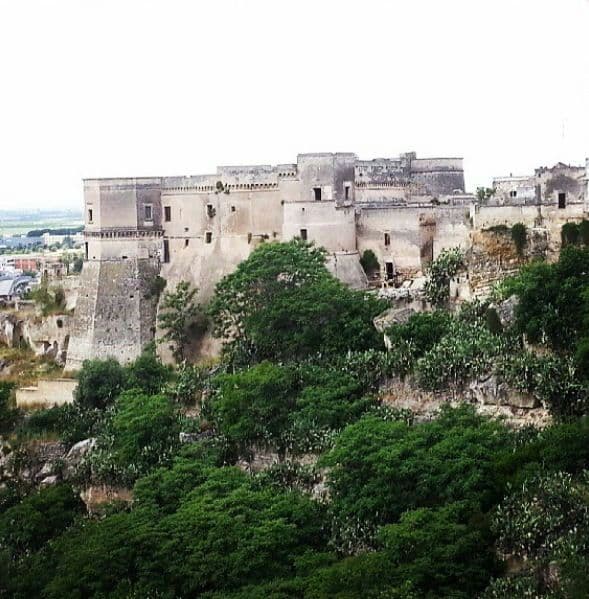
Massafra Castle stands as a prominent medieval fortress in the historic center of Massafra, Italy, overlooking the dramatic Pizzo Ravine and the area of San Marco. The castle's strategic position atop a hill allowed it to serve as a vital defensive stronghold throughout its long history, reflecting the military and architectural evolution of the region from the 10th century onward. Its design shares characteristics common to many castles in the Apulia region, notably the quadrilateral layout with four towers connected by sturdy curtain walls.
The castle's earliest documented mention dates to the year 970 AD, marking it as an important early medieval fortification. This initial phase likely focused on basic defensive needs, with the oldest towers featuring a circular plan typical of the period. The southeast tower, distinguished by its octagonal shape, was rebuilt in the 18th century under the auspices of the influential Imperiali family, with architectural guidance from Mauro Manieri of Lecce.
Historical development and ownership
Early medieval origins and norman period
The castle is first recorded in a document from 970 AD, establishing its presence during the early medieval period. In 1081, it was officially owned by Richard Senescalco, also known as Richard of Salerno, a Norman nobleman who played a significant role in southern Italy's history. Under his tenure, the castle served not only as a military bastion but also as an administrative center, consolidating Norman power in the region.
Fortification under the angevins and aragonese
With the rise of the Angevin dynasty in southern Italy, the castle underwent major architectural enhancements to meet the evolving demands of warfare. The addition of crenellated ramparts and fortified towers transformed Massafra Castle into a formidable fortress. These modifications reflect the military architecture trends of the High to Late Medieval periods, emphasizing defense against siege warfare and artillery advancements.
The subsequent Aragonese period brought further changes, continuing the castle's adaptation to new military technologies and strategic requirements. These successive layers of construction illustrate the castle's sustained importance over several centuries.
18th-century reconstruction by the imperiali family
In the 18th century, the Imperiali family initiated significant restoration and rebuilding efforts, notably reconstructing the octagonal southeast tower and refurbishing the castle facade facing the ravine. These works, designed by Mauro Manieri, introduced more refined architectural details, blending defensive features with aesthetic considerations typical of the period.
Architectural features and layout
Overall structure and towers
Massafra Castle is characterized by its quadrilateral plan, with four towers arranged in a wishbone-like pattern and interconnected by boundary walls. Three of the towers retain their original circular shapes, while the southeast tower stands out with its octagonal form, a unique feature resulting from 18th-century reconstruction.
Entrance and defensive elements
The main entrance is located on Via La Terra, accessed through a large gate leading into the piazza d’armi or parade ground. This open space includes a well and a ramp that historically led to a drawbridge. Remnants of the drawbridge pulley system are still visible, providing insight into the castle's defensive mechanisms.
Internal courtyard and functional spaces
Beyond the parade ground lies an enclosed courtyard with a grand staircase ascending to the lord's residential chambers on the upper floor. The lower levels housed essential service areas such as stables, barns, an armory, and prisons located within the towers and the octagonal southeast tower. Additional spaces served as warehouses, icehouses for food preservation, and pitch storage for torches, indicating the castle's self-sufficiency during sieges.
Chapel and spiritual aspects
A chapel dedicated to Saint Lawrence (San Lorenzo) is situated within the castle, reflecting the integration of religious practice into the daily life of its inhabitants. This sacred space underscores the dual military and residential nature of the fortress.
Modern restorations and current use
The castle has undergone several restoration projects in the 20th and early 21st centuries to preserve its structure and adapt it for contemporary use. In 1965, the collapsed southwest tower was rebuilt, and in 1975, the parapet was restored to maintain the defensive walls. Around the year 2000, architect Francesco Coratella led the consolidation of the east tower and redesigned the castle's forecourt, introducing a modern elevator to improve visitor accessibility.
Today, Massafra Castle serves as a cultural hub, housing the Civic Library and the Civic Archaeological Museum, which showcases the region's historical connection to oil and wine production. Since 2014, some rooms have been dedicated to the provincial delegation office of Taranto for the National Institute for the Honor Guard of the Royal Tombs of the Pantheon, commemorating Marshal Carlo De Trizio.
Legends and cultural significance
Local tradition speaks of secret passages and a hidden tunnel connecting the castle to the sea, adding an element of mystery to its history. While no archaeological evidence confirms these tales, they contribute to the castle's cultural identity and allure.
Massafra Castle was honored on an Italian postage stamp issued in 2007, symbolizing its importance to the city's heritage and identity. This recognition highlights the castle's role not only as a historic monument but also as a living part of the community's cultural fabric.
Frequently asked questions (FAQ)
- What is the historical significance of Massafra Castle?
- Massafra Castle dates back to the 10th century and played a key role as a defensive fortress and administrative center through Norman, Angevin, and Aragonese periods.
- Can visitors explore the interior of Massafra Castle?
- Yes, the castle is open to the public and houses the Civic Library and Archaeological Museum, offering access to various restored rooms and exhibitions.
- Are there any unique architectural features at Massafra Castle?
- The castle features a distinctive octagonal southeast tower rebuilt in the 18th century, alongside three original circular towers and crenellated ramparts.
- Has Massafra Castle undergone restoration?
- Significant restorations occurred in the 20th century, including tower reconstruction and parapet repairs, with further consolidation and modernization around 2000.
- Is there any truth to the legend of secret tunnels at Massafra Castle?
- Local tradition mentions secret passages and a tunnel to the sea, but no archaeological evidence has confirmed their existence.
Photo gallery

Information
Sources & official resources
Verify the information above using these authoritative references.
Loading map...
Visitor reviews
No reviews yet. Been here? Write the first review and help other travelers!
Write the first reviewVisited this castle? Share your experience
Your review helps other travelers and adds first-hand knowledge to our encyclopedia.