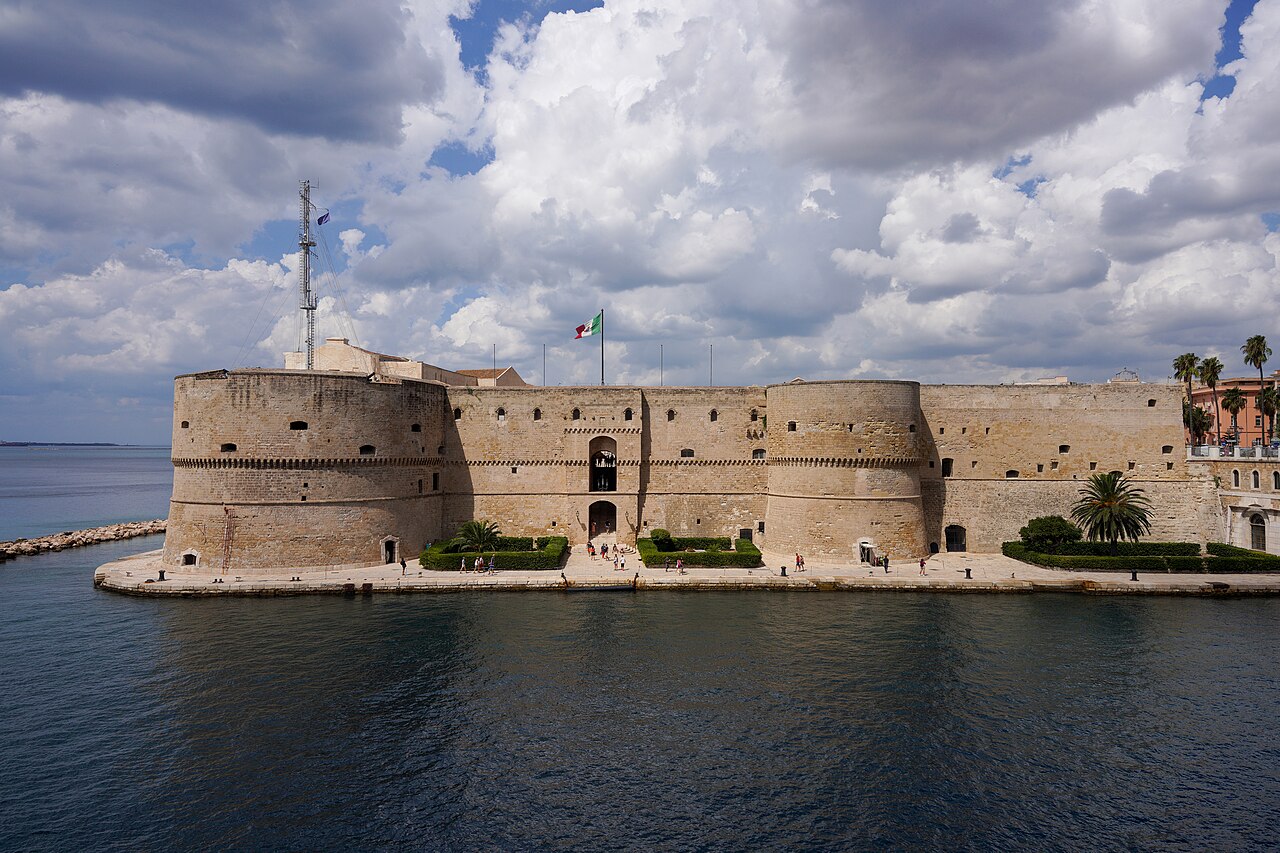
Falconibus Castle
Falconibus Castle stands as a remarkable example of late medieval hill castle architecture in the town of Pulsano, Italy. Originally constructed between the 12th and 14th centuries, the castle's history reflects the turbulent times of the Mediterranean coastal region, marked by frequent pirate raids and noble family rivalries. Its strategic location atop a hill overlooking the town provided a defensive vantage point, essential for protection against Saracen incursions and other threats.
The earliest known structure on the site was a solitary tower known as the Torre Quadrata or Torre Massima, built around the year 1100. This tower initially functioned as a hunting lodge before evolving into a fortified refuge for local inhabitants. Over time, it became the nucleus around which the larger fortress was developed.
Historical development and noble ownership
The castle's ownership and structure evolved significantly over several centuries. The De Falconibus family, a noble lineage, came into possession of the tower and undertook major expansions by adding four additional towers of varying shapes and sizes. This expansion transformed the modest tower into a quadrangular fortress with five towers, a layout that remains a defining characteristic of the castle today.
By the late 13th century, the castle and its lands were controlled by the Sambiasi family, and later passed to F. dell’Antognietta in the mid-14th century. The fortress was then acquired by Ercole Petugy, who restored the original tower before the castle suffered destruction in 1388.
Reconstruction began around 1430 under the direction of the De Falconibus family, who completed the rebuilding within five years. This restoration solidified the castle’s present form and its association with the De Falconibus name. Notably, an underground passage once connected Falconibus Castle to the nearby Castello Muscettola and extended toward the sea, suggesting a secret route for escape or supply during sieges.
Subsequent ownership by the Muscettola family brought further fortifications, including the addition of a moat and a drawbridge, enhancing the castle’s defensive capabilities. In the early 19th century, the castle played a minor military role when Joachim Murat, King of Naples, removed three cannons from the fortress to defend the city of Taranto during conflict with Spanish forces.
Architectural features and layout
Falconibus Castle is characterized by its quadrangular plan and the presence of five towers of differing heights and bases. The original Torre Quadrata faces west toward the main piazza and remains the dominant feature of the castle’s façade. The other four towers, added during the medieval expansion, exhibit various architectural forms, reflecting the complex's evolution from a simple refuge to a fortified noble residence.
The castle rises to three stories, with thick defensive walls integrated into the town's ancient fortifications. The moat, once surrounding the castle, has been leased out and converted into garden plots, but its original perimeter is still discernible in the layout of adjacent properties. This leasing arrangement has resulted in parts of the castle, including three towers and sections of the northern and eastern walls, being incorporated into private buildings and thus hidden from external view.
Until the late 20th century, a small public building obscured part of the southern wall, but its demolition allowed partial restoration of the castle’s original outline. Inside, visitors can find remnants of painted wall decorations and stone relief carvings, along with heraldic emblems of the De Falconibus and Muscettola families, which testify to the castle's noble heritage and artistic embellishments.
Cultural significance and modern use
Following the death of the last male heir of the Muscettola family in the early 20th century, the castle was purchased by Giovanni Giannone, who donated it to the local community. Since then, Falconibus Castle has served various cultural roles, including hosting art exhibitions, municipal council meetings, and seasonal events such as a living nativity scene.
The castle’s enduring presence at the northeast corner of Pulsano’s ancient walls makes it a prominent landmark and a symbol of the town’s medieval past. Its layered history, from a defensive tower to a noble fortress and finally a community cultural site, illustrates the adaptive reuse of historic architecture over centuries.
Underground passage and defensive innovations
The sealed underground passage linking Falconibus Castle to Castello Muscettola and extending toward the sea highlights the strategic ingenuity of medieval fortifications in the region. Such tunnels were vital for secret communication, escape routes, or supply lines during sieges, underscoring the castle’s role in regional defense networks.
Impact of political and military events
The removal of cannons by Joachim Murat in the early 1800s reflects the castle’s continued military relevance even as warfare evolved. This action connects Falconibus Castle to broader historical events involving the Kingdom of Naples and conflicts with Spanish forces, adding depth to its historical narrative.
Visiting falconibus castle today
Today, visitors to Falconibus Castle can explore its exterior and some interior spaces that retain historical and artistic features. While parts of the castle are incorporated into private properties, the visible sections offer a glimpse into medieval defensive architecture and noble residence design. The castle’s location near the main piazza makes it accessible and a key point of interest in Pulsano’s historic center.
Interpretive signage and occasional cultural events enhance the visitor experience, providing insights into the castle’s architectural evolution and its significance in local history. The castle’s preserved heraldic emblems and decorative fragments contribute to understanding the artistic tastes and social status of its former inhabitants.
Frequently asked questions (FAQ)
- What is the historical significance of Falconibus Castle?
- Falconibus Castle is a late medieval fortress in Pulsano, Italy, originally built as a defensive refuge against pirate raids and later expanded by noble families. It played roles in local defense and noble residence over centuries.
- Can visitors explore the interior of Falconibus Castle?
- Visitors can access some interior areas of Falconibus Castle that retain historical features, though parts of the castle are incorporated into private properties and not fully open to the public.
- How did the underground passage at Falconibus Castle function?
- The sealed underground passage connected Falconibus Castle to Castello Muscettola and extended toward the sea, likely used for secret escape or supply during sieges, highlighting medieval defensive strategies.
- Who were the main noble families associated with Falconibus Castle?
- The De Falconibus and Muscettola families were the principal noble owners who expanded and fortified the castle, leaving heraldic emblems and architectural legacies.
- Is Falconibus Castle involved in any cultural events today?
- Yes, the castle hosts cultural events such as art exhibitions, municipal meetings, and seasonal activities like living nativity scenes, serving as a community landmark in Pulsano.
Information
Current owner
Local community
Loading map...
Visitor reviews
No reviews yet. Been here? Write the first review and help other travelers!
Write the first reviewVisited this castle? Share your experience
Your review helps other travelers and adds first-hand knowledge to our encyclopedia.