Aqaba Castle
Aqaba Castle stands as a monumental testament to the rich military and religious history of southern Jordan, located strategically in the city of Aqaba near the Gulf of Aqaba. This fortress, primarily constructed during the Mamluk and Ottoman periods, has played a critical role in protecting pilgrimage routes, serving as a military bastion, and witnessing pivotal events such as the Arab Revolt during World War I.
The origins of Aqaba Castle are deeply intertwined with the ancient fortified city of Ayla, an early Muslim settlement that flourished but declined by the early 12th century. Though no physical remains from the 12th-century Crusader or Ayyubid periods survive, historical records suggest that a small fortification existed at the site, which laid the groundwork for later, more substantial constructions.
Mamluk and ottoman construction phases
The castle as it is known today owes much of its architecture to two main phases of construction. The first significant phase was under the reign of Mamluk Sultan Al-Nasir Muhammad around 1320, who is credited with initial fortifications that strengthened the site’s defensive capabilities. The most extensive construction took place during the early 16th century under Sultan Al-Ashraf Qansuh Al-Ghuri, a period marked by increased military and religious significance. This phase established much of the castle’s quadrilateral stone masonry layout, including robust walls and towers.
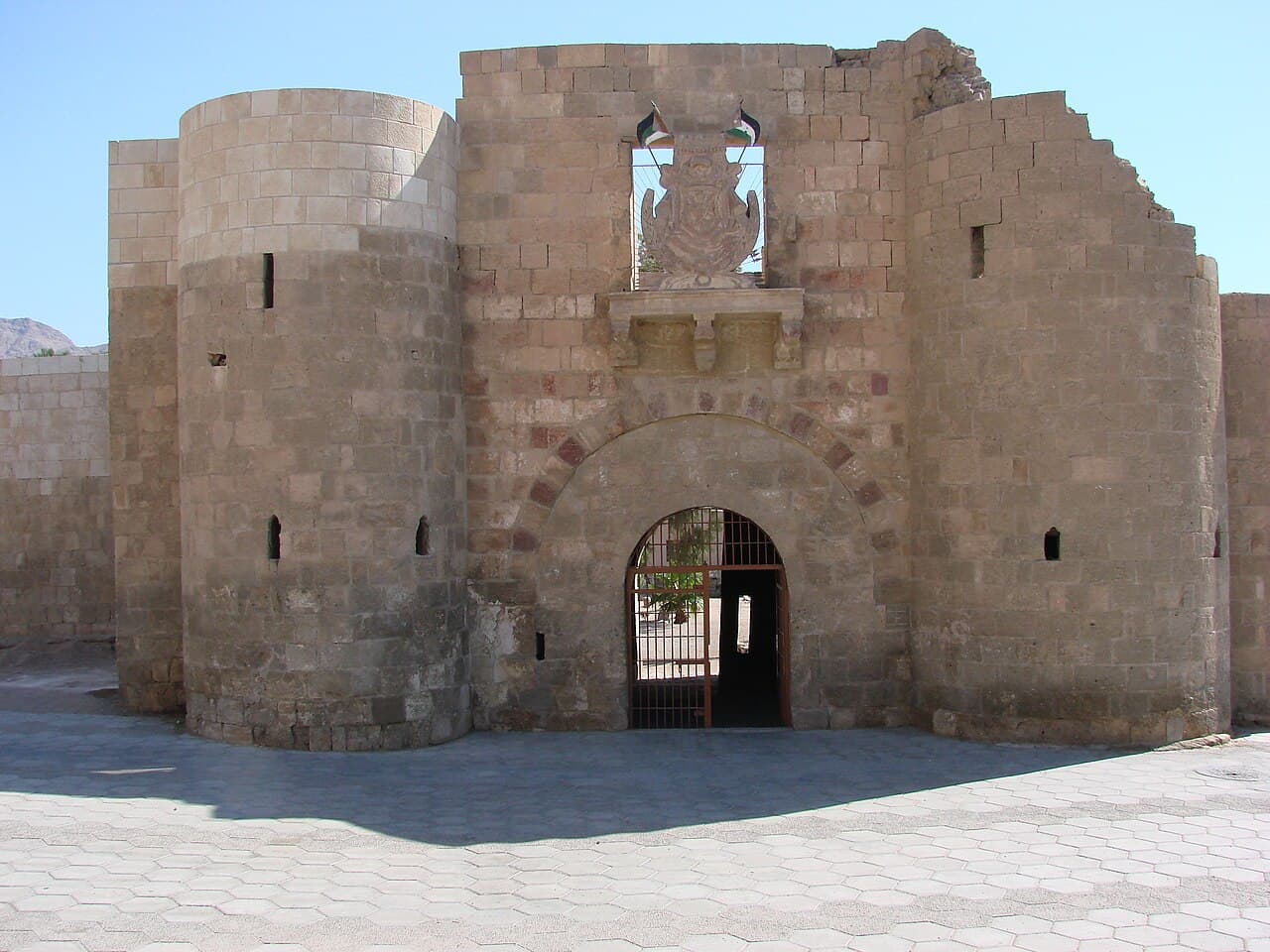
Later, in 1587, the castle underwent restoration and modification under Ottoman Sultan Murad III. These renovations included the repair of defensive structures and the enhancement of the castle’s gatehouse, which features two prominent inscriptions honoring both the Mamluk and Ottoman patrons. This blend of architectural influences reflects the castle’s evolving role and the changing styles of military fortification over time.
Historical significance and military role
Aqaba Castle was originally part of a fortified caravanserai complex designed to protect and accommodate Muslim pilgrims traveling from Egypt along the Hajj route to the holy cities of Mecca and Medina. Its strategic location made it a vital military outpost, guarding trade and pilgrimage routes in the region.
In the 19th century, the castle came under Egyptian control in 1841, when it was reinforced to secure the pilgrimage path further. The castle’s military importance continued into the 20th century, culminating in its critical role during World War I. In July 1917, the fortress was famously captured during the Arab Revolt by an Arab camel charge, a daring and decisive action that marked a turning point against Ottoman control. Following this victory, the British officer T.E. Lawrence, known as Lawrence of Arabia, used Aqaba Castle as a base to report to General Allenby, solidifying the castle’s place in modern Middle Eastern history.
Arab revolt and modern legacy
The capture of Aqaba Castle not only had military implications but also symbolized the broader struggle for Arab independence. The castle and the surrounding port became a crucial supply center for the Arab Revolt, linking the local geography to global wartime strategies. Today, a commemorative panel bearing the Hashemite coat of arms adorns the castle entrance, honoring this historic victory.
Adjacent to the castle, the Aqaba Flagpole was erected in 2004, flying the flag of the Arab Revolt. At one point, it was the tallest flagpole in the world, serving as a modern landmark that connects visitors to the site’s enduring historical significance.
Architectural features and archaeological insights
The castle exhibits a roughly quadrilateral plan constructed mainly from stone masonry typical of Mamluk and Ottoman military architecture. Its dominant feature is a large gatehouse with a vaulted interior chamber leading into a central courtyard. This gatehouse is notable for two inscriptions, one praising Sultan Al-Ashraf Qansuh Al-Ghuri and the other dedicated to Sultan Murad III, which provide valuable historical documentation of the castle’s construction phases.
Each corner of the fortress originally featured stone towers. The eastern towers, initially polygonal, were reshaped into rounded forms after 1828, reflecting changes in defensive architectural strategies. Despite damage and alterations over centuries, the foundations of these towers remain visible, offering insights into the castle’s evolving design.
Inside the courtyard, two large diwan halls flank either side, likely serving administrative and reception functions. These halls also bear inscriptions linking their construction and restoration to the Mamluk and Ottoman sultans, further emphasizing the castle’s dual heritage.
Archaeological excavations have revealed multiple layers of occupation at the site. Notably, irrigation installations dating back to the Umayyad period demonstrate early water management efforts essential for sustaining life in this arid environment. Additionally, several caravanserais or khans from the 13th to 15th centuries have been uncovered beneath or aligned with the castle, highlighting the site’s longstanding role as a hub for trade and pilgrimage.
Damage, preservation, and current status
During World War I, the castle suffered damage from shelling, particularly affecting the west wall and northwest tower. Despite this, the main fortress and gatehouse remain largely intact, preserving much of the original military architecture. The castle has since been transformed into a museum, allowing visitors to explore its rich history and architectural features.
Nearby, the former residence of Sharif Hussein from 1917 has been converted into the Aqaba Archaeological Museum, complementing the castle’s historical narrative with artifacts and exhibits from the region’s past.
Cultural and heritage importance
Aqaba Castle is a significant cultural landmark that encapsulates centuries of military, religious, and political history in Jordan. Its enduring presence reflects the strategic importance of Aqaba as a gateway between the Arabian Peninsula and the Levant. The castle’s layered history, from the Umayyad period through the Mamluk and Ottoman eras to the modern Arab Revolt, offers a unique window into the complex historical dynamics of the region.
For visitors today, the castle provides a tangible connection to the past, with its architectural features, inscriptions, and archaeological remains telling stories of defense, faith, and resilience. The site’s preservation as a museum ensures that Aqaba Castle remains a vital educational and cultural resource, attracting scholars, tourists, and history enthusiasts alike.
Frequently asked questions (FAQ)
- How do I get to Aqaba Castle?
- Aqaba Castle is located in the city of Aqaba, Jordan, near the Gulf of Aqaba. It is accessible by car or taxi from the city center and is well-signposted for visitors.
- What is the historical significance of Aqaba Castle?
- Aqaba Castle played a crucial role in protecting Muslim pilgrims on the Hajj route and was a key military fortification during the Mamluk and Ottoman periods. It was also pivotal in the Arab Revolt during World War I.
- When was Aqaba Castle built?
- The castle's main construction phases occurred during the 14th to 16th centuries, primarily under Mamluk Sultan Al-Nasir Muhammad and Sultan Al-Ashraf Qansuh Al-Ghuri, with later Ottoman restorations.
- Can I visit Aqaba Castle year-round?
- Yes, Aqaba Castle is open daily from 08:00 to 17:00, allowing visitors to explore the site throughout the year.
- Is there an entrance fee to visit Aqaba Castle?
- Visiting Aqaba Castle is free of charge, making it an accessible historical attraction for all visitors.
Photo gallery

Information
Opening hours
08:00-17:00, daily
Ticket prices
Free
Current owner
State museum
Website
Visit websiteSources & official resources
Verify the information above using these authoritative references.
Loading map...
Visitor reviews
No reviews yet. Been here? Write the first review and help other travelers!
Write the first reviewVisited this castle? Share your experience
Your review helps other travelers and adds first-hand knowledge to our encyclopedia.