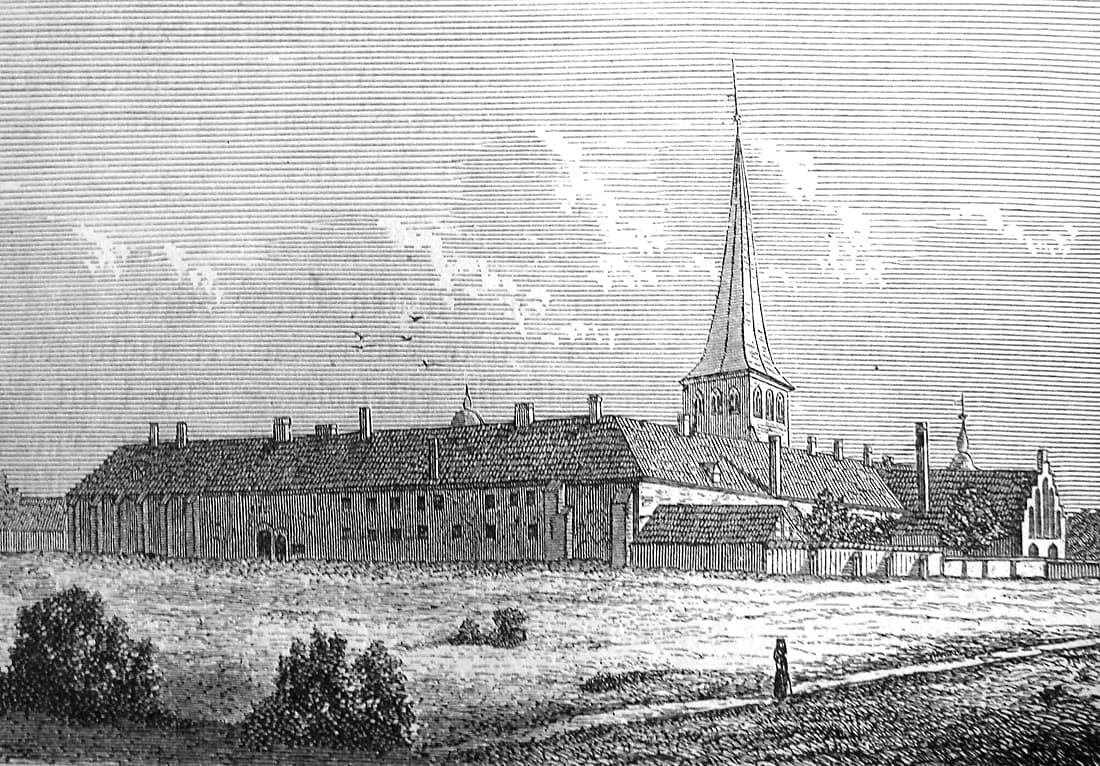
Antvorskov
Antvorskov monastery, located near the town of Slagelse on the island of Zealand, Denmark, was a significant medieval religious and military complex. Founded in the late 12th century, it served as the principal Scandinavian headquarters of the Knights Hospitaller, also known as the Order of Saint John of Jerusalem. This order was a Catholic military and hospitaller organization dedicated to caring for the sick and defending Christendom. Antvorskov’s establishment around 1165–1170 followed a land grant by King Valdemar the Great, marking the start of a major religious institution with a hospital, monastery, and church complex.
The monastery quickly grew in prominence, becoming one of the largest landowners in Denmark by the 13th and 14th centuries through donations from nobility seeking spiritual favor. The prior of Antvorskov held considerable political influence, often sitting on the Danish Council of the Realm (Rigsrådet). Notable priors such as Henrik of Hohenscheid and Jep Mortensen contributed to the monastery’s religious and architectural development. Mortensen, in particular, led a major rebuilding phase in the late 15th century, adding a chapel and other structures to the complex.
Medieval religious and architectural complex
The original monastery was constructed primarily using medieval brick known locally as munkesten, typical of 12th-century Danish ecclesiastical buildings. The complex included the monastery living quarters, a church with an adjoining chapel, and a hospital dedicated to caring for pilgrims and those afflicted with diseases such as leprosy. The layout reflected the dual religious and hospitaller mission of the Knights Hospitaller, combining spiritual functions with medical care facilities.
Architectural modifications continued over the centuries, culminating in the late 15th century with the addition of a new chapel by Jep Mortensen. This period saw the expansion of the complex to accommodate the growing religious community and its needs. The church itself was a central feature, with a tower that was later enhanced with a tall spire by 1584, reflecting its transformation into a royal castle under King Frederik II.
Transition to royal castle and decline
The Reformation in Denmark brought significant changes to Antvorskov. The Catholic monastery was dissolved, and its revenues were taken over by the Danish crown. In 1580, King Frederik II appointed Peder Reedtz as the secular administrator, converting the former monastic complex into a royal residence known as Antvorskov Castle. Frederik II spent his final years at the castle, dying there in 1588.
Following Frederik II’s death, the castle’s importance waned. King Christian IV used it only occasionally, and the site suffered damage during the mid-17th-century Swedish wars. The abbey church was closed in 1684, and parish activities were moved to St. Peter’s Church in Slagelse. In the early 18th century, the estate briefly became a countship under Elisabeth Helene von Vieregg but later reverted to royal ownership. Between 1717 and 1763, the castle served as a cavalry district, housing soldiers, and the church reopened for worship in 1722.
Ruin and archaeological preservation
By the late 18th century, the monastery church was dismantled, and its building materials were reused in nearby manor houses. The remaining monastic buildings deteriorated and were demolished by 1816 due to their ruinous state. Excavations conducted in 1887–1888 uncovered substantial remains of the original monastery, including some of the earliest 12th-century brickwork.
Today, the ruins of Antvorskov are preserved and exhibited by the National Museum in Slagelse. These archaeological remains reveal the layout and scale of a major medieval monastic complex, illustrating the architectural techniques and religious functions of the Knights Hospitaller in Scandinavia. The site continues to attract interest for its historical significance and connection to Danish medieval and early modern history.
Historical significance and legacy
Antvorskov monastery was not only a religious center but also a political institution. Its priors were influential figures in Danish governance until the Reformation. The site’s transformation into a royal castle reflects the shifting religious and political landscape of Denmark in the 16th century. The legacy of Antvorskov endures through its archaeological remains and the historical records documenting its role as a key Scandinavian outpost of the Knights Hospitaller.
The ruins also inspired cultural figures such as Hans Christian Andersen, who mentioned the site in his writings, highlighting its place in Denmark’s romantic historical imagination during the 19th century.
Frequently asked questions (FAQ)
- What is the historical significance of Antvorskov Castle?
- Antvorskov Castle, located in Slagelse, Denmark, holds great historical importance as it was established in the late 12th century and served as a royal residence. It played a vital role in the political and military history of Denmark, particularly during the Middle Ages, and is a testament to the architectural styles of that period.
- When was Antvorskov Castle constructed?
- Antvorskov Castle was constructed around the late 12th century, with significant developments occurring in the following centuries. The castle has undergone various renovations and restorations, reflecting the architectural changes and historical events that shaped its existence.
- How do I visit Antvorskov Castle?
- Visitors can access Antvorskov Castle by following the signs from Slagelse town center. It is advisable to check the official website for any guided tour options or specific visitor information, as access to certain areas may vary.
- What are the opening hours for Antvorskov Castle?
- Antvorskov Castle is generally open to visitors during the summer months, from June to August, with specific hours of operation. It is recommended to verify the current opening hours on the official website, as they may change seasonally.
- Can I take photos inside Antvorskov Castle?
- Yes, visitors are typically allowed to take photos inside Antvorskov Castle, but it is important to respect any signs or guidelines regarding photography. Some areas may have restrictions to preserve the historical integrity of the site.
- Is it possible to find guided tours at Antvorskov Castle?
- Yes, guided tours are often available at Antvorskov Castle, providing visitors with in-depth knowledge about its history and architecture. These tours can enhance your experience and help you appreciate the castle's significance more fully.
- What is the best time to visit Antvorskov Castle?
- The best time to visit Antvorskov Castle is during the late spring and summer months when the weather is mild and the gardens are in full bloom. This allows for a more enjoyable exploration of the grounds and nearby attractions.
- Are there any nearby attractions to visit while at Antvorskov Castle?
- Yes, there are several nearby attractions, including the historical town of Slagelse and the scenic nature areas surrounding the castle. Visitors can also explore local museums and cultural sites that highlight the region's rich history.
- What are the ticket prices for visiting Antvorskov Castle?
- Ticket prices for Antvorskov Castle vary depending on the season and whether you opt for a guided tour. It is best to check the official website for the most up-to-date pricing information and any available discounts for families or groups.
Photo gallery

Photo by unknown for the image•Public domain
Information
Loading map...
Visitor reviews
No reviews yet. Been here? Write the first review and help other travelers!
Write the first reviewVisited this castle? Share your experience
Your review helps other travelers and adds first-hand knowledge to our encyclopedia.



