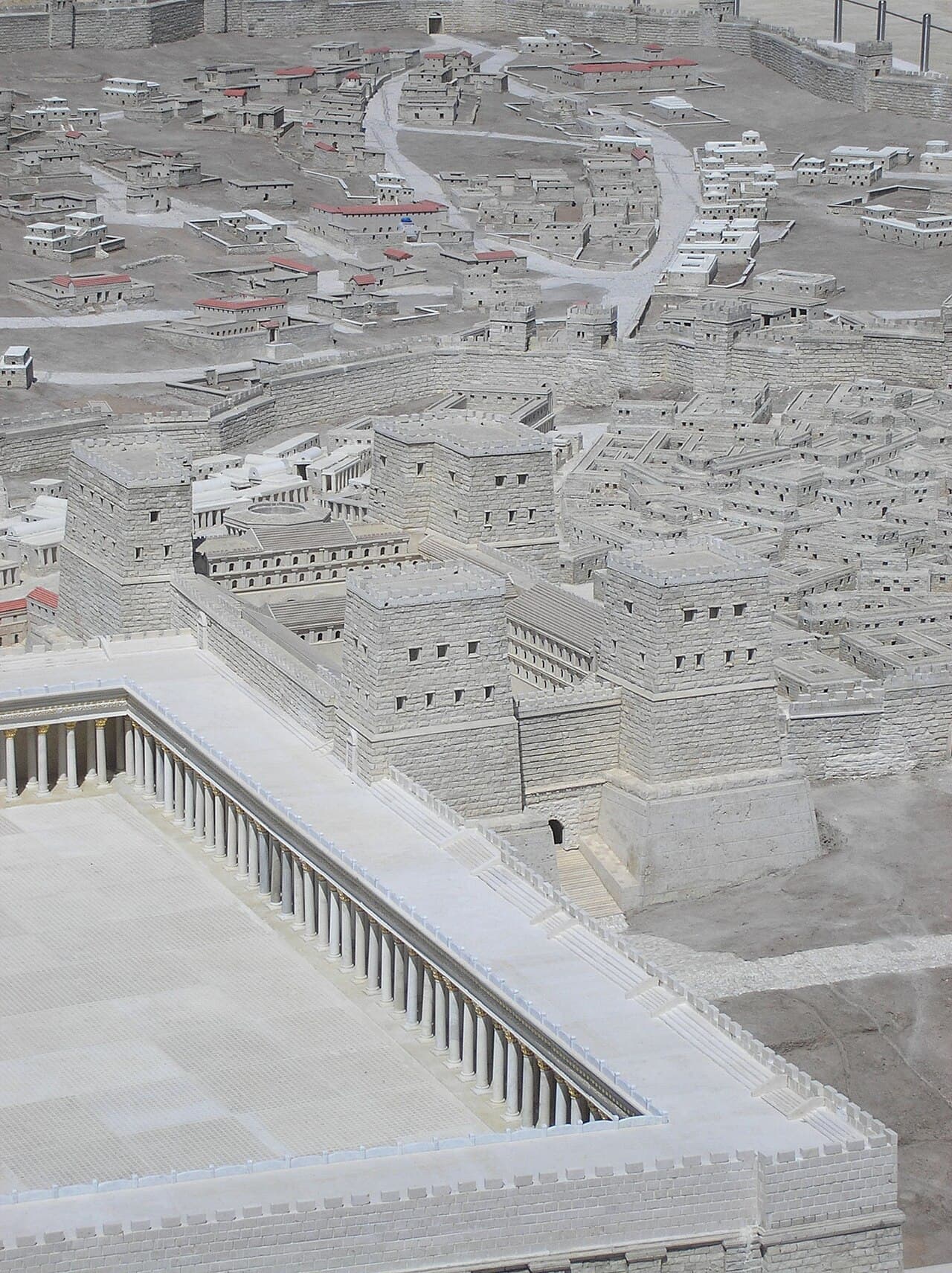
The Antonia Fortress was a significant Herodian citadel constructed in the 1st century BC during the reign of Herod the Great. Named after Herod's Roman patron, Mark Antony, this fortress served a crucial military and religious function by guarding the Second Temple in Jerusalem. Strategically positioned at the north-western corner of the Temple Mount, it stood at the eastern end of the city's Second Wall, overseeing both the temple complex and the surrounding city.
The fortress was designed as a stronghold to maintain order and prevent unrest around the sacred precincts of the temple. Its architecture included massive stone walls, towers, and fortified battlements that provided a commanding view of the temple courtyards and the city streets. The Antonia Fortress was connected to the temple by a series of porticoes, allowing troops to move quickly between the fortress and the temple grounds.
Historical context and purpose
Built by Herod the Great, a client king under Roman authority, the Antonia Fortress was part of a broader strategy to assert control over Jerusalem and its religious center. The fortress was named in honor of Mark Antony, reflecting the political alliances of the period. Its primary role was to serve as a military barracks and a defensive position to protect the temple from potential attacks or uprisings.
Throughout its history, the fortress played a role in several key events, including the Jewish revolts against Roman rule. It was a base for Roman soldiers who monitored the temple activities and controlled access to the sacred site. The fortress's presence was a symbol of Roman authority imposed on the Jewish population.
Architectural features and layout
The Antonia Fortress was constructed with large ashlar stones typical of Herodian architecture, known for its precision and durability. The fortress featured multiple towers, including a prominent corner tower that overlooked the temple courts. Its walls were thick and fortified with crenellations and defensive parapets.
One of the fortress's notable architectural features was the integration with the Temple Mount platform. The fortress was linked to the temple compound by a series of covered walkways or porticoes, facilitating secure movement of troops and officials. The elevated position of the fortress allowed for surveillance over the temple area and the city below.
Relation to the Second Wall and temple complex
The fortress was situated at the eastern terminus of Jerusalem's Second Wall, which enclosed the expanding city during the late Second Temple period. This location was strategic for controlling access to the northern approaches of the temple. The fortress's walls formed part of the city's defensive system, complementing the temple's own fortifications.
Destruction and archaeological remains
The Antonia Fortress was severely damaged and largely destroyed during the First Jewish–Roman War (66–73 CE) and subsequent conflicts. The fortress did not survive intact into later periods, and today it exists primarily as archaeological ruins. Excavations have revealed foundations, wall fragments, and remnants of towers that provide insight into its original scale and design.
Despite its ruinous state, the site remains an important archaeological and historical landmark in Jerusalem. It offers valuable evidence about Roman military architecture in Judea and the complex relationship between Roman authorities and the Jewish population during the Early Medieval period.
Legacy and cultural significance
The Antonia Fortress holds a prominent place in religious and historical narratives related to Jerusalem. It is frequently mentioned in ancient texts, including accounts of the trial of Jesus Christ, where Roman soldiers stationed at the fortress played a role. The fortress symbolizes the intersection of Roman imperial power and Jewish religious tradition.
Today, the site attracts scholars and visitors interested in the history of Jerusalem, Roman military engineering, and the Second Temple period. Its ruins contribute to the understanding of the city's ancient urban landscape and the dynamics of power during a pivotal era in history.
Frequently asked questions (FAQ)
- What was the primary function of the Antonia Fortress?
- The Antonia Fortress primarily served as a military stronghold to protect the Second Temple and maintain order in Jerusalem during the Roman period.
- Where was the Antonia Fortress located in Jerusalem?
- It was located at the north-western corner of the Temple Mount, at the eastern end of the Second Wall.
- When was the Antonia Fortress built?
- The fortress was constructed in the 1st century BC by Herod the Great.
- What remains of the fortress can be seen today?
- Today, only archaeological ruins remain, including foundations and fragments of walls and towers uncovered through excavations.
- Is the Antonia Fortress accessible to visitors?
- The site is primarily an archaeological area; access may be limited and is often subject to local regulations and preservation efforts.
Photo gallery

Photo by deror avi•Attribution
Information
Loading map...
Visitor reviews
No reviews yet. Been here? Write the first review and help other travelers!
Write the first reviewVisited this castle? Share your experience
Your review helps other travelers and adds first-hand knowledge to our encyclopedia.