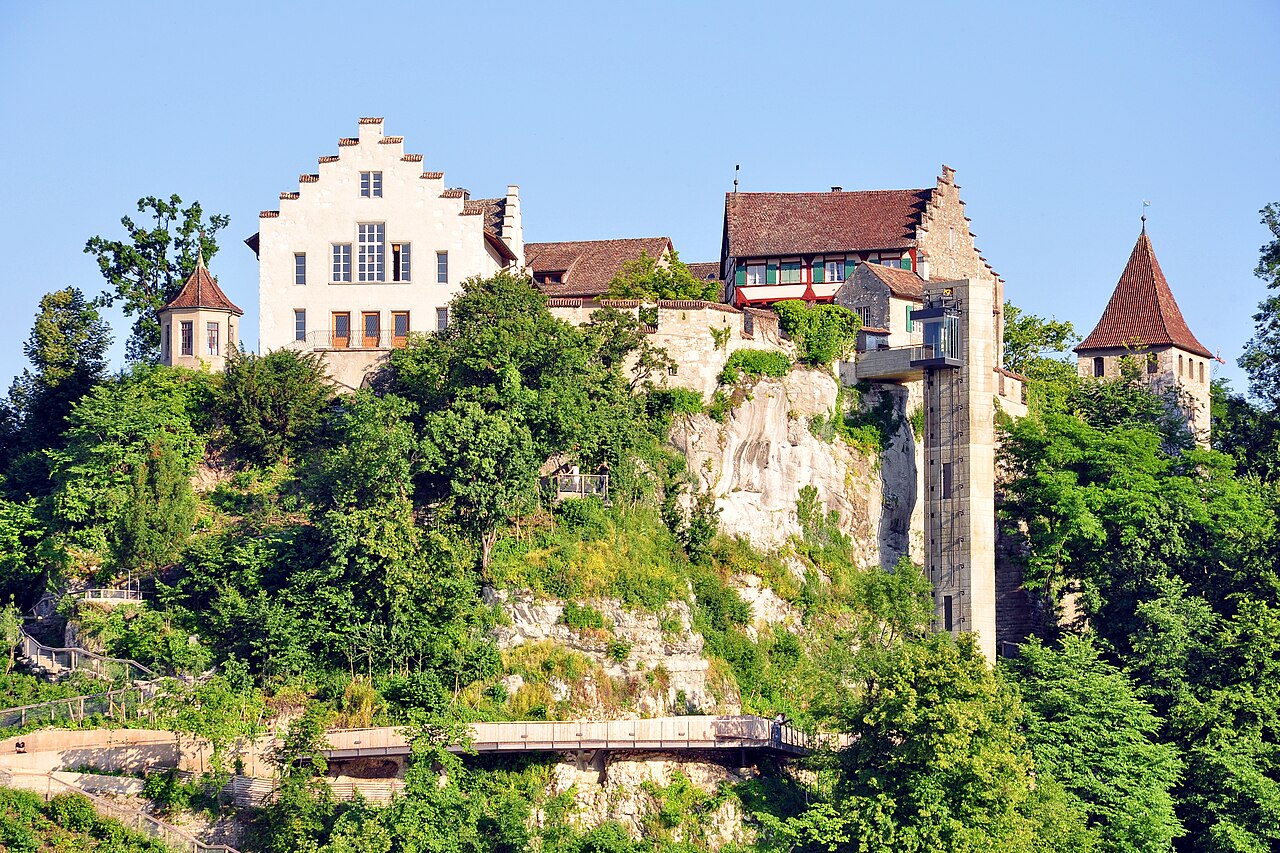
Andelfingen Castle
Andelfingen Castle stands as a significant historical manor located in the municipality of Andelfingen, Switzerland. Its origins date back to the early 17th century, when the first "new castle" was constructed between 1613 and 1614 to serve as the residence of the Landvogt, the bailiff overseeing the region. This initial structure was a multifunctional complex, incorporating a weapons depot, a powder tower for gunpowder storage, and an archive, underscoring its dual military and administrative roles during the early modern period.
Located strategically approximately midway between the town’s church and the Thur River, the castle originally occupied a site about 200 meters west of its current location. The castle's position provided a commanding view over the surrounding landscape and a covered wooden bridge spanning the river, which was an important local crossing point.
17th-century origins and early functions
The original castle was built by local authorities to consolidate administrative control and provide military security in the region. As the residence of the Landvogt, it was the center of governance and law enforcement, reflecting the political structures of the time. The inclusion of a powder tower and weapons depot highlights the castle’s role in regional defense during a period marked by frequent territorial disputes and military tensions.
Reconstruction in the late 18th century
Between 1780 and 1782, the original 17th-century structure was demolished following a professional evaluation by a skilled carpenter from the renowned Grubenmann family of Teufen, experts known for their contributions to Swiss architecture and engineering. The assessment concluded that a new manor house was necessary, leading to the construction of the current building that replaced the original castle. This new manor house reflected architectural and functional shifts of the late 18th century, moving away from fortified structures toward more representative and comfortable residences.
Architectural characteristics of the manor house
The present-day Andelfingen Castle is an 18th-century manor house that embodies the transition from medieval fortifications to residential estates. While detailed records of the construction materials and interior layout are scarce, the manor is noted for its representative style and its integration with the surrounding landscape. The estate covers approximately 1.5 hectares, including a garden commissioned in 1817 by Hans Kaspar Schweizer, which enhances the property’s aesthetic and historical value.
Political changes and evolving uses
Until 1798, the castle functioned as the official residence of the Landvogt. However, the French invasion of Switzerland in 1798 dramatically altered the political landscape, ending the castle's role as an administrative center. During the subsequent period of foreign occupation and upheaval, the castle was rented to Matthias Escher, a physician, marking a shift toward private use.
Following the withdrawal of French forces and the conclusion of the Mediation Constitution, the castle regained administrative importance as the seat of the Oberamtmann, or district governor. This role underscored the restoration of regional governance and the castle’s continued significance in local administration.
19th-century reforms and ownership changes
The administrative office of Oberamtmann was abolished in 1830 due to district reforms implemented by the canton of Zürich. Subsequently, in 1832, the castle was sold by the city of Zürich to Johann Heinrich von Sulzer-Wart. The Sulzer-Wart family maintained ownership for several decades, preserving the estate through the 19th century.
Upon the death of the last heir, Anna Maria von Sulzer-Wart, the castle and its garden were donated to the municipality of Andelfingen, transferring the property into public ownership. This marked a new phase in the castle’s history, focusing on community use and preservation.
20th-century adaptation and current use
From 1925 until 1999, Andelfingen Castle served as a retirement home, reflecting adaptive reuse of historic properties in the modern era. Since 2000, the castle has been managed by a foundation and currently accommodates the Statthalteramt (bailiff’s office), alongside a private residential apartment and facilities for various events. This multifunctional use ensures the castle remains an active part of the community while preserving its historical legacy.
Site and surroundings
The castle estate encompasses about 1.5 hectares, including the historic garden laid out in 1817. The grounds maintain the layout established in the late 18th century, preserving the character of the manor and its setting. The location near the Thur River and the covered wooden bridge adds to the site’s scenic and historical significance.
Though the original 17th-century castle no longer stands, the current manor house and its gardens serve as a tangible reminder of the region’s administrative history and architectural evolution. The castle’s layered past, from a fortified residence to an administrative center and community asset, reflects broader historical trends in Swiss governance and architecture.
Frequently asked questions (FAQ)
- When was Andelfingen Castle originally built and for what purpose?
- Andelfingen Castle was originally built between 1613 and 1614 to serve as the residence of the Landvogt, functioning as both an administrative center and a military facility with a weapons depot and powder tower.
- What architectural changes took place in the late 18th century?
- Between 1780 and 1782, the original castle was demolished and replaced by a manor house following an evaluation by a carpenter from the Grubenmann family, reflecting a shift from fortified structures to representative residences.
- How did the castle’s function change after the French invasion in 1798?
- After the 1798 French invasion, the castle ceased its administrative role and was rented to a private physician, marking a transition from official use to private occupation during foreign occupation.
- Who owns Andelfingen Castle today and how is it used?
- Today, Andelfingen Castle is owned by the municipality of Andelfingen and is managed by a foundation. It houses the Statthalteramt (bailiff’s office), a private apartment, and event facilities, maintaining its role as a community asset.
- What is the significance of the garden surrounding the castle?
- The garden, commissioned in 1817 by Hans Kaspar Schweizer, enhances the estate’s aesthetic and historical value, preserving the character of the property and reflecting early 19th-century landscape design.
Information
Sources & official resources
Verify the information above using these authoritative references.
Loading map...
Visitor reviews
No reviews yet. Been here? Write the first review and help other travelers!
Write the first reviewVisited this castle? Share your experience
Your review helps other travelers and adds first-hand knowledge to our encyclopedia.