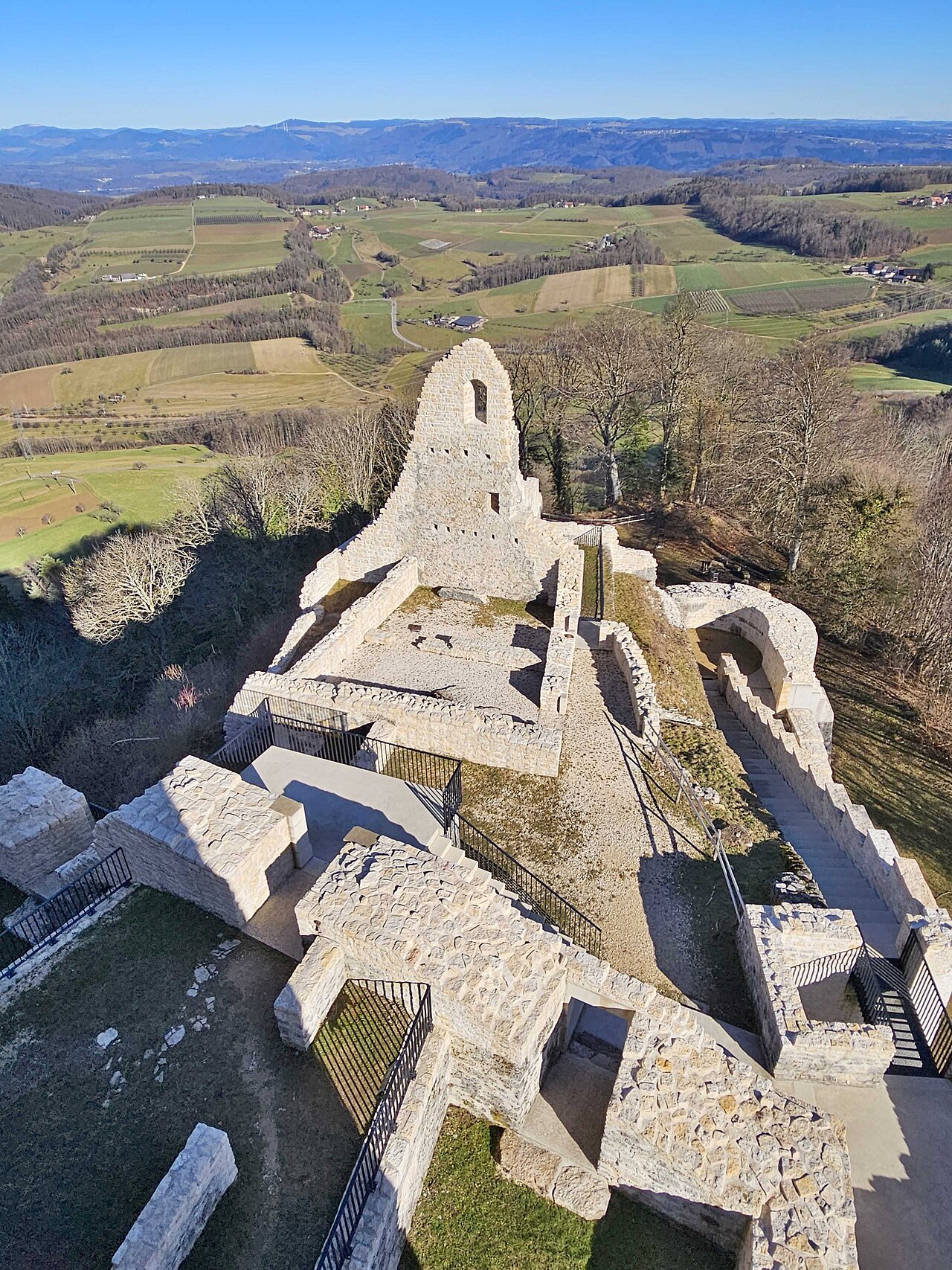
Alt-Thierstein Castle
Alt-Thierstein Castle is a significant medieval fortress located on a hillside in the municipality of Gipf-Oberfrick, Switzerland. Constructed in the early 11th century by the noble Counts of Tierstein, later known as the Counts of Homberg, the castle stands as a testament to early medieval fortification practices and noble family heritage in the region.
Historical background and noble lineage
The castle's earliest documented association is with Count Rudolf I, who referenced the fortress in official documents dated 1082 and 1114. This highlights the castle's role as a family stronghold and seat of power during the high medieval period. In the early 12th century, the Homberg family split into two branches, with one led by Count Rudolf III of Homberg establishing the Tierstein line, which took control of Alt-Thierstein Castle.
During the 14th century, the Tierstein family further divided, giving rise to the Farnsburg lineage, which inherited the castle. The construction of Neu-Thierstein Castle near Büsserach in the late 13th century reflected shifts in family holdings and the need for new residences. Despite this, Alt-Thierstein remained inhabited well into the 15th century, with its abandonment closely linked to the extinction of the Tierstein-Farnsburger line.
Architectural features and site layout
Alt-Thierstein Castle is a classic example of a hill castle, strategically positioned on the southeastern slope of the Tiersteinberg hill, approximately 750 meters high. Rather than occupying the summit, the fortress was built on a large rocky outcrop about 600 meters above sea level. This natural foundation, measuring roughly 55 by 40 meters, provided a robust base for the castle’s structures.
The castle's design ingeniously adapted to the steep hillside through the use of terracing. Builders carved multiple terraces into the slope, creating level platforms for construction. This stepped arrangement not only maximized defensive capabilities but also integrated the fortress harmoniously with the natural landscape.
Although much of the original masonry has been removed over time—often repurposed by local inhabitants—the remaining ruins still delineate the castle's footprint and its relationship with the terrain. Surrounding fields bear names such as "Burgmatte" and "Burghalde," German terms meaning "castle meadow" and "castle slope," preserving the memory of the fortress in local toponymy.
Impact of natural disasters and archaeological efforts
The castle endured the 1356 Basel earthquake, a major seismic event that also destroyed nearby Alt-Homburg Castle. Records indicate that Alt-Thierstein sustained damage but was repaired rather than abandoned immediately. This resilience underscores the castle’s importance and the commitment to maintaining its defensive role during the medieval period.
In 1934, an archaeological excavation led by Hans Erb sought to uncover more about the site. Unfortunately, the excavation was poorly documented, and artifacts were mixed, complicating modern study. Despite this, the dig contributed valuable insights into the castle’s layout and construction phases.
Cultural significance and preservation status
Today, Alt-Thierstein Castle stands as a partially preserved hill castle ruin that offers visitors a glimpse into medieval fortification strategies and noble life in Switzerland. Its location on a prominent rocky outcrop provides commanding views of the surrounding landscape, emphasizing its strategic importance.
The castle’s ruins, though incomplete, remain a valuable cultural heritage site. They illustrate the interplay between natural topography and human engineering in medieval castle construction. The site is accessible to visitors interested in history, architecture, and archaeology, contributing to the understanding of regional medieval history.
Architectural elements and defensive features
While detailed architectural plans are lacking, the castle’s terraced design suggests a complex arrangement of defensive walls, residential buildings, and possibly a keep or tower house. The natural rocky foundation would have enhanced the castle’s defensibility, making it difficult for attackers to approach or undermine the walls.
The terraces likely supported various functional spaces, including living quarters, storage areas, and defensive battlements. The integration of natural rock formations into the castle’s defenses is characteristic of hill castles built in challenging terrain during the medieval period.
Historical context within Swiss medieval fortifications
Alt-Thierstein Castle is part of a broader network of medieval fortifications in the Swiss Jura region. Its construction and use reflect the feudal dynamics and territorial disputes typical of the high and late medieval periods. The castle’s endurance through seismic events and family line transitions highlights its strategic and symbolic significance.
The transition from Alt-Thierstein to Neu-Thierstein Castle mirrors broader trends in castle development, where newer residences were built to accommodate changing defensive needs and residential preferences among noble families.
Visitor information and accessibility
Located near Gipf-Oberfrick, the castle ruins are accessible via hiking trails that ascend the Tiersteinberg hillside. Visitors can explore the terraces and enjoy panoramic views of the Swiss landscape. While no formal visitor center exists, informational signage at the site provides historical context.
Due to the castle’s ruinous state, visitors should exercise caution when navigating uneven terrain. The site is open year-round, with the best visiting conditions in late spring through early autumn when weather is favorable.
Frequently asked questions
- When was Alt-Thierstein Castle built? The castle was constructed in the early 11th century by the Counts of Tierstein.
- What type of castle is Alt-Thierstein? It is a hill castle, built on a rocky outcrop with terraced platforms.
- Is the castle accessible to visitors? Yes, the ruins are accessible via hiking trails near Gipf-Oberfrick and can be visited year-round.
- What happened during the 1356 earthquake? The castle was damaged but repaired after the major earthquake centered near Basel.
- Are there any archaeological excavations? A 1934 excavation led by Hans Erb uncovered artifacts, although documentation was limited.
- Why was the castle abandoned? Its abandonment is linked to the extinction of the Tierstein-Farnsburger noble line in the 15th century.
Frequently asked questions (FAQ)
- What is the historical significance of Alt-Thierstein Castle?
- Alt-Thierstein Castle, dating back to the 13th century, is a remarkable example of medieval architecture in Switzerland. It served as a strategic fortress and residence for the local nobility, reflecting the region's feudal history and importance during the Middle Ages.
- When was Alt-Thierstein Castle built?
- The construction of Alt-Thierstein Castle began in the early 1200s, with significant expansions and renovations occurring over the following centuries. Its long history is evidenced by the various architectural styles present in the structure today.
- Can I visit Alt-Thierstein Castle?
- Yes, Alt-Thierstein Castle is open to the public for visits. Guests can explore the castle grounds and enjoy the stunning views of the surrounding landscape, making it an ideal spot for history enthusiasts and nature lovers alike.
- What are the opening hours for Alt-Thierstein Castle?
- Alt-Thierstein Castle typically opens from April to October, with specific hours varying by season. It is advisable to check the official website or local tourism information for the most accurate and up-to-date opening times before planning your visit.
- Is it possible to access Alt-Thierstein Castle by public transportation?
- Yes, Alt-Thierstein Castle is accessible via public transportation. Visitors can take local trains or buses to nearby Gipf-Oberfrick and then enjoy a short walk to reach the castle.
- What is the best time to visit Alt-Thierstein Castle?
- The best time to visit Alt-Thierstein Castle is during the spring and summer months when the weather is pleasant and the surrounding nature is in full bloom. This is also when the castle hosts various events and tours, enhancing the visitor experience.
- Are there any nearby attractions to explore after visiting the castle?
- Absolutely! After exploring Alt-Thierstein Castle, visitors can enjoy nearby attractions such as the Fricktal Nature Centre and the picturesque towns of Frick and Laufenburg. These locations offer additional historical insights and beautiful landscapes.
- What are the ticket prices for Alt-Thierstein Castle?
- Ticket prices for Alt-Thierstein Castle are generally affordable, with discounts available for children, students, and seniors. It's best to check the official website for current pricing and any special promotions that may be offered during your visit.
- Is Alt-Thierstein Castle wheelchair accessible?
- While Alt-Thierstein Castle has some accessible areas, the historical nature of the site means that certain sections may be challenging for those with mobility issues. It is recommended to contact the castle administration in advance to inquire about specific accessibility options available during your visit.
Information
Loading map...
Visitor reviews
No reviews yet. Been here? Write the first review and help other travelers!
Write the first reviewVisited this castle? Share your experience
Your review helps other travelers and adds first-hand knowledge to our encyclopedia.