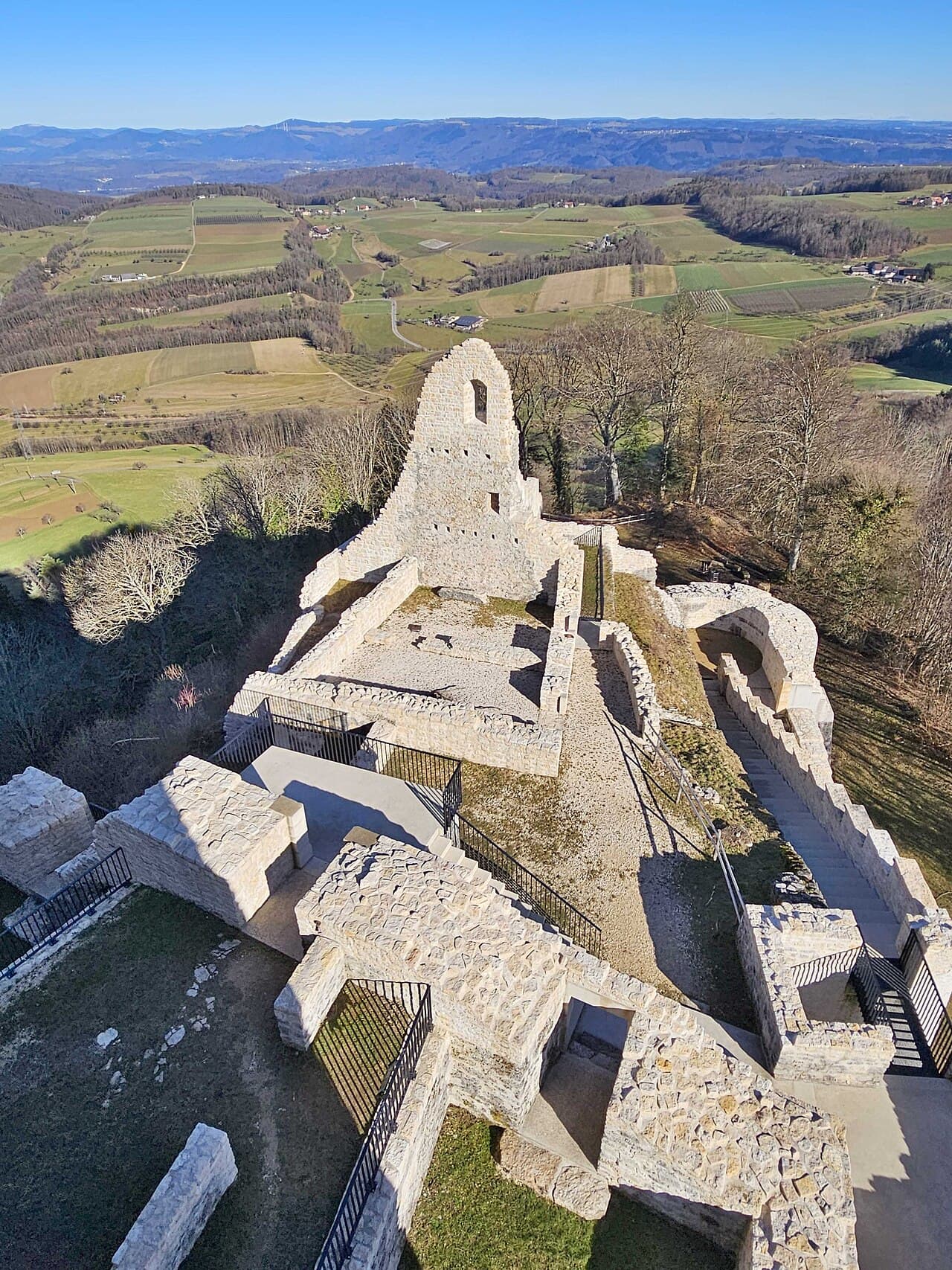
Farnsburg Castle Ruins
Farnsburg Castle ruins stand as a testament to medieval fortification and noble heritage in the Swiss canton of Basel-Landschaft. Built in the early 14th century by the Counts of Thierstein, this hill castle was a significant stronghold and administrative center during the late medieval period. Its strategic location on a rocky spur at 734 meters above sea level offered commanding views and natural defenses, which were enhanced by formidable architectural features such as a massive shield wall, a deep neck ditch, and multiple towers.
Constructed between 1319 and 1342, Farnsburg Castle was initially the seat of the Thierstein-Farnsburg branch, overseeing the Landvogtei of Sisgau. The castle's role evolved over the centuries, reflecting the shifting political landscape of medieval Switzerland. After the extinction of the Thierstein-Farnsburg line in 1418, the castle passed to the barons of Falkenstein, who held it as a fief from the Bishop of Basel. The Falkensteins' alliance with the Habsburgs during the Old Zürich War brought military conflict to Farnsburg's doorstep, including a siege by Swiss confederate forces in 1444, which was ultimately lifted following the Battle of St. Jakob an der Birs.
Historical significance and political context
Farnsburg Castle's history is deeply intertwined with regional power struggles and social upheavals. The castle served as a symbol of noble authority and administrative control, especially after its acquisition by the city of Basel in 1461. Basel transformed Farnsburg into a Landvogteischloss, an administrative residence for a bailiff, marking a shift from purely military functions to governance and local administration. Renovations during this period included the addition of glass windows and a forework, reflecting changing architectural tastes and defensive needs.
The castle's military importance waned over time, as evidenced by its easy capture during the Peasants' War of 1653 and again during the Basel revolution of 1798. These events culminated in the castle being set ablaze by revolting farmers, leading to its abandonment and subsequent use as a quarry. Despite this decline, Farnsburg remains a vital cultural heritage site, offering insights into medieval Swiss nobility, feudal administration, and military architecture.
Architectural features and layout
Site and defensive structures
Farnsburg Castle is perched on a prominent rocky spur that dominates the surrounding landscape. The site extends approximately 130 meters in length and up to 60 meters in width, divided into two main sections: the lower castle (Vorburg) and the upper castle (Kernburg). The natural rock formations were skillfully modified with artificial terracing to create defensive advantages, including a sheer cliff about eight meters deep between the rock edge and the imposing shield wall.
A significant defensive feature is the neck ditch carved in front of the castle, nearly nine meters wide, which served both as a formidable obstacle to attackers and as a quarry source for building stone. The forework at the southeastern end of the neck ditch includes a well-preserved gatehouse flanked by a semicircular tower, providing controlled access to the castle complex.
Lower castle structures
The lower castle is enclosed by a continuous ring wall punctuated by several towers, including the notable Bettelturm (Hundsturm) round tower at the southeastern corner. This area housed a guardhouse with stables and a granary, indicating a blend of military readiness and domestic functionality. A semicircular shell tower along the eastern wall functioned as a storage space for gunpowder and firearms, highlighting the castle's adaptation to evolving military technology.
Residential buildings within the lower castle are linked to the ministerial family Zielemp, whose seal inspired the coat of arms of Ormalingen village. The presence of stables and other outbuildings supports the interpretation of this area as both a defensive and residential zone. Archaeological evidence suggests occasional burials may have taken place within the lower castle precincts.
Upper castle and residential quarters
The upper castle served as the heart of residential and administrative life. It contained an administrative building, a chapel, and a bathhouse, reflecting the castle's role beyond military defense. Access between the lower and upper castles was facilitated by the Lange Stiege, a long stairway ascending the southeastern slope. This stairway leads visitors past the Blue Tower, over a drawbridge crossing the Wolf's Ditch, and up to the Pfisterhaus (bakery), each with gates controlling entry.
The Blue Tower is particularly notable for its side door leading to a sophisticated cistern system that tapped groundwater, ensuring a reliable water supply even if the lower castle was compromised. Another cistern collected rainwater from the roofs but was damaged during World War II bunker construction.
The upper castle's massive shield wall facing the neck ditch was flanked by small watchtowers known as Pfefferbühcsen or "pepper boxes," enhancing its defensive capabilities. The residential wing inside the shield wall rose at least four stories and featured a shed roof. Inside were living quarters and a kitchen equipped with a smoke channel built into the shield wall for ventilation.
On the northeast side, a complex of connected buildings housed administrative functions, including a scriptorium for document copying, the bathhouse, chapel, and chaplain's quarters. A small courtyard separated these from the residential areas, illustrating the castle's multifunctional design.
Preservation and modern access
After centuries of neglect and damage from conflict and quarrying, Farnsburg Castle underwent archaeological excavations and restoration beginning in the early 20th century. Major restoration efforts in 1930 and 1931 stabilized the ruins, with further repairs and studies conducted throughout the mid-1900s and early 2000s. Although safety concerns led to a temporary closure in 2012, the site reopened in 2013, allowing visitors to explore its extensive remains.
Today, Farnsburg Castle ruins are accessible via a scenic 20-minute hike from the nearby Landgasthof Farnsburg. The site offers picnic and BBQ facilities, making it a popular destination for history enthusiasts and outdoor lovers alike. A modern spiral staircase added in the 1930s leads to a viewing platform atop the shield wall, providing panoramic views of the surrounding villages and the distant Swiss Alps.
Farnsburg Castle remains an important cultural landmark, showcasing the evolution of medieval Swiss castle architecture, noble residence, and regional governance. Its well-preserved ruins and dramatic setting continue to attract visitors interested in history, architecture, and natural beauty.
Frequently asked questions (FAQ)
- How do I reach Farnsburg Castle ruins?
- Farnsburg Castle ruins can be reached by a scenic 20-minute hike from the Landgasthof Farnsburg, which serves as a convenient starting point for visitors.
- What is the historical significance of Farnsburg Castle?
- Farnsburg Castle was a key administrative center for the Counts of Thierstein and later the city of Basel, reflecting medieval noble power and regional governance.
- Can I explore the entire castle ruins?
- Visitors can explore the extensive ruins, including the lower and upper castles, towers, and defensive walls, though some areas may be restricted for safety reasons.
- When is the best time to visit Farnsburg Castle ruins?
- The castle ruins are accessible year-round, but spring through autumn offers the best weather for hiking and enjoying the panoramic views from the site.
- Is there an entrance fee to visit Farnsburg Castle?
- There is no entrance fee to visit Farnsburg Castle ruins; access is free to the public.
- Are there facilities near Farnsburg Castle ruins?
- Yes, near the ruins there are picnic and BBQ facilities, making it a pleasant spot for visitors to relax after exploring the castle.
Photo gallery

Information
Opening hours
Open year-round, access via hiking trail
Ticket prices
Free
Current owner
Municipality of Ormalingen
Website
Visit websiteSources & official resources
Verify the information above using these authoritative references.
Loading map...
Visitor reviews
No reviews yet. Been here? Write the first review and help other travelers!
Write the first reviewVisited this castle? Share your experience
Your review helps other travelers and adds first-hand knowledge to our encyclopedia.


