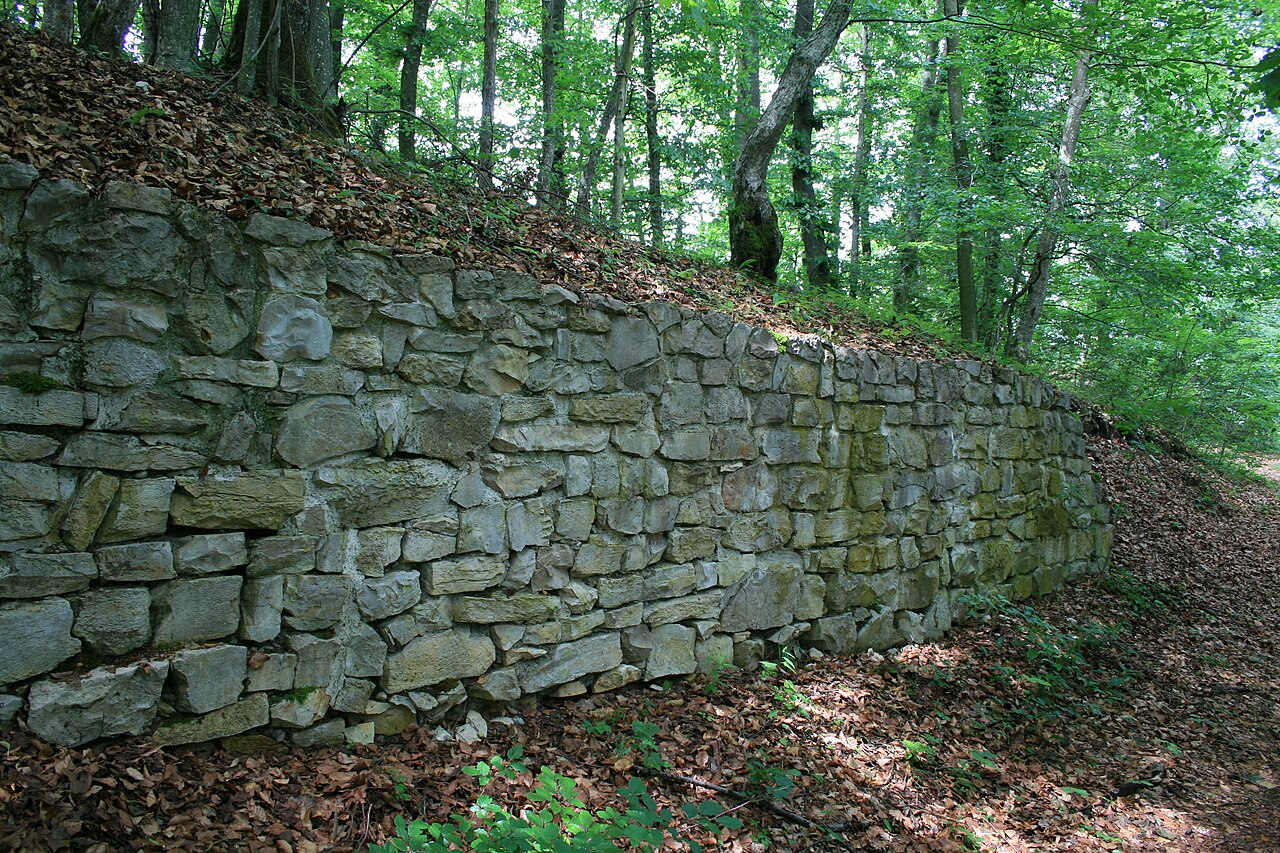
Laufenburg Castle
Laufenburg Castle stands as a remarkable example of a high medieval hill castle situated in the Swiss town of Laufenburg, in the canton of Aargau. Constructed in the 12th century by the influential Habsburg family, this fortress played a significant role in regional defense and governance along the Rhine River. Its strategic position atop a hill overlooking the river allowed control over vital trade and travel routes, making it a focal point of power and conflict for centuries.
The castle's origins trace back to around 1180 when the Habsburgs acquired the territory surrounding present-day Laufenburg. They established fortifications on both sides of the Rhine, including an initial castle on the northern bank. Elements of this early structure were likely incorporated into the later southern castle, which evolved into the main stronghold. The castle's design reflects the typical medieval emphasis on defense, featuring a robust bergfried (main tower), thick stone walls, and multiple defensive towers.
Historical development and ownership
The history of Laufenburg Castle is closely intertwined with the fortunes of the Habsburg dynasty. In the late 12th century, Count Rudolf II of Habsburg sought to found a town adjacent to the castle. However, his ambitions were curtailed by an arbitration ruling favoring the abbess of the nearby Säckingen monastery, which prevented the establishment of the town at that time. Despite this setback, Rudolf's son, Rudolf III, moved his residence to the southern castle and transformed it into a more comfortable residential castle, founding the Habsburg-Laufenburg lineage.
Throughout the 13th century, the settlement around the castle gradually expanded and was granted town privileges, officially renewed in 1328. These rights helped the town develop economically and politically, despite ongoing disputes over its status. The castle and its lordship remained under Habsburg control until financial difficulties forced Graf Hans IV to sell the property in 1386 to Duke Leopold III of Austria for 12,000 guilders.
The 15th century was marked by military conflicts that impacted the castle's fortunes. During the Old Zürich War in 1443, forces from Basel and Bern attacked Laufenburg, causing significant damage to the fortress. Later, during the Burgundian Wars, the castle briefly came under the control of Duke Charles the Bold. Following his defeat, Kaspar von Schönau took possession and undertook repairs in 1486 to restore the castle's defenses and habitability.
Sieges and military significance
The castle's military importance continued into the Thirty Years' War, during which it was captured three times by Swedish forces. This turbulent period further strained the castle's structure and defenses. It was not until 1648 that Austrian control was reestablished. At this time, the castle still retained substantial fortifications, including defensive walls with towers nearly as tall as the bergfried. The complex featured numerous rooms, a castle garden, and a chapel, illustrating its dual role as a fortress and noble residence.
However, the prolonged warfare left the castle in a deteriorated condition. By 1687, military experts from Italy declared the fortress obsolete, leading to its abandonment as a defensive site. The castle was gradually neglected and eventually deserted in 1787. Subsequently, it was used as a quarry, with stones taken for other building projects.
Architectural features and remains
Today, the most prominent surviving feature of Laufenburg Castle is the bergfried, an imposing main tower that rises nearly intact. This tower originally had an entrance door positioned about four meters above the courtyard level on its northern side, a defensive measure to prevent easy access. Visitors now reach the bergfried via a modern external spiral staircase made of steel, which leads to an observation platform approximately thirteen meters above ground.
The platform offers panoramic views of the historic town on both sides of the Rhine, the river itself, several bridges, nearby railway lines, and a hydroelectric power station along the High Rhine. Inside, a separate internal staircase ascends the full height of the tower, ending at a metal box marking the top of the stairs.
The castle's former defensive perimeter included a ring wall reinforced by multiple towers, which in their prime rose to nearly the height of the bergfried. These stone walls exemplify medieval construction techniques designed to withstand sieges and attacks. Although the majority of the castle's residential buildings, garden, and chapel no longer survive above ground, archaeological studies and historical documents attest to their existence and importance.
Preservation and modern significance
After the castle was purchased by the city of Laufenburg in 1803, efforts to preserve the ruins began slowly. A park was established on the site in 1908, providing public access and enhancing the area's cultural value. More comprehensive restoration work was undertaken in 1986 to stabilize the remaining structures, particularly the bergfried and adjoining walls.
Today, Laufenburg Castle stands as a significant historical monument and a testament to the region's medieval heritage. It attracts visitors interested in castle architecture, medieval history, and the legacy of the Habsburg dynasty. The castle's location on a hill overlooking the Rhine continues to offer strategic and scenic importance, linking past and present in the heart of Laufenburg.
Visitor experience and accessibility
Visitors to Laufenburg Castle can explore the ruins and ascend the bergfried to enjoy sweeping views of the surrounding landscape. The site is accessible via well-maintained paths leading up the hill, and the modern staircases ensure safe access to the tower's observation platform. Informational signage provides historical context, enriching the visitor experience. The castle's proximity to the town center makes it an easily reachable destination for those interested in Swiss medieval architecture and history.
Cultural and heritage importance
Laufenburg Castle is emblematic of the high medieval fortifications established by the Habsburgs during their territorial expansion. Its history reflects the complex political and military struggles of the region, including conflicts such as the Old Zürich War and the Thirty Years' War. The castle's architectural features, particularly the bergfried and defensive walls, offer valuable insights into medieval construction and defensive strategies.
As a preserved ruin, the castle also serves as a cultural landmark, fostering local identity and historical awareness. Conservation efforts have ensured that this heritage site remains a vital part of Laufenburg's landscape, contributing to tourism and education.
Frequently asked questions (FAQ)
- What is the historical significance of Laufenburg Castle?
- Laufenburg Castle, dating back to the 13th century, played a crucial role in the region's history as a defensive stronghold. Its strategic location on the Rhine River allowed it to control trade routes and protect the surrounding areas from invaders.
- When was Laufenburg Castle built?
- The construction of Laufenburg Castle began in the early 1200s and was completed in the late 13th century. Over the years, it has undergone various renovations and restorations, reflecting different architectural styles and historical periods.
- Can I visit Laufenburg Castle?
- Yes, visitors are welcome to explore Laufenburg Castle. Guided tours are available, providing insights into the castle's history, architecture, and the stunning views of the Rhine River.
- What are the opening hours for Laufenburg Castle?
- Laufenburg Castle is typically open to visitors from April to October, with specific hours varying by season. It is advisable to check the official website for the most current information on opening times before your visit.
- Is it possible to access Laufenburg Castle with limited mobility?
- While Laufenburg Castle offers breathtaking views, accessibility may be challenging due to uneven paths and staircases. Visitors with limited mobility are encouraged to contact the castle staff in advance to inquire about specific accommodations.
- What is the best time to visit Laufenburg Castle?
- The best time to visit Laufenburg Castle is during the spring and early autumn months when the weather is mild and the surrounding landscapes are vibrant. Additionally, visiting on weekdays can help you avoid larger crowds.
- Are there any nearby attractions to Laufenburg Castle?
- Yes, nearby attractions include the charming town of Laufenburg with its picturesque streets and the scenic Rhine River. Visitors can also explore hiking trails and enjoy local dining options in the surrounding area.
- How much does it cost to enter Laufenburg Castle?
- Ticket prices for Laufenburg Castle are generally affordable, with discounts available for students and seniors. It is recommended to check the castle's official website for current pricing and any special offers.
Information
Website
Visit websiteSources & official resources
Verify the information above using these authoritative references.
Loading map...
Visitor reviews
No reviews yet. Been here? Write the first review and help other travelers!
Write the first reviewVisited this castle? Share your experience
Your review helps other travelers and adds first-hand knowledge to our encyclopedia.