Alnwick Castle
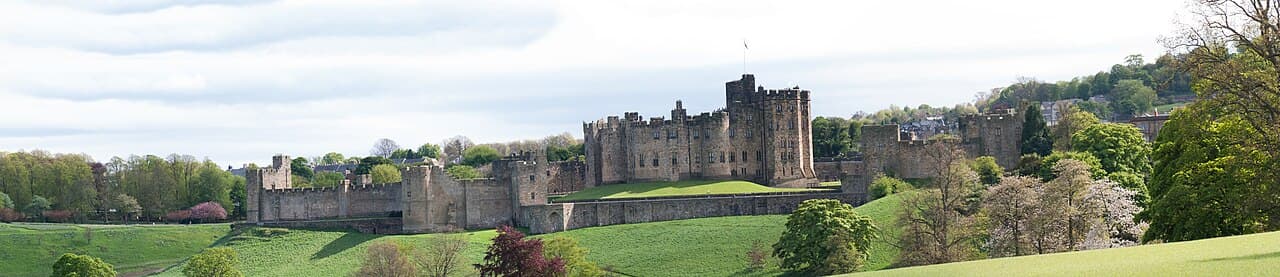
Alnwick Castle stands as a magnificent example of an English hill castle with a rich history dating back to the 11th century. Located in Alnwick, Northumberland, England, it has served as the ancestral home of the Duke of Northumberland for over seven centuries. The castle’s origins trace to the period shortly after the Norman conquest of 1066, when Ivo de Vesci, a Norman nobleman, established the initial fortifications to control key northern routes and defend against Scottish incursions. Over time, Alnwick Castle evolved from a military stronghold to a grand country house, reflecting changes in architectural style and the shifting needs of its owners.
The castle’s strategic location on a commanding site overlooking the River Aln and separated from the town by a deep ravine allowed it to dominate the surrounding landscape and guard an important river crossing. This position made it a focal point in the turbulent history of the Anglo-Scottish border, playing a significant role in conflicts such as the battles involving King Malcolm III of Scotland in 1093 and the capture of King William I of Scotland in 1174. The castle’s military significance continued through the High Medieval period, including involvement in the Anarchy and the Wars of the Roses.
Early history and medieval significance
The first castle was built around 1096 by Ivo de Vesci, who constructed a stone fortress to replace earlier timber defenses. The castle was first documented in 1136 when it was captured by King David I of Scotland, highlighting its importance in the border conflicts of the time. The castle was described as "very strong" during this period. Subsequent sieges occurred in 1172 and 1174, with the latter resulting in the capture of King William I of Scotland during the Battle of Alnwick, a pivotal moment in the castle’s military history.
Ownership of the castle remained with the de Vesci family until the early 14th century. In 1309, the Percy family acquired Alnwick Castle, marking the beginning of a long-standing association that continues today. The Percys, who rose to become Earls and later Dukes of Northumberland, undertook significant expansions and fortifications, transforming the castle into a formidable fortress and a luxurious noble residence. The 14th-century additions include the Abbot's Tower, Middle Gateway, and Constable's Tower, which survive as key architectural features.
Role in border conflicts and civil wars
Throughout the medieval period, Alnwick Castle was a key military asset in the ongoing border disputes between England and Scotland. It witnessed numerous sieges and battles, including during the Anarchy and the Wars of the Roses. The castle was held by Lancastrian forces during the Wars of the Roses and endured multiple sieges, reflecting its strategic importance. Its defenses and garrison played critical roles in the conflicts, with the castle changing hands several times before finally returning to Percy control under King Edward IV.
Architectural evolution and renovations
The castle’s architecture reflects its long history and the evolving needs of its occupants. Originally built as a stone fortress with a shell keep—a ring of ten closely arranged towers replacing the traditional square keep—the castle’s layout was innovative for its time. The entrance features a Romanesque archway flanked by two semi-octagonal towers added in the 14th century to enhance defense.
The outer bailey is protected by ten main towers of varied shapes, including D-shaped and rectangular designs, with notable towers such as the Postern Tower, Constable’s Tower, and Abbot’s Tower. The main gatehouse is defended by two semi-octagonal towers and a long barbican, a fortified outwork. The battlements are decorated with carved figures dating from around 1300 and the mid-18th century, commissioned by the first Duke and Duchess of Northumberland.
From the 18th century onwards, the castle underwent extensive remodeling by prominent architects including Robert Adam, James Paine, Daniel Garrett, and Anthony Salvin. These renovations introduced elements of the Strawberry Hill Gothic style and later Victorian Italianate decorations. Salvin’s work in the mid-19th century notably reshaped the kitchen, added the Prudhoe Tower, and reconfigured the inner ward. The interiors reflect a blend of Gothic revival and Italianate styles, showcasing the castle’s transition from fortress to stately home.
Gardens and landscape
Adjacent to the castle is The Alnwick Garden, a formal garden developed in the early 21st century by Jane Percy, Duchess of Northumberland. The garden features a cascading fountain, a large treehouse complex, and a unique poison garden growing plants such as cannabis and opium poppy. Designed by Belgian landscape architects Jacques and Peter Wirtz, the garden complements the historic setting and attracts visitors worldwide.
Modern use and cultural significance
Alnwick Castle remains the residence of the current Duke of Northumberland, making it one of the largest inhabited castles in England after Windsor Castle. It is open to the public during the summer months, drawing hundreds of thousands of visitors annually. The castle’s well-preserved condition contrasts with many other English castles, which often exist as ruins.
The castle gained international fame as a filming location for the Harry Potter film series, where it served as the exterior and some interior scenes of Hogwarts School of Witchcraft and Wizardry. This association has significantly boosted public interest and tourism, shaping popular perceptions of what a castle should look like.
Beyond tourism, parts of the castle have served educational purposes, hosting evacuees during World War II and later functioning as a teacher training college and a branch campus for St. Cloud State University. Exhibitions in the castle’s perimeter towers showcase archaeological finds, military history, and regimental collections, enriching visitors’ understanding of the castle’s heritage.
Preservation and public access
Alnwick Castle is a Grade I listed building, recognized for its exceptional architectural and historic value. The castle’s ongoing maintenance and restoration efforts ensure its preservation for future generations. Visitors can explore several rooms, the battlements, and the surrounding parks, including the landscaped grounds designed by Capability Brown in the 18th century.
The castle’s combination of military architecture, noble residence features, and modern adaptations make it a unique example of English castle evolution. Its continuous occupation by the Percy family adds to its cultural significance and historical continuity.
Frequently asked questions (FAQ)
- How do I get to Alnwick Castle?
- Alnwick Castle is located in the town of Alnwick, Northumberland, UK. It is easily accessible by car with ample parking available, and there are also regular bus services connecting Alnwick to major cities like Newcastle. If traveling by train, the nearest station is Alnwick, which is a short taxi ride away.
- What are the opening hours of Alnwick Castle?
- Alnwick Castle typically opens from 10:00 AM to 5:00 PM daily, but hours may vary depending on the season. It is advisable to check the official website before your visit for the most accurate information on opening times and potential seasonal events.
- When was Alnwick Castle built?
- Alnwick Castle dates back to the 11th century, with its construction beginning in 1096. Over the centuries, it has undergone numerous renovations and expansions, making it a fascinating representation of medieval architecture and history. The castle has also served as a residence for the Percy family for over 700 years.
- Can I take photos inside the castle?
- Yes, visitors are allowed to take photographs in many areas of Alnwick Castle, but please be mindful of signage that may restrict photography in certain exhibitions or private spaces. Capturing the stunning architecture and beautiful gardens will enhance your visit and provide lasting memories.
- Why is Alnwick Castle significant in history?
- Alnwick Castle has played a pivotal role in English history, notably during the border conflicts between England and Scotland. It has also been featured in popular culture, including its appearance in the Harry Potter films, which has made it a beloved destination for fans and history enthusiasts alike.
- Is it possible to visit the gardens at Alnwick Castle?
- Yes, visitors can explore the beautiful Alnwick Gardens, which are located adjacent to the castle. The gardens feature a variety of plants, water features, and a unique poison garden, making it a delightful addition to your castle visit. Entry to the gardens typically requires a separate ticket.
- What are the ticket prices for Alnwick Castle?
- Ticket prices for Alnwick Castle vary depending on the season and whether you are an adult, child, or family group. Discounts may also be available for students and seniors, so it's best to check the official website for the latest pricing and any special offers before your visit.
- When is the best time to visit Alnwick Castle?
- The best time to visit Alnwick Castle is during the spring and summer months when the gardens are in full bloom and many outdoor events take place. However, visiting during the off-peak seasons can also offer a quieter experience with fewer crowds, allowing for a more leisurely exploration of the castle and its grounds.
- What nearby attractions can I visit while at Alnwick Castle?
- While visiting Alnwick Castle, you can also explore the charming town of Alnwick, which offers shops, cafes, and the historic Alnwick Market. Additionally, nearby attractions include the beautiful Northumberland coast, the picturesque village of Rothbury, and the stunning landscapes of the Northumberland National Park.
Photo gallery

Information
Website
Visit websiteFeatured in
Articles on the Castlopedia blog that feature Alnwick Castle.

Sources & official resources
Verify the information above using these authoritative references.
Loading map...
Visitor reviews
No reviews yet. Been here? Write the first review and help other travelers!
Write the first reviewVisited this castle? Share your experience
Your review helps other travelers and adds first-hand knowledge to our encyclopedia.