Warkworth Castle
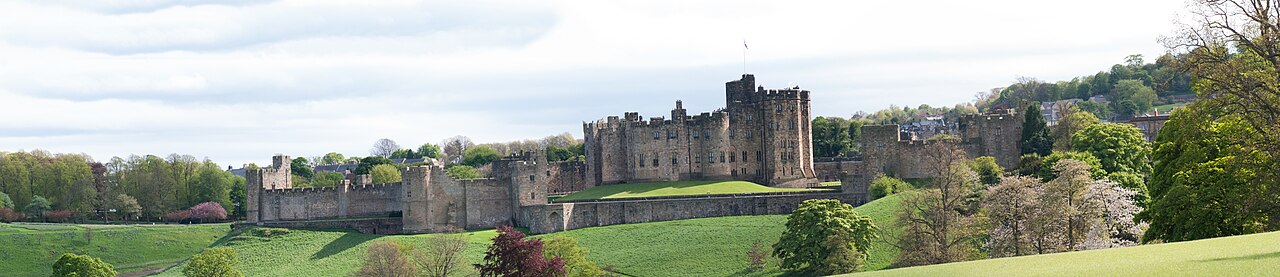
Warkworth Castle stands prominently in the village of Warkworth, Northumberland, England, as a striking example of a medieval hill castle with a rich history spanning several centuries. Constructed initially by the Normans during the high medieval period, this castle evolved from a simple timber fortification into a formidable stone fortress and noble residence. Its strategic location on a natural mound overlooking the River Coquet valley provided both defensive advantages and commanding views of the surrounding landscape.
The castle's origins are traditionally attributed to Prince Henry of Scotland in the mid-12th century, though more recent scholarship suggests it was likely founded by King Henry II of England around 1157 as part of his efforts to consolidate control over northern England. The earliest documentary evidence dates from the late 1150s to early 1160s, when Henry II granted the site to Roger fitz Richard, a Norman nobleman. Initially, the castle was a timber motte-and-bailey structure, typical of Norman military architecture, but it was considered relatively weak and was left undefended during a Scottish invasion in 1173.
Norman foundation and early expansion
Roger fitz Richard's son, Robert fitz Roger, inherited Warkworth and undertook significant stone rebuilding and expansion, transforming the castle into a more durable and imposing fortress. Robert's close ties to the English crown, particularly under King John, who visited the castle in 1213, underscored Warkworth's growing importance. The castle remained in the FitzRichard family for several generations, occasionally managed by guardians during minority periods.
By the late 13th century, Warkworth had gained strategic significance during the turbulent Anglo-Scottish conflicts. King Edward I resided at the castle in 1292, and during the reign of Edward II, the castle's defenses were reinforced to withstand Scottish attacks. Its successful resistance during two Scottish sieges in 1327 highlighted its military value.
The Percy family and architectural grandeur
Following the death of John de Clavering in 1332 and the subsequent passing of his widow, King Edward III granted Warkworth to Henry de Percy, 2nd Baron Percy, marking the beginning of the castle's long association with the powerful Percy family. Although the Percys owned the grander Alnwick Castle, Warkworth was adopted as their principal residence in Northumberland.
In the late 14th century, Henry Percy, the first Earl of Northumberland, commissioned the construction of the castle's iconic stone keep, a masterpiece of medieval military architecture. The keep's distinctive Greek cross-shaped plan, battlements, and heraldic carvings, including the Percy lion emblem and angelic figures, exemplify the high craftsmanship of the period and the family's status. The master mason John Lewyn is believed to have designed this imposing structure.
The 4th Earl of Northumberland later remodeled the castle's domestic buildings within the bailey and initiated the construction of a collegiate church, an ambitious religious project that was never completed and was dismantled in the early 16th century. Under the Percys, Warkworth became a symbol of noble power and a center of political activity in northern England.
Political turmoil and decline
The castle was a focal point during the late 14th and early 15th centuries' political conflicts. Henry Percy, known as "Hotspur," and his father rebelled against King Henry IV, resulting in the temporary confiscation of Warkworth. The castle was restored to the Percy family in 1416 and remained their residence through the Wars of the Roses, despite intermittent forfeitures and restorations.
By the 16th century, Warkworth Castle experienced decline due to neglect and the region's political unrest, including involvement in the Rising of the North in 1569 and the aftermath of the Gunpowder Plot. The castle was leased to Sir Ralph Grey, who allowed further deterioration. During the English Civil War, Warkworth initially supported the Royalists but surrendered to Scottish forces in 1644. Parliamentarian forces took control in 1648, removing metal fittings to prevent military reuse and possibly dismantling parts of the structure.
After the death of the last Percy earl in 1670, the castle's stone was quarried for other buildings. Ownership passed through marriage to the Dukes of Northumberland, who retained the site into modern times. The castle slowly deteriorated during the 18th century but attracted literary interest, notably from Bishop Thomas Percy's poem "The Hermit of Warkworth."
Preservation and modern management
Preservation efforts began in the 19th century, including restoration of the keep by architect Anthony Salvin in the 1850s. Archaeological excavations uncovered the remains of the collegiate church and other structures, enhancing understanding of the castle's complex history. In 1922, responsibility for Warkworth Castle passed to the government, and since 1984 it has been managed by English Heritage as a protected historic monument, ensuring its conservation and public accessibility.
Architectural features and layout
Site and defensive structures
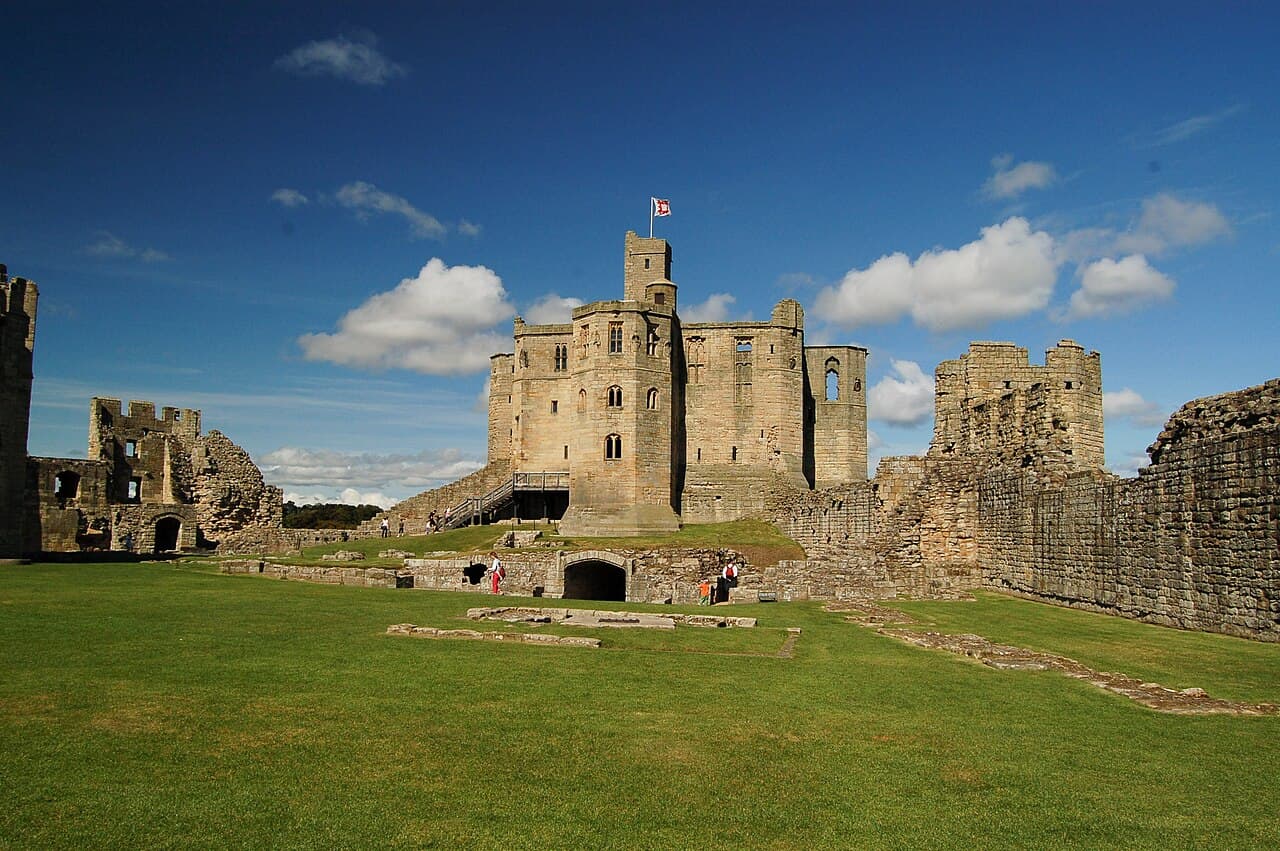
Warkworth Castle occupies an irregularly shaped site dominated by its massive stone keep at the northern end, perched atop an earlier motte or earth mound. The keep overlooks the village and the surrounding countryside, emphasizing its defensive and symbolic prominence. The bailey, or courtyard, lies to the south, enclosed by substantial stone curtain walls dating mainly from the early 13th century. Originally, the castle was almost entirely surrounded by a moat, except on the north side where natural topography provided protection.
The curtain walls are reinforced by four main towers, each with distinct functions and architectural details. The Carrickfergus Tower in the southwest corner is a polygonal structure that housed latrines and fireplaces, expanding living quarters adjacent to the great chamber. The Montagu Tower at the southeast corner, likely built in the 15th century by John Neville, featured fireplaces and latrines on upper floors and was repurposed as a stable by the 16th century. The postern tower on the west wall, north of the kitchen, dates from around 1200 and was later converted into living quarters, possibly serving as a discreet delivery entrance. The Grey Mare’s Tail Tower, constructed circa 1290, is notable for its narrow vertical openings on each of its five faces, allowing defenders to observe approaches along the curtain wall.
Domestic and ceremonial buildings
The great hall complex extends along the west curtain wall south of the kitchen. Originally built around 1200 and rebuilt circa 1480 by the 4th Earl of Northumberland, the hall was divided into two aisles of unequal width and heated by open hearths, two of which survive from the earlier construction. It was once richly decorated with tapestries and served as the main ceremonial and social space.
Adjacent to the great hall is the Lion Tower, the northern gateway to the hall. This tower features heraldic carvings, including the Percy family’s lion emblem and the Lucy family arms, although these have suffered damage over time. The Lion Tower provided access to the kitchen, the collegiate church ruins, and domestic chambers such as the pantry and buttery.
The castle's collegiate church, located in the northern half of the bailey, was an ambitious 15th-century project aligned east to west but was never completed and was dismantled in the early 16th century. Nearby, the kitchen building is positioned at a sharp angle in the curtain wall, with adjacent service rooms and withdrawing chambers—private living areas connected to the great hall.
The Little Stair Tower connected the bailey to withdrawing chambers beside the great hall. This square tower allowed passage in multiple directions with doorways on all sides at ground level. Above the passage was a room of uncertain function, possibly a chapel, guest room, or antechamber. The castle chapel, located nearby, survives only as fragments of its spiral staircase.
In the southern part of the castle, a two-storey building housed withdrawing chambers dating from around 1200. The upper story contained the great chamber with a fireplace and a small adjoining room possibly used as secure storage. From here, the polygonal Carrickfergus Tower could be accessed. To the east of the bailey stood a two-storey stable building, now in ruins, while immediately west was a stone-lined well approximately 18 meters deep, essential for the castle’s water supply.
Gatehouse and keep details
The gatehouse on the south curtain wall is a major defensive feature dating mostly from the 13th century. It originally included a drawbridge, two gates, and a portcullis for security. Decorative semi-octagonal projections flanked the entrance passage, and machicolations—openings in the wall above—allowed defenders to drop objects on attackers. Guardrooms flanked the gate passage, which has narrow slits for observation. Later modifications adapted the gatehouse to provide accommodation for the castle custodian, with some openings filled in.
The castle's highlight is the large stone keep, constructed in the late 14th century. Its Greek cross-shaped plan was originally topped with battlements and possibly adorned with statues. Carvings of angels holding shields survive near the top, alongside a large lion emblem representing the Percy family, facing north toward the town. These features were likely painted in medieval times. The keep originally had a roof that was later removed; a lookout tower now sits atop it.
Inside the keep, the ground floor primarily served as storage for food and wine, including a small basement chamber interpreted as either a secure room for valuables or a guardroom with a dungeon. A postern door in the west wall allowed discreet deliveries. The first floor contained kitchens along the west side and a large great hall spanning the first and second floors, heated by a central hearth. An adjoining chapel led to an impressive chamber used for receiving guests. Upper floors housed bedrooms and withdrawing chambers. In the 19th century, these rooms were re-roofed and occasionally used by the Duke of Northumberland during visits. The keep also features a central lightwell—a vertical shaft providing daylight—with a rainwater tank at its base used for cleaning.
Warkworth Castle today
Today, Warkworth Castle stands as a well-preserved monument to medieval military architecture and noble residence design. Managed by English Heritage, it is open to the public and offers visitors a chance to explore its extensive ruins, including the imposing keep, curtain walls, towers, and remnants of domestic and religious buildings. The castle's layered history, from Norman origins through Percy family grandeur to civil war conflict and eventual preservation, makes it a fascinating destination for those interested in England's medieval past.
Visitors can appreciate the castle's architectural evolution and its role in the turbulent history of northern England. The site also provides scenic views of the surrounding Northumberland countryside and the nearby River Coquet, enhancing its appeal as a heritage attraction.
Frequently asked questions (FAQ)
- How do I get to Warkworth Castle?
- Warkworth Castle is located in the picturesque village of Warkworth, Northumberland. It is accessible by car, with parking available nearby, and is also reachable by public transport, including local buses that connect to larger cities.
- What is the historical significance of Warkworth Castle?
- Warkworth Castle has a rich history dating back to the 12th century and played a significant role in the defense of the North East of England. It was the ancestral home of the Percy family and reflects the military architecture of its time, showcasing the evolution of castle design.
- When was Warkworth Castle built?
- Construction of Warkworth Castle began in the late 12th century, with significant additions and modifications made over the centuries. The castle has witnessed many historical events, including the Wars of the Roses, which adds to its historical intrigue.
- Can I visit Warkworth Castle year-round?
- Yes, Warkworth Castle is open to visitors year-round, although opening hours may vary seasonally. It is advisable to check the official website for the most current visiting hours before planning your visit.
- Why is Warkworth Castle popular among tourists?
- Warkworth Castle is popular for its impressive ruins, stunning views of the surrounding countryside, and its connection to the Percy family. Visitors are drawn to its historical significance and the picturesque village of Warkworth, making it a charming day trip destination.
- Is it possible to access Warkworth Castle with a wheelchair?
- Warkworth Castle strives to be accessible to all visitors, with some pathways and areas designed to accommodate those with mobility challenges. However, certain parts of the castle may have uneven terrain, so it is recommended to contact the site beforehand for specific accessibility information.
- What are the ticket prices for Warkworth Castle?
- Ticket prices for Warkworth Castle are generally affordable, offering discounts for children, students, and seniors. Family tickets are also available, making it a cost-effective option for groups.
- What is the best time to visit Warkworth Castle?
- The best time to visit Warkworth Castle is during the late spring and summer months when the weather is pleasant, and the gardens are in full bloom. However, visiting in the fall can also provide a beautiful backdrop with autumn colors.
- Are there any nearby attractions to Warkworth Castle?
- Yes, Warkworth Castle is close to several attractions, including the charming village of Warkworth itself, the beautiful beaches at Amble, and the stunning landscapes of Northumberland National Park. These nearby sites offer additional opportunities for exploration and enjoyment.
Photo gallery

Information
Website
Visit websiteSources & official resources
Verify the information above using these authoritative references.
Loading map...
Visitor reviews
No reviews yet. Been here? Write the first review and help other travelers!
Write the first reviewVisited this castle? Share your experience
Your review helps other travelers and adds first-hand knowledge to our encyclopedia.