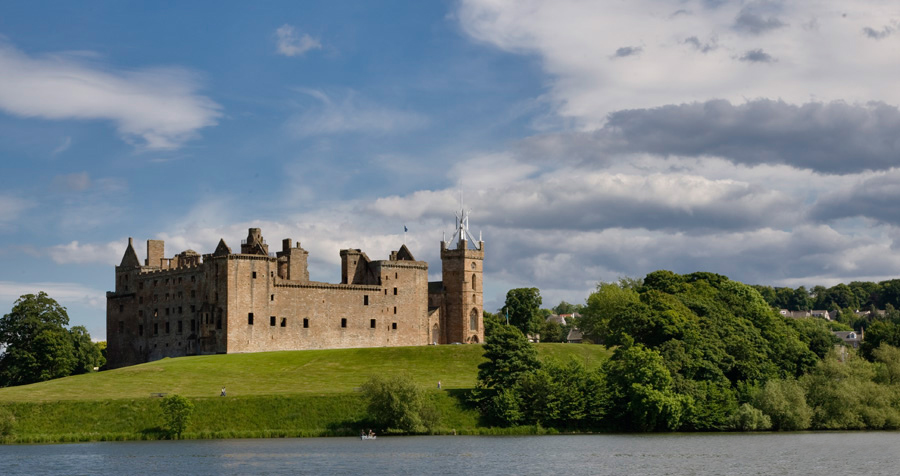
Almond Castle
Almond Castle is a notable example of a late medieval L-plan castle located in Linlithgow, Scotland. Constructed around 1470 by the Crawford family, this castle served as a fortified residence during a period marked by frequent clan conflicts and political unrest. The castle’s strategic design, featuring a vaulted basement and multiple floors, reflects the defensive and domestic needs of Scottish nobility in the 15th century.
Architectural features and layout
The castle is built on an L-shaped plan, a common design in Scottish castles of the period, which allowed for both defensive strength and functional living spaces. It originally rose to four storeys and a garret, with the main entrance situated on the long south-east face. This entrance provided direct access to the first-floor hall, a typical arrangement in Scottish tower houses where the main hall was elevated for security and status.
The vaulted basement beneath the hall was likely used for storage and as a secure refuge during attacks. The wing of the castle contained the kitchen, separated from the main living quarters to reduce fire risk and manage smoke. Surrounding the castle is a courtyard enclosed by a wall and ditch, which protected the ancillary buildings dating from the 16th century, added during the castle’s expansion under the Livingstone family.
Historical ownership and expansions
Initially owned by the Crawford family, Almond Castle was built as their stronghold. Around 1540, ownership transferred to the Livingstone family through marriage. The Livingstones were responsible for significant expansions, including an extension on the south-west side and further additions along the south-east wall in 1586. These expansions reflected the family’s rising status and the need for more comfortable and representative living spaces.
In 1633, when James Livingstone was ennobled as Baron Livingstone of Almond, the castle’s name was officially changed from Haining to Almond Castle. This period marked the castle’s peak as a noble residence before political upheavals would lead to its decline.
The castle's decline and later history
The Jacobite rising of 1715 had significant consequences for the castle and its owners. The Livingstone Earls of Callendar, who held the castle at the time, were attainted for their support of the Jacobite cause, resulting in the castle's forfeiture to the crown. Following this, the castle was gradually abandoned during the 1750s, falling into ruin as the political and social landscape of Scotland changed.
In 1783, the ruin was sold by the York Buildings Company to William Forbes. Since then, Almond Castle has remained a ruin, its walls and structures bearing witness to centuries of Scottish history.
Architectural significance and preservation
Despite its ruined state, Almond Castle retains important architectural features such as the vaulted basement, the remnants of the courtyard walls, and the distinctive L-plan layout. These elements provide valuable insights into 15th and 16th-century Scottish castle design, particularly in how noble families balanced fortification with domestic comfort.
The castle’s courtyard enclosed by a defensive wall and ditch is characteristic of the period’s approach to protecting not only the main residence but also the supporting buildings. The presence of 16th-century extensions illustrates the evolution of the castle to accommodate changing needs and tastes over time.
Visiting Almond Castle today
Almond Castle stands as a partially preserved ruin accessible to visitors interested in Scotland’s medieval heritage. Its location near Linlithgow makes it a point of interest for those exploring the rich history of the Lothian region. Visitors can observe the castle’s structural remains and imagine the life of the noble families who once inhabited this fortified home.
The castle’s setting, combined with its architectural features, offers a tangible connection to Scotland’s turbulent past, including the clan rivalries and national conflicts that shaped the region’s history.
Information
Loading map...
Visitor reviews
No reviews yet. Been here? Write the first review and help other travelers!
Write the first reviewVisited this castle? Share your experience
Your review helps other travelers and adds first-hand knowledge to our encyclopedia.