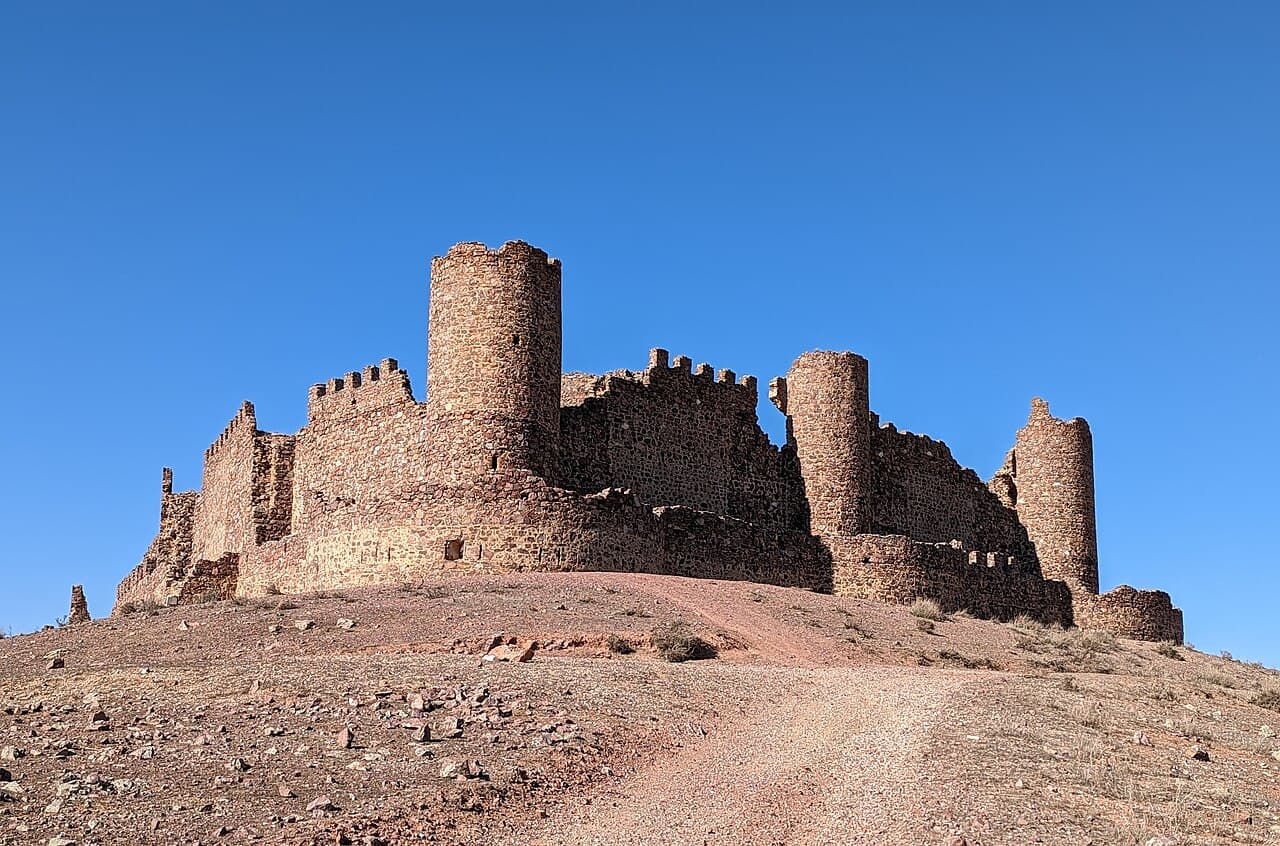
Almonacid de Toledo Castle
Almonacid de Toledo Castle, locally known as Castillo de Almonacid de Toledo, stands prominently on a hill about 20 km southeast of the historic city of Toledo in the province of Toledo, Spain. This hill castle commands sweeping views over the surrounding countryside and the village of Almonacid below. Its strategic location overlooking ancient routes into the region of La Mancha made it a vital military stronghold throughout its history.
The origins of the castle trace back to the early medieval period, with its first documented mention in 848 AD. It was likely constructed by the Moors during their control of the Iberian Peninsula. The fortress initially served as a watchtower and defensive post to control movements along key passages. The name "Almonacid" is thought to derive either from the Arabic word "ribat," meaning monastery or fortress, or from the Latin "almonaster," reflecting the site's religious or defensive significance. A popular legend associates the name with "The battlements of El Cid," the famed Spanish knight of the Reconquista, though this is less historically supported.
Medieval origins and moorish influence
The castle's earliest recorded history involves a significant battle in 854 AD between the troops of the Emir of Córdoba and rebellious forces from Toledo, underscoring its early military importance. As a motte and bailey style fortress evolved into a more fortified stone structure, the castle became a key defensive asset in the region during the late medieval period.
Following the Christian Reconquest, the castle passed into the hands of King Alfonso VI of León and Castile through the dowry of his wife, Princess Zaida, a Moorish princess. In 1086, Alfonso VI donated the fortress to the Archbishopric of Toledo, which marked the beginning of ecclesiastical stewardship. Under the direction of Archbishop Don Pedro Tenorio in the 14th century, the castle underwent significant strengthening and remodeling to enhance its defensive capabilities, including the addition of polygonal walls and towers.
Architectural features and defensive design
Almonacid de Toledo Castle showcases a polygonal layout typical of late medieval military architecture. The castle's inner defensive wall preserves remnants of two square towers and three round towers, which provided vantage points for archers and lookouts. The fortress also features a three-storey square keep, or tower of homage, constructed from a combination of brick and finely cut ashlar stone. Each floor of the keep is covered by brick vaults, which enhanced structural strength and fire resistance.
The castle's defensive system includes a barbican—an outer fortification protecting the main gate—and a chemin de ronde, a narrow walkway along the battlements allowing defenders to patrol and repel attackers. One distinctive feature is the presence of triple arrow slits or troneras, narrow vertical openings that allowed archers to fire while remaining shielded. These architectural details demonstrate the castle's role as a formidable defensive bastion during sieges.
Water supply was critical during prolonged attacks, and the castle contains two cisterns (aljibes) designed to collect and store rainwater. Additionally, a silo for grain storage and several ancillary rooms supported the self-sufficiency of the garrison. Despite centuries of wear and partial dismantling, these features remain visible and attest to the castle's robust design.
Historical significance and notable events
Throughout its history, Almonacid de Toledo Castle played a significant role in regional conflicts and power struggles. In the late 14th century, it was used as a prison for Alfonso Enríquez, Count of Gijón and Noreña, an illegitimate son of King Henry II of Castile. He was detained there by order of his half-brother, King John I of Castile, highlighting the castle's function as both a military and political stronghold.
In the 18th century, the fortress passed into the hands of the Counts of Mora, transitioning from ecclesiastical to noble ownership. The castle's strategic importance continued into the Peninsular War when, in 1809, it served as a refuge for Spanish troops under General Venegas during the Battle of Almonacid against French forces. Although the battle ended in a French victory, the castle's role as a military refuge underscores its enduring significance. The battle's importance is commemorated by the inscription of "Almonacid" on the Arc de Triomphe in Paris.
Following the war, the castle's condition declined as local residents removed bricks for sale, accelerating its deterioration. Ownership passed through prominent families, including María Eugenia de Guzmán y Portocarrero, Countess of Mora and Empress of France, and the Manso family of Toledo, reflecting its continued association with nobility despite its reduced military role.
Current condition and visitor experience
Today, Almonacid de Toledo Castle stands as a partially preserved late medieval fortress offering visitors a tangible connection to Spain's complex medieval past. The ruins, including the keep, towers, battlements, and cisterns, are freely accessible and provide panoramic views of the surrounding landscape and neighboring castles such as Peñas Negras Castle.
The castle's concentric design and well-preserved defensive features make it a favorite among enthusiasts of military architecture. Visitors can explore the remains of the polygonal walls, the inner courtyard, and the imposing keep, gaining insight into medieval fortification techniques and the castle's strategic role over centuries.
Its location on a prominent hilltop not only offered military advantages but also creates a striking visual landmark visible from miles away, enhancing its appeal as a cultural and historical destination in the region of Toledo.
Visitor information
- The castle is open to the public with free access, allowing visitors to explore at their own pace.
- Best visiting times are during daylight hours to fully appreciate the views and architectural details.
- Due to the ruinous condition, visitors should wear sturdy footwear and exercise caution on uneven surfaces.
Cultural heritage significance
Almonacid de Toledo Castle is an important monument reflecting the layered history of Spain, from its Moorish origins through the Christian Reconquest and into the turbulent conflicts of the early modern period. Its architectural evolution embodies the transition from early medieval fortifications to more sophisticated late medieval military designs.
The castle's preservation as a ruin allows historians and visitors alike to study the defensive strategies employed in the region and appreciate the craftsmanship of medieval builders. It stands as a testament to the strategic importance of Toledo and its environs throughout Spanish history.
Frequently asked questions (FAQ)
- How do I get to Almonacid de Toledo Castle?
- Almonacid de Toledo Castle is located on Calle Santa Bárbara in the town of Almonacid de Toledo, about 20 km southeast of Toledo city. It is accessible by car and local roads connecting from Toledo and nearby villages.
- What is the historical significance of Almonacid de Toledo Castle?
- The castle has Moorish origins dating back to the 9th century and played a key role during the Reconquest and the Peninsular War. It was also used as a prison for notable historical figures and is commemorated on the Arc de Triomphe in Paris.
- Can I visit the castle freely?
- Yes, the castle is freely accessible to the public. Visitors can explore the ruins and enjoy panoramic views without an entrance fee.
- What architectural features are notable at Almonacid de Toledo Castle?
- Notable features include the polygonal defensive walls, a three-storey square keep with brick vaults, battlements with chemin de ronde, and triple arrow slits known as troneras.
- When is the best time to visit Almonacid de Toledo Castle?
- The best time to visit is during daylight hours in spring and autumn when weather is mild, allowing clear views and comfortable exploration of the ruins.
Photo gallery

Information
Sources & official resources
Verify the information above using these authoritative references.
Loading map...
Visitor reviews
No reviews yet. Been here? Write the first review and help other travelers!
Write the first reviewVisited this castle? Share your experience
Your review helps other travelers and adds first-hand knowledge to our encyclopedia.


