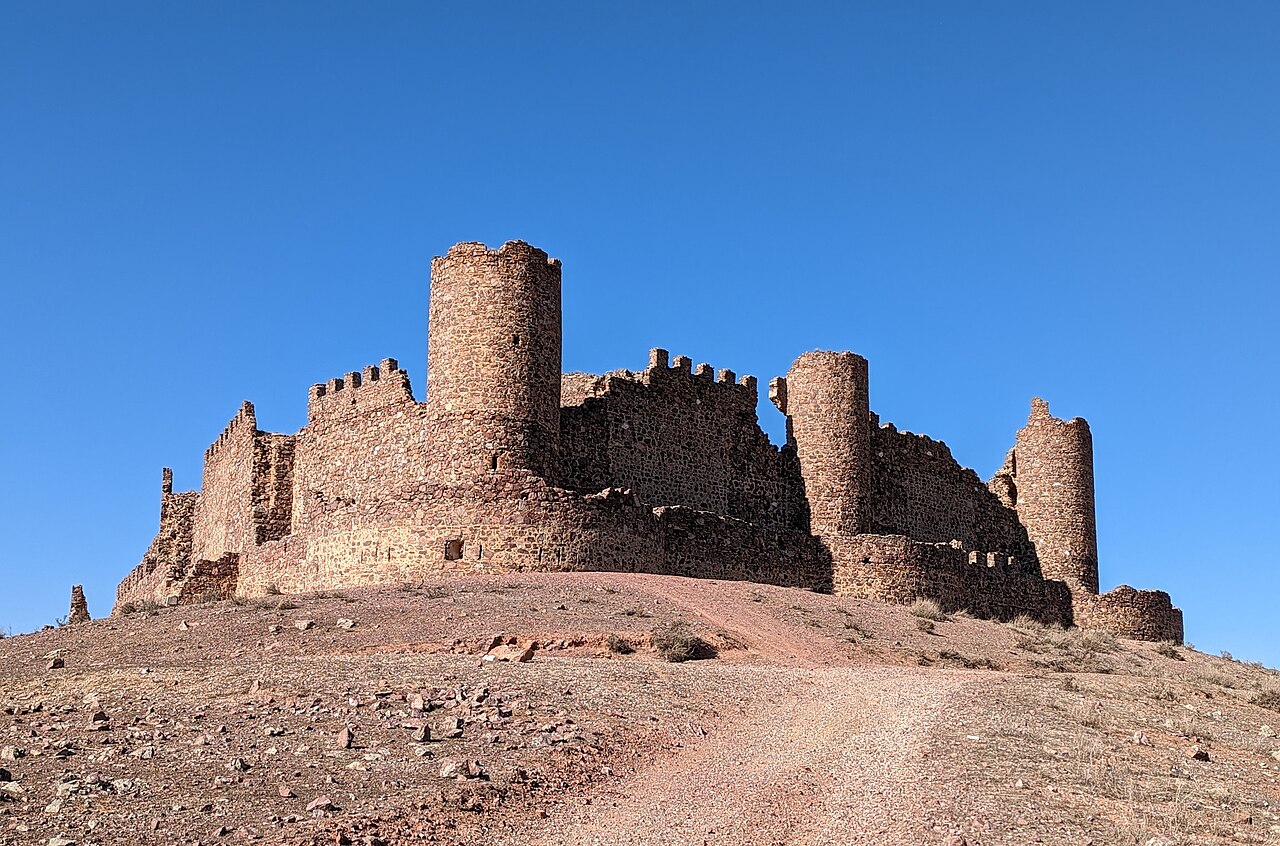
Mascaraque Castle
Mascaraque Castle, also known as Castillo de Mascaraque or Castillo Juan de Padilla, is a significant late-medieval fortress located in the heart of the town of Mascaraque, in the province of Toledo, Spain. This castle was constructed during the 14th century, likely on the foundations of an earlier Arab fortress, reflecting the region's complex history of cultural and military transitions during the medieval period.
Historical context and strategic importance
The castle's location was strategically chosen to serve as a defensive link between the more powerful and prominent nearby castles of Almonacid de Toledo and Peñas Negras. This positioning highlights its role in the network of fortifications that protected the territory during the turbulent Reconquista era, when Christian kingdoms sought to reclaim lands from Muslim rule.
In the 16th century, the castle came under the ownership of the Padilla family, who undertook significant renovations in 1518. It remains uncertain whether this family was directly related to the notable Juan de Padilla, a missionary and explorer associated with North America during that time. Subsequently, the castle passed into the hands of the Dukes of Abrantes, indicating its continued importance among noble lineages.
Architectural features and design
Mascaraque Castle is notable for its rectangular plan, combining elements of both a traditional medieval castle and a palatial residence. This hybrid design reflects a transitional architectural style where defensive features were integrated with residential comfort and status display.
Originally, the castle was protected by a moat and featured two drawbridges, defensive mechanisms that have since disappeared but would have played a crucial role in its security. The castle's walls and gates are adorned with distinctive five-pointed stars above several doorways, a unique decorative motif whose origins and symbolism invite further study.
Structural elements
The castle's robust walls and fortified towers are characteristic of late-medieval military architecture in Spain, designed to withstand sieges and attacks. The blend of castle and palace elements suggests adaptations over time to meet changing needs, from purely military defense to noble residence.
Current status and preservation
Today, Mascaraque Castle remains private property, which restricts public access to its interior. Observations indicate that the castle appears uninhabited and secured, with no regular visitor access. Despite this, its exterior continues to attract interest for its historical and architectural significance.
The preservation state reflects the challenges faced by many privately owned historic structures in Spain, balancing heritage conservation with private ownership. The castle's visible features, such as its walls and distinctive star motifs, remain valuable for study and appreciation.
Architectural and cultural significance
Mascaraque Castle stands as an example of late-medieval fortifications that evolved into noble residences, illustrating the architectural transition during the post-Reconquista period in central Spain. Its possible connection to historical figures like Juan de Padilla adds a layer of cultural interest, linking the site to broader narratives of Spanish exploration and nobility.
The castle's unique decorative elements and strategic location contribute to its importance within the heritage of Toledo province, a region rich in medieval history and architecture.
Frequently asked questions (FAQ)
- How do I visit Mascaraque Castle?
- Mascaraque Castle is private property and its interior is not open to the public. Visitors can view the castle's exterior from the street but cannot enter the building.
- What is the historical significance of Mascaraque Castle?
- Built in the 14th century, Mascaraque Castle served as a strategic link between nearby castles during the late-medieval period and was later owned by the Padilla family and Dukes of Abrantes.
- When was Mascaraque Castle renovated?
- The castle underwent renovations in 1518 under the ownership of the Padilla family, reflecting its continued use and importance in the 16th century.
- Are there any unique architectural features of Mascaraque Castle?
- Yes, the castle features a rectangular plan combining castle and palace elements, originally had a moat and two drawbridges, and displays distinctive five-pointed stars above several doors.
- Is Mascaraque Castle accessible for events or tours?
- Currently, Mascaraque Castle is privately owned and not accessible for tours or events, limiting public interaction to viewing its exterior.
Information
Current owner
Private owner
Address
Calle Castillo 4-6, Mascaraque, Toledo, Spain
Loading map...
Visitor reviews
No reviews yet. Been here? Write the first review and help other travelers!
Write the first reviewVisited this castle? Share your experience
Your review helps other travelers and adds first-hand knowledge to our encyclopedia.